
IU vs mL: Why “Units” Are Not a Dose
Spend any time around peptide research and you’ll hear measurements given in “units” — as in, “I drew 20 units.” It’s convenient shorthand, but on its own it is not a real measurement of how much compound you’ve drawn. Here’s why, and what to use instead.
A “unit” is a volume mark, not an amount of peptide
The “units” on an insulin syringe are simply volume graduations. On the standard U-100 syringe, 100 units equals 1 millilitre (mL), so 1 unit = 0.01 mL. The scale measures the volume of liquid you pull into the barrel. It says nothing about how much peptide is dissolved in that liquid.
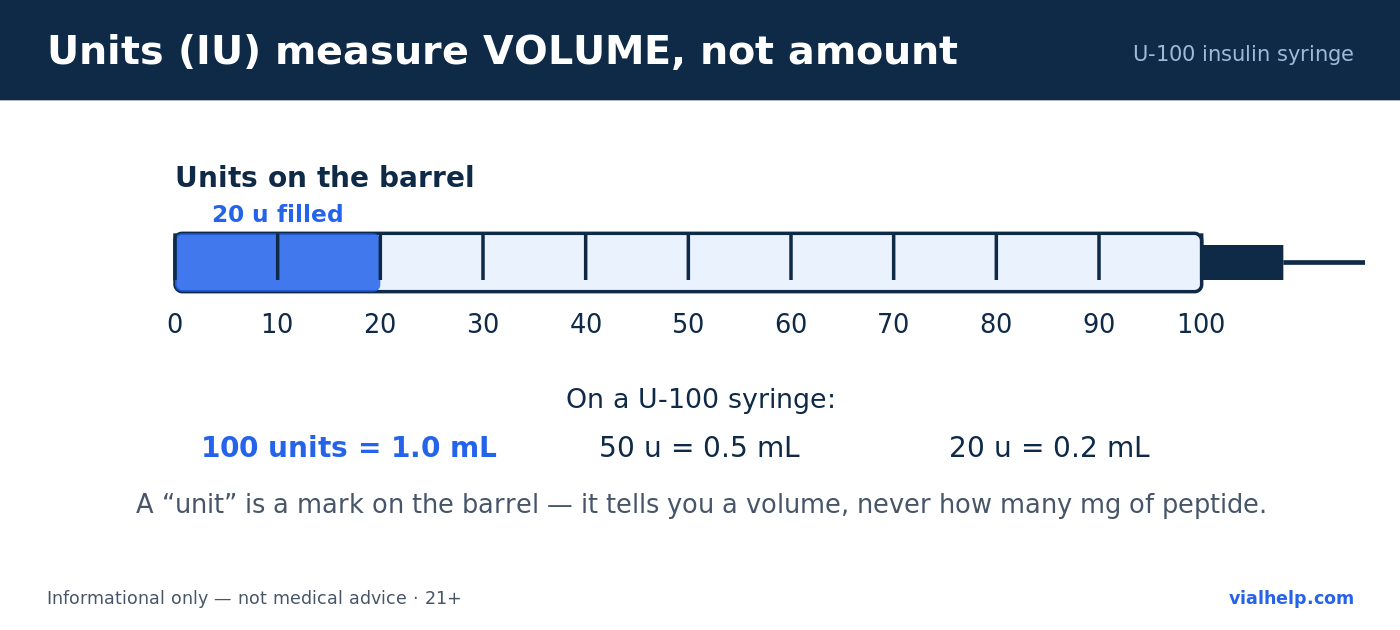
Why “how many units” isn’t a valid measurement
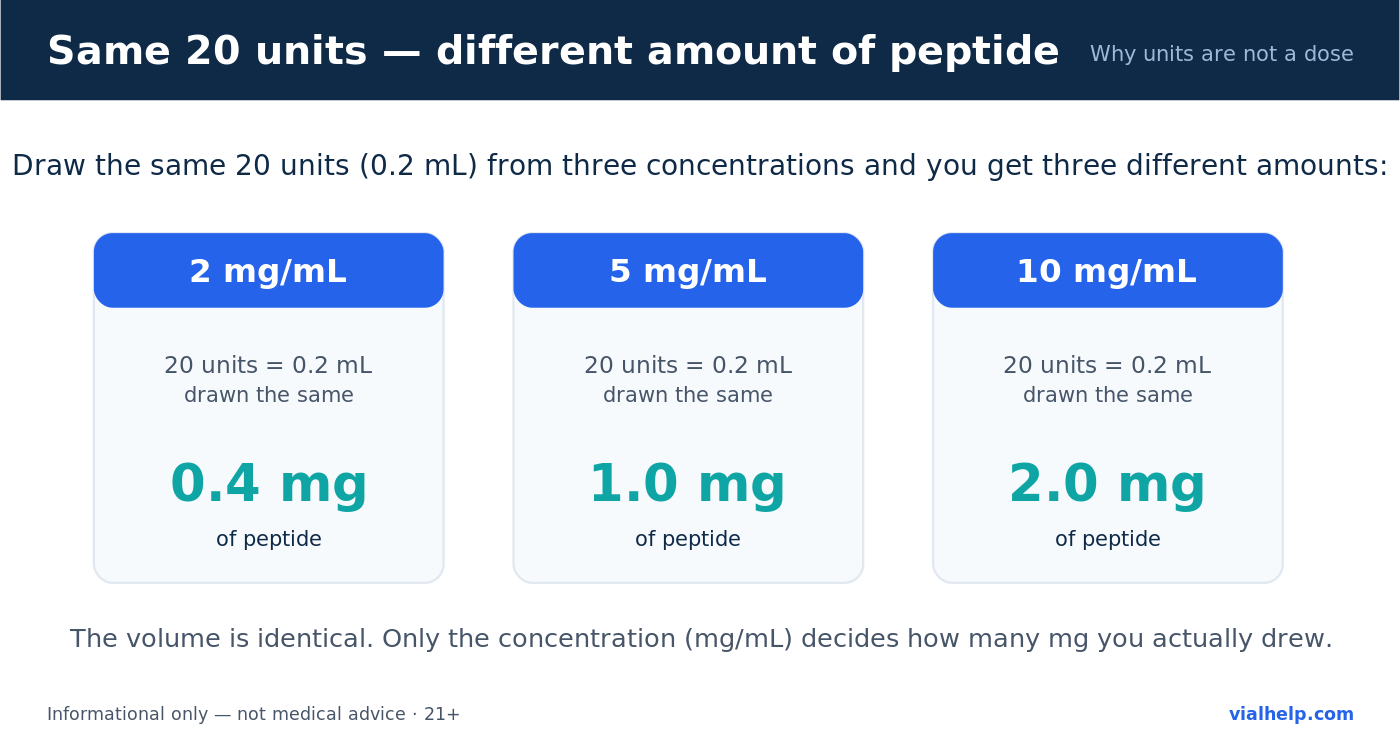
The amount of compound in a given volume depends entirely on the concentration (mg/mL), which is set when the vial is reconstituted. Two researchers can both draw “20 units” and have completely different amounts of material in the syringe.
- A 10 mg vial reconstituted with 2 mL gives 5 mg/mL. 20 units (0.2 mL) = 1 mg.
- The same 10 mg vial reconstituted with 1 mL gives 10 mg/mL. 20 units (0.2 mL) = 2 mg.
Same syringe, same “20 units,” double the mass. Units alone are meaningless without the concentration.
The only chain that actually works
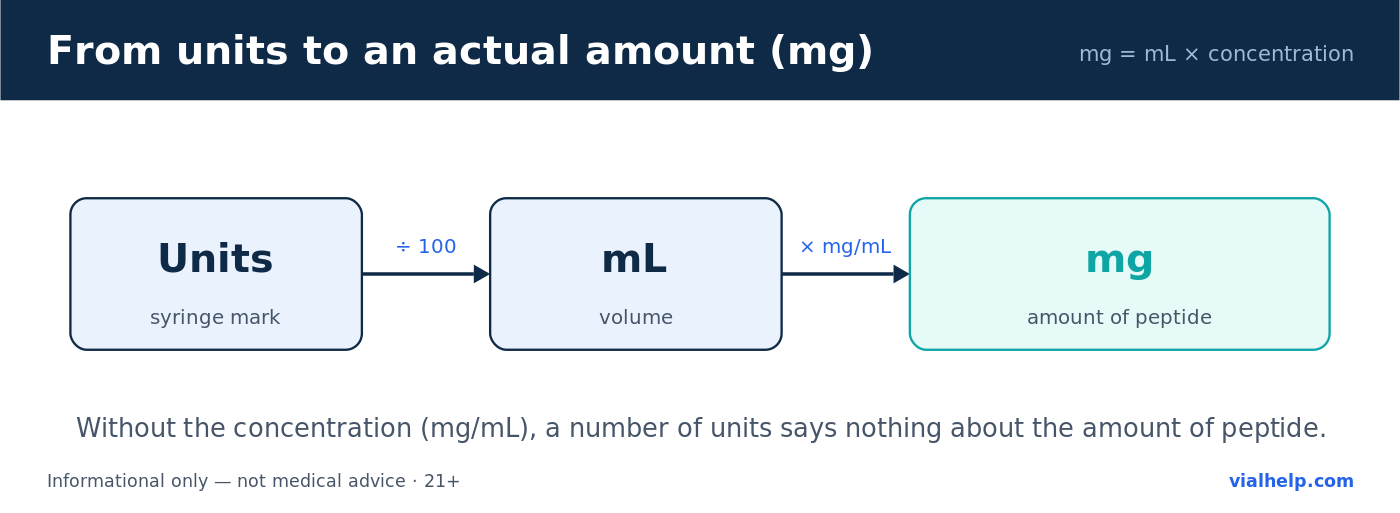
To know what you’ve measured, work in mass and concentration first, and treat the syringe as a volume readout:
- Concentration = vial amount (mg) ÷ reconstitution volume (mL)
- Volume to draw = desired amount (mg) ÷ concentration (mg/mL)
- Units (U-100) = volume (mL) × 100
Our reconstitution calculator does this automatically and shows the exact mark on a U-100 syringe.
Watch the scale: U-100 vs U-40
Not every insulin syringe uses the same scale. A U-40 syringe marks 40 units per mL, so the same “20 units” is a different volume than on a U-100. Always confirm which scale your syringe uses before converting between units and volume.
Takeaway
Record and compare your work in mg and mg/mL. Use the syringe’s units only as a volume readout once you know the concentration. That’s the difference between a reproducible measurement and a number that means nothing on its own.
For informational use only. This article explains measurement and volume relationships for general information (21+). It is not medical advice.
Related tool: Use the concentration & volume converter to convert between mg, mL, and mg/mL, or see all peptide guides.