
HGH Fragment 176-191
Summary
HGH Fragment 176-191 is the natural C-terminal fragment of human growth hormone, studied in animals for fat metabolism (lipolysis) without the growth or blood-sugar effects of the full hormone. It is not FDA-approved, and human clinical data belong to the separate analog AOD-9604.
Quick facts
| Also known as | hGH 176-191, HGH Frag 176-191, growth hormone lipolytic fragment, Somatotropin (176-191) |
| Category | Growth hormone fragment |
| Status | Research compound – not FDA-approved; WADA-prohibited (S2) |
| CAS | 66004-57-7 |
| Formula | C78H123N23O22S2 |
| Molecular weight | ~1799.1 g/mol |
| Sequence | YLRIVQCRSVEGSCGF (16 aa; disulfide Cys7-Cys14) |
| Half-life | Short – reported qualitatively around 30 minutes (secondary sources) |
| Storage | Lyophilized: store frozen (-20 C), protect from light. Reconstituted: refrigerate 2-8 C, use within a limited window, avoid freeze-thaw. |
In Plain English
HGH Fragment 176-191 is a small, lab-made copy of the tail end of human growth hormone — just one little piece of the natural hormone. Researchers are interested in it because, in animal studies, that piece seems to nudge the body to burn fat without the growth effects of the full hormone. It has not been proven to work in people, and it is not an approved medicine. Scientists mainly use it to understand how growth hormone controls fat.
HGH Fragment 176-191 is a synthetic 16-amino-acid peptide that copies the tail end (the C-terminus) of human growth hormone. First mapped in the late 1970s by researchers studying which parts of growth hormone control metabolism, it became known as the “lipolytic fragment” because, in laboratory animals, it reproduced growth hormone’s fat-reducing activity while leaving out its growth-promoting and blood-sugar effects.
What is HGH Fragment 176-191?
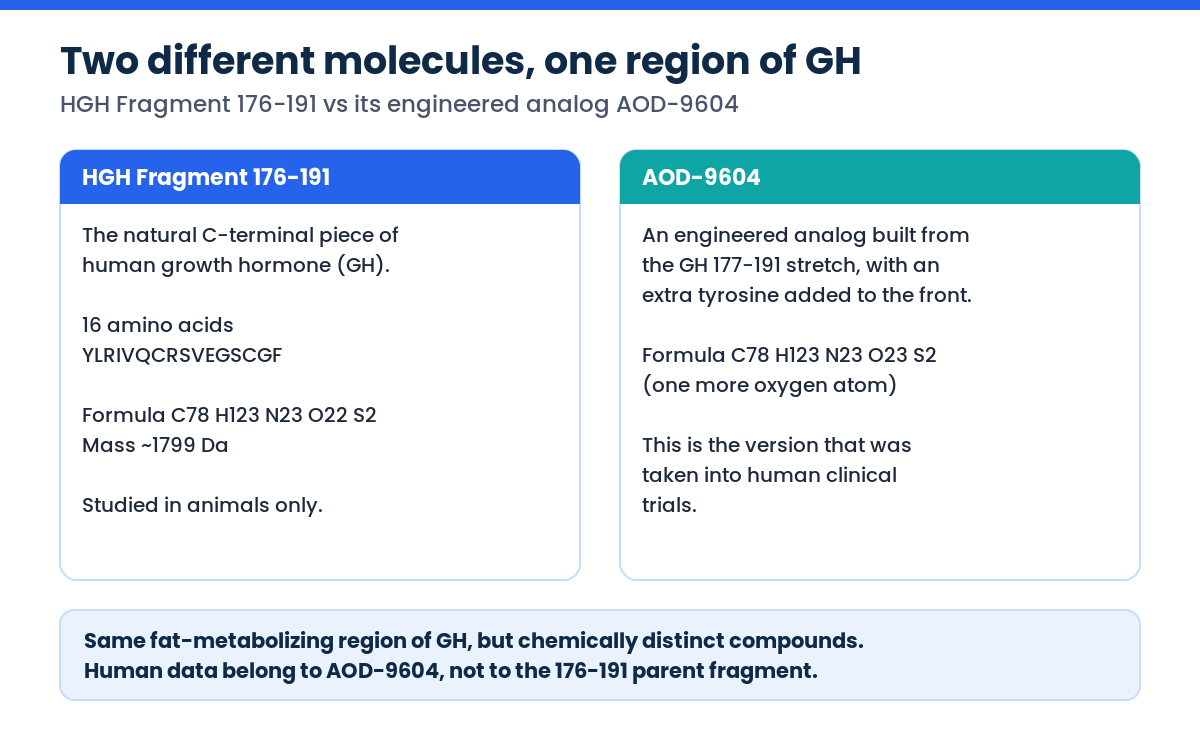
HGH Fragment 176-191 (also written hGH 176-191 or HGH Frag 176-191) is the final stretch of amino acids — positions 176 through 191 — of the 191-amino-acid human growth hormone molecule. On its own it is a short peptide with the sequence YLRIVQCRSVEGSCGF and an internal disulfide bond. Its molecular formula is C78H123N23O22S2 and its mass is roughly 1799 daltons.
Because it is only a small piece of growth hormone, it does not behave like the whole hormone. In animal studies it does not meaningfully raise IGF-1 (growth hormone’s growth mediator) or cause the insulin resistance associated with full-length growth hormone; instead its activity concentrates on fat metabolism.
A crucial point of confusion: HGH Fragment 176-191 is not the same molecule as AOD-9604. AOD-9604 is a separately engineered analog built from a slightly shorter stretch (residues 177-191) with an extra tyrosine added to the front — one oxygen atom heavier and chemically distinct. Almost all of the human clinical data attributed to “the fragment” actually come from AOD-9604, not from 176-191 itself.
How HGH Fragment 176-191 is studied to work
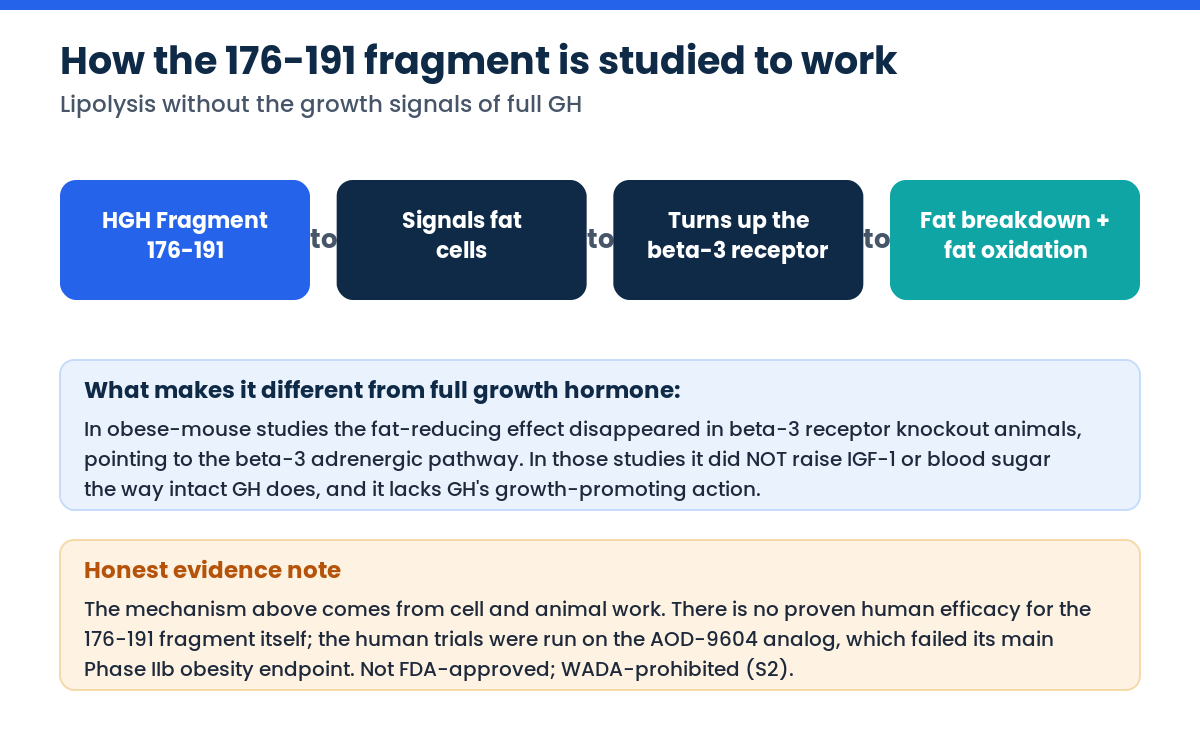
In the research literature, the fragment’s main studied action is lipolysis — the breakdown of stored fat — together with increased fat oxidation (burning fat for energy). The proposed pathway runs through the beta-3 adrenergic receptor on fat cells rather than the classic growth-hormone receptor.
- Signals adipose (fat) tissue rather than acting through the growth-hormone receptor for growth.
- Appears to upregulate the beta-3 adrenergic receptor, a switch involved in fat breakdown and energy use.
- In a key mouse study, the fat-reducing effect was abolished in beta-3 receptor knockout animals, implicating that pathway.
- Reported, in animals, not to raise IGF-1 or blood glucose the way intact growth hormone does.
In plain terms, researchers have asked whether this piece of growth hormone can separate the “fat-burning” part of the hormone from its growth and blood-sugar effects. That separation is the central hypothesis behind the fragment and its analog.
Reported effects and benefits in the research literature
- Reduced body weight and fat mass in obese-mouse models.
- Increased fat oxidation and energy expenditure in animal studies.
- Investigated (mainly via the AOD-9604 analog) for cartilage and osteoarthritis applications after obesity development stopped.
- No consistent effect on IGF-1 or blood glucose at studied doses in animals.
What this does not mean: these are largely preclinical (animal and cell) findings, or findings from the AOD-9604 analog. They do not establish that HGH Fragment 176-191 produces weight loss or any benefit in humans. There is no approved human use, and the most rigorous human trial of the analog did not beat placebo.
What the human evidence shows
Direct human data on the unmodified 176-191 fragment are essentially absent. The human clinical program was run on the analog AOD-9604 by Metabolic Pharmaceuticals in Australia. Across several trials AOD-9604 was reported to be reasonably well tolerated, but its pivotal Phase IIb obesity trial (roughly 300 participants) failed to produce significantly more weight loss than placebo, and obesity development was discontinued around 2007. The compound was later explored for osteoarthritis.
On the regulatory side, HGH Fragment 176-191 is not approved by the FDA or any major regulator for any use. The FDA has placed AOD-9604 among bulk drug substances that raise significant safety concerns, meaning it is not eligible for pharmacy compounding. In sport, growth-hormone fragments — including 176-191 and AOD-9604 — fall under Section S2 of the WADA Prohibited List and are banned in and out of competition.
Handling, storage and reconstitution (research context)
- Lyophilized (freeze-dried) peptide is the most stable form; typically stored frozen (around -20 °C) and protected from light.
- Once reconstituted (commonly with bacteriostatic water), keep refrigerated at 2-8 °C and use within a limited window.
- Avoid repeated freeze-thaw cycles, which can degrade peptides.
To work out concentration and volume relationships after reconstitution, use the VialHelp reconstitution calculator, and read our explainer on why IU/units are a volume mark, not a dose.
Cautions and considerations
- Research compound only — not an approved medicine and no established human dosing.
- Not FDA-approved; the related analog AOD-9604 is on the FDA significant-safety-risk compounding list; WADA-prohibited (S2).
- Research-market material varies in purity — a certificate of analysis (COA) and endotoxin testing matter.
- Frequently confused with AOD-9604 — check exactly which molecule a source is describing.
- Informational only — not medical advice.
Frequently asked questions
Is HGH Fragment 176-191 the same as AOD-9604?
No. They share the same region of growth hormone but are different molecules: AOD-9604 is an engineered analog (GH 177-191 plus an added tyrosine, one oxygen heavier). Most human data belong to AOD-9604.
Does HGH Fragment 176-191 raise IGF-1 or blood sugar?
In animal studies it did not meaningfully raise IGF-1 or cause the blood-sugar effects of full growth hormone — that selectivity is the main reason it is studied. Human data are lacking.
Is it approved or proven for weight loss?
No. It is not FDA-approved, and the analog’s pivotal human obesity trial did not beat placebo.
How is it stored?
Lyophilized peptide is kept frozen and protected from light; reconstituted peptide is refrigerated and used within a limited window.
Related compounds and further reading
- AOD-9604 — the engineered analog built from this same region of growth hormone.
- IGF-1 LR3 — a growth-factor analog often discussed alongside GH peptides.
- How to reconstitute peptides and sterile technique.
- Browse the full Peptide Library and Guides.
- IU vs mL: why units are not a dose.
Share this article
References
For informational use only. Not medical advice; consult a qualified healthcare professional. 21+.
HGH Fragment 176-191 reconstitution calculator
Use the calculator below to find the concentration (mg/mL), draw volume and U-100 syringe units for HGH Fragment 176-191 once it is reconstituted with bacteriostatic water. HGH Fragment 176-191 has molecular formula C78H123N23O22S2 and a molecular weight of ~1799.1 g/mol. Enter your vial amount and the water volume to see the lab math — informational use only, not dosing advice.
Open the full calculator · Back to the HGH Fragment 176-191 profile