
Guides · Reconstitution & handling
To reconstitute peptides means to turn the dry, freeze-dried powder in a vial back into a liquid by adding bacteriostatic water. It is simple once you understand two things: the small amount of arithmetic that sets your concentration, and the gentle technique that keeps the molecule intact. This guide covers both, plus the handling habits that protect a vial after it is mixed.
What you need
- Your lyophilized peptide vial.
- Bacteriostatic water (the usual diluent for multi-use vials — see our bacteriostatic water guide).
- A sterile syringe and needle.
- Alcohol (70%) prep pads and a clean work surface.
Step 1 — Decide how much water to add
The volume of water you add is a choice, and it sets the concentration. There is no single “correct” volume — more water gives a lower concentration and a larger, easier-to-measure draw; less water gives a higher concentration and smaller draws. Pick a volume that makes your intended measurement convenient.
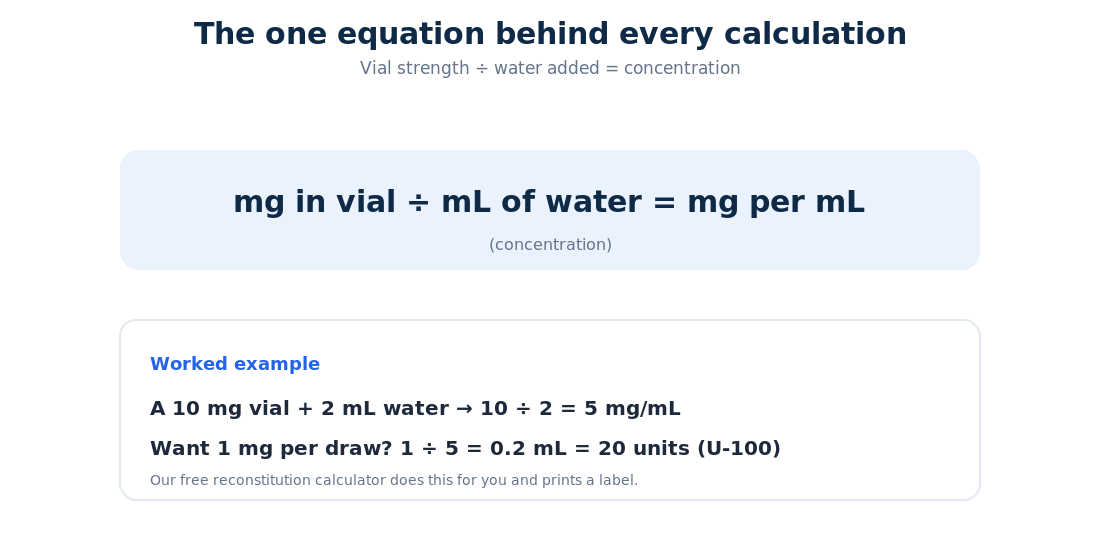
The relationship is simply:
mg in vial ÷ mL of water = mg per mL
For example, a 10 mg vial reconstituted with 2 mL of water gives 10 ÷ 2 = 5 mg/mL. Our reconstitution calculator does this for you and shows the volume per amount on a U-100 syringe; the concentration converter works the math in any direction.
Step 2 — Reconstitute, gently
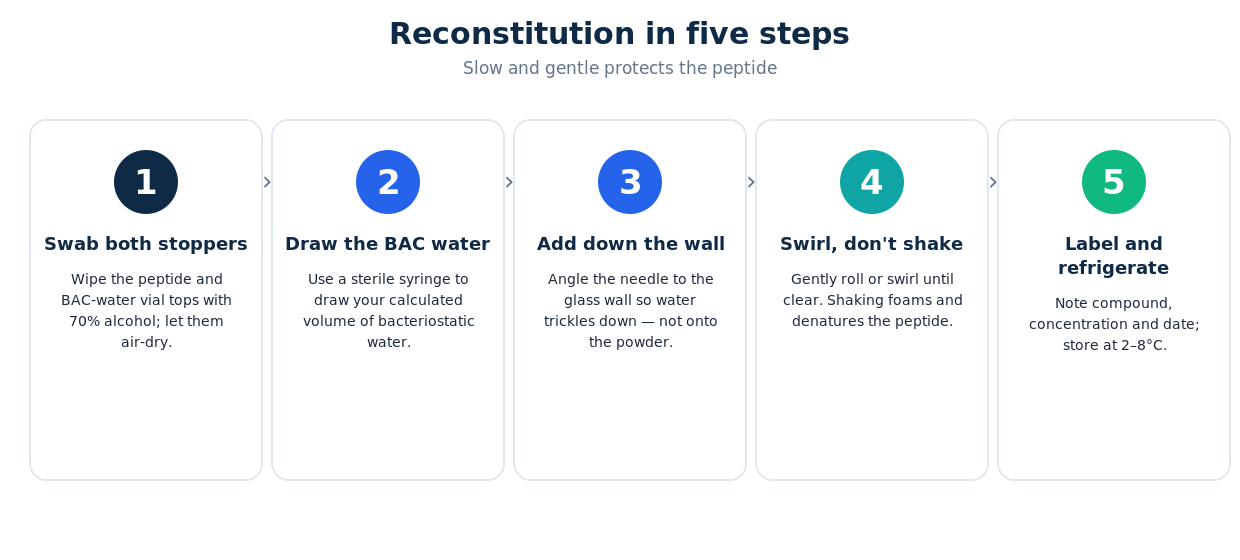
- Swab both stoppers. Wipe the peptide and water vial tops with a 70% alcohol pad and let them air-dry.
- Draw the water. Pull your calculated volume of bacteriostatic water into the sterile syringe.
- Add it down the wall. Angle the needle so the water runs down the inside glass wall of the vial and pools onto the powder from the side — not as a hard stream directly onto it.
- Swirl, do not shake. Gently roll the vial between your palms or swirl it until the powder fully dissolves and the solution is clear.
- Label and refrigerate. Note the compound, concentration and date, and store at 2–8 °C.
Step 3 — Handle and store the mixed vial
- Return the vial to the fridge promptly after each use; minimise time at room temperature.
- Swab the stopper again before every subsequent draw, and use a fresh sterile needle each time.
- Inspect before each use — a clear, colourless solution with no particles is what you want.
- Respect the solution’s window (commonly up to a few weeks refrigerated; defer to the COA). See the storage and stability guide.
Common reconstitution mistakes
- Spraying water onto the powder — causes foaming and uneven dissolution.
- Shaking to “speed it up” — denatures the peptide.
- Adding the wrong volume — throws off every later measurement. Double-check the math first.
- Skipping the label — an unlabeled vial of unknown concentration and age is useless and easy to mix up.
For the sterile-handling details — hand hygiene, swabbing and single-use needles — see the companion sterile technique guide.
Frequently asked questions
How much bacteriostatic water should I add?
However much gives a concentration that is convenient to measure. More water = lower concentration and larger draws; less water = higher concentration and smaller draws. Use the reconstitution calculator to see the trade-off.
Why can’t I shake the vial to dissolve it faster?
Shaking foams the solution and creates air–liquid interfaces that unfold and denature the peptide. Swirl or gently roll instead.
What if some powder won’t dissolve?
Give it time with gentle swirling. Adding water down the vial wall rather than onto the powder, and being patient, usually resolves it without agitation.
References
- Verified Peptides — How to Reconstitute Lyophilized Peptides: Best Practices
- Bachem — Handling and Storage Guidelines for Peptides
- WHO Best Practices for Injections and Related Procedures (NCBI Bookshelf)
Informational only. This guide is for educational and laboratory/measurement purposes and is not medical advice. It does not recommend or instruct personal human use. Consult a qualified healthcare professional for any health decision. Content is intended for adults 21+. Verify scientific details against the primary sources cited.