
Guides · Storage & handling
Good peptide storage is the cheapest way to protect an experiment. Peptides are sensitive molecules, and the same vial can stay usable for years or be ruined in an afternoon depending on temperature, light and handling. This guide explains how to store research peptides in both their dry (lyophilized) and reconstituted forms, what shelf life to expect, and the chemistry behind why peptides degrade.
Lyophilized vs reconstituted: two very different shelf lives
Most research peptides arrive as a lyophilized (freeze-dried) white powder. In this dry, sealed state they are remarkably stable. Once you add bacteriostatic water and the peptide is in solution, the clock speeds up dramatically — water enables the hydrolysis, oxidation and aggregation reactions that break peptides down. The single most useful rule of thumb is therefore: keep it dry and cold for as long as possible, and only reconstitute what you will use within the solution’s window.
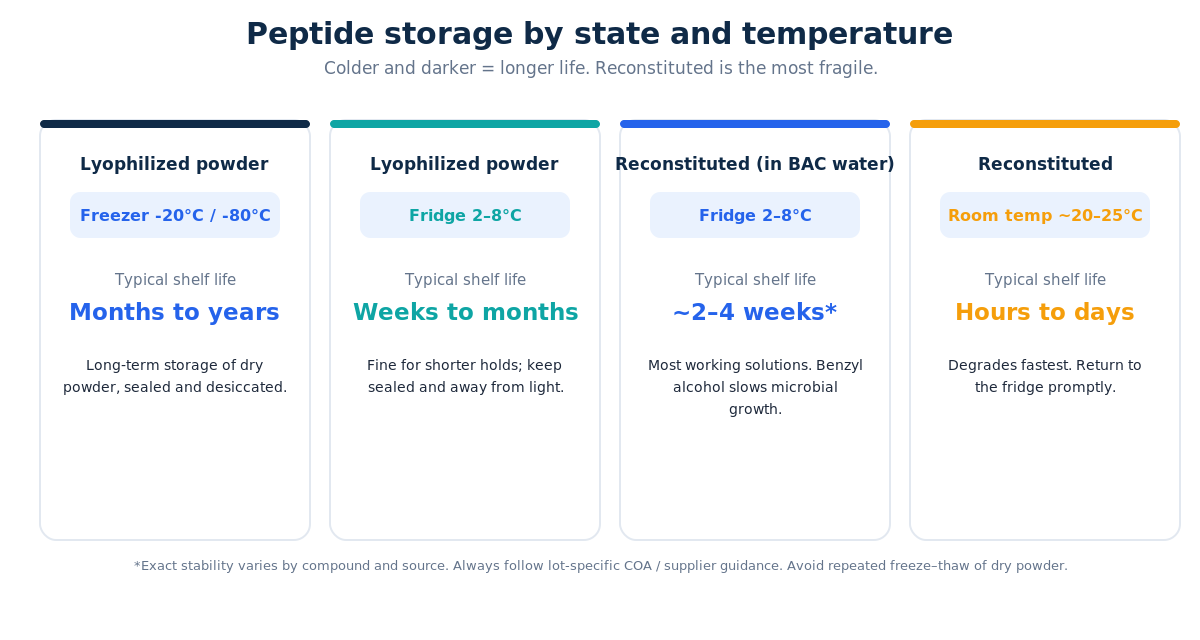
Storing lyophilized (dry) peptides
- Long term: a freezer at −20 °C (or −80 °C for extended storage) keeps sealed lyophilized peptides stable for many months to years.
- Short term: a refrigerator at 2–8 °C is fine for weeks to a few months if the vial stays sealed and dry.
- Keep it desiccated. Moisture is the enemy of dry powder. Let a cold vial reach room temperature before opening so condensation does not form inside, and keep any desiccant pack that shipped with it.
- Protect from light. Store in the original vial or an opaque container; UV and strong light can damage light-sensitive residues.
Storing reconstituted (in-solution) peptides
Once mixed with bacteriostatic water, most reconstituted peptides are kept in the refrigerator at 2–8 °C. Reported stability ranges from a few days to about two to four weeks, depending heavily on the specific peptide and its concentration. The benzyl alcohol in bacteriostatic water inhibits microbial growth, which is why it — rather than plain sterile water — is used for multi-use vials. Always defer to the lot-specific guidance on the product’s Certificate of Analysis when it is available.
What actually degrades a peptide
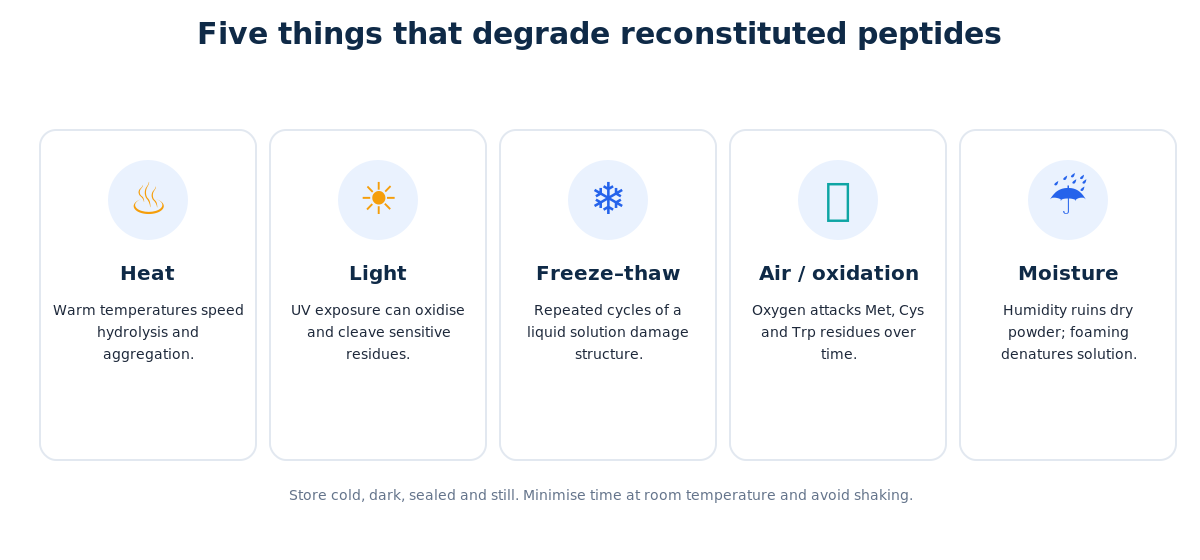
Peptide breakdown is driven by a handful of predictable chemical processes:
- Hydrolysis — water cleaves peptide bonds; accelerated by heat and time in solution.
- Oxidation — oxygen attacks methionine, cysteine and tryptophan residues. Minimise headspace air and time at room temperature.
- Aggregation and surface denaturation — agitation, foaming and air–liquid interfaces unfold the molecule. This is why you swirl rather than shake.
- Microbial growth — relevant once a vial is opened and punctured; bacteriostatic water slows it but does not make a solution sterile forever.
Signs a peptide may have degraded
Inspect every vial before use. Discard, or treat with suspicion, a solution that is cloudy, discoloured, or contains visible particles or floaters, or a dry powder that has clumped into a hard mass or changed colour. A clear, colourless solution and a clean white powder are what you want to see. Visual inspection is not a purity test, but it catches obvious contamination and aggregation.
A simple storage workflow
- Store the sealed dry vial cold (fridge for weeks, freezer for months).
- Bring it to room temperature before opening to avoid condensation.
- Reconstitute only what you will use within the solution window.
- Label the reconstituted vial with the compound, concentration and date.
- Return it to the fridge immediately after each use and minimise time at room temperature.
Frequently asked questions
How long does a reconstituted peptide last in the fridge?
Commonly a few days to about two to four weeks at 2–8 °C, depending on the specific peptide and concentration. Always defer to lot-specific COA or supplier guidance, and discard any solution that looks cloudy or has particles.
Can I freeze a reconstituted peptide?
Freezing single-use aliquots once is gentler than repeatedly freezing and thawing one vial. Repeated freeze–thaw cycles stress the molecule, so avoid them.
Why bring a cold vial to room temperature before opening?
To prevent condensation forming inside the vial. Moisture degrades dry lyophilized powder, so let it warm sealed, then open.
References
- Bachem — Handling and Storage Guidelines for Peptides
- Mountainside Medical — Bacteriostatic Water vs Sterile Water for Injection
- WHO Best Practices for Injections and Related Procedures (NCBI Bookshelf)
Informational only. This guide is for educational and laboratory/measurement purposes and is not medical advice. It does not recommend or instruct personal human use. Consult a qualified healthcare professional for any health decision. Content is intended for adults 21+. Verify scientific details against the primary sources cited.