
Guides · Quality & verification
A Certificate of Analysis (COA) is the single most useful document for judging a research peptide’s quality. It is a lab report — ideally from an independent third party — that states what a specific lot actually contains. Learning to read one means you are evaluating evidence rather than trusting a label. This guide walks through each line of a typical peptide COA and what it really tells you.
What a COA is (and is not)
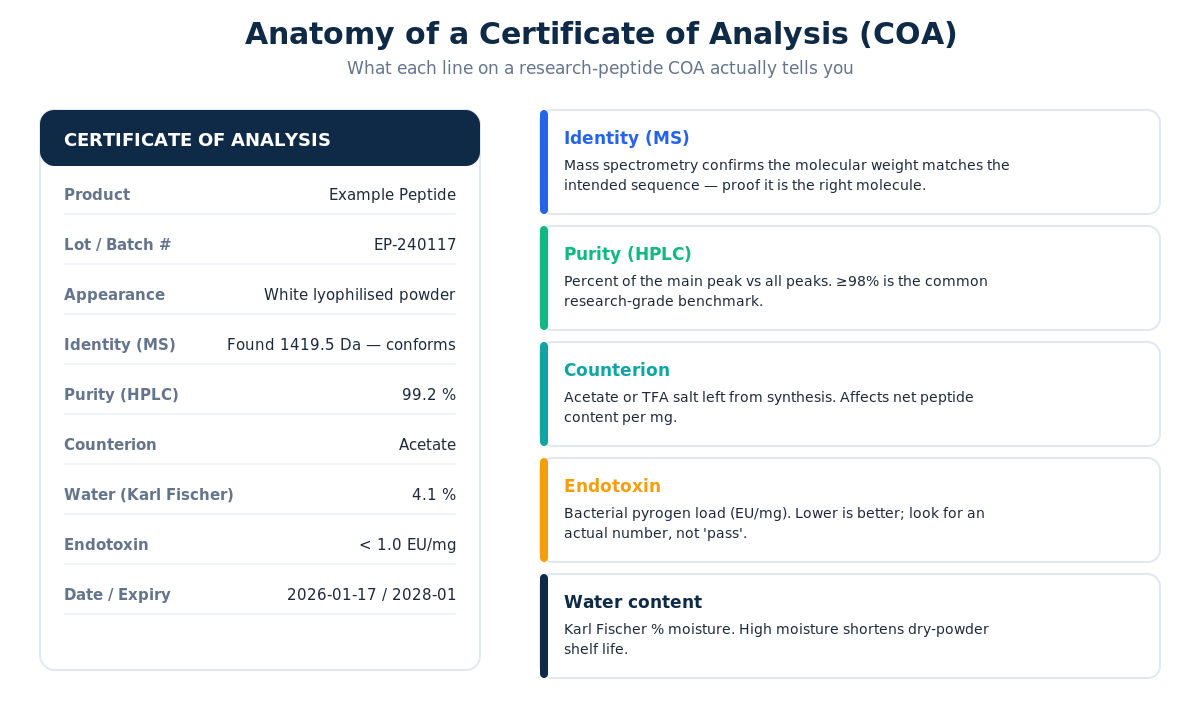
A COA reports test results for one specific lot or batch. It is not a generic marketing sheet, and a COA for a different lot does not describe the vial in your hand. The most informative COAs are third-party: tested by a lab that did not make the product. When you read one, check that the lot number on the certificate matches the lot number on your vial.
Identity: mass spectrometry
Mass spectrometry (MS) confirms the peptide’s molecular weight. Because each amino-acid sequence has a characteristic mass, MS is strong evidence that the vial contains the intended molecule and not a different analog. A good COA shows the observed mass and notes that it conforms to the expected (theoretical) mass for that sequence. High purity means little if the molecule is the wrong one, so identity and purity are read together.
Purity: the HPLC chromatogram
Purity is measured by high-performance liquid chromatography (HPLC) and reported as a percentage. The chromatogram separates the sample into peaks; the largest peak is the target peptide and smaller peaks are impurities.
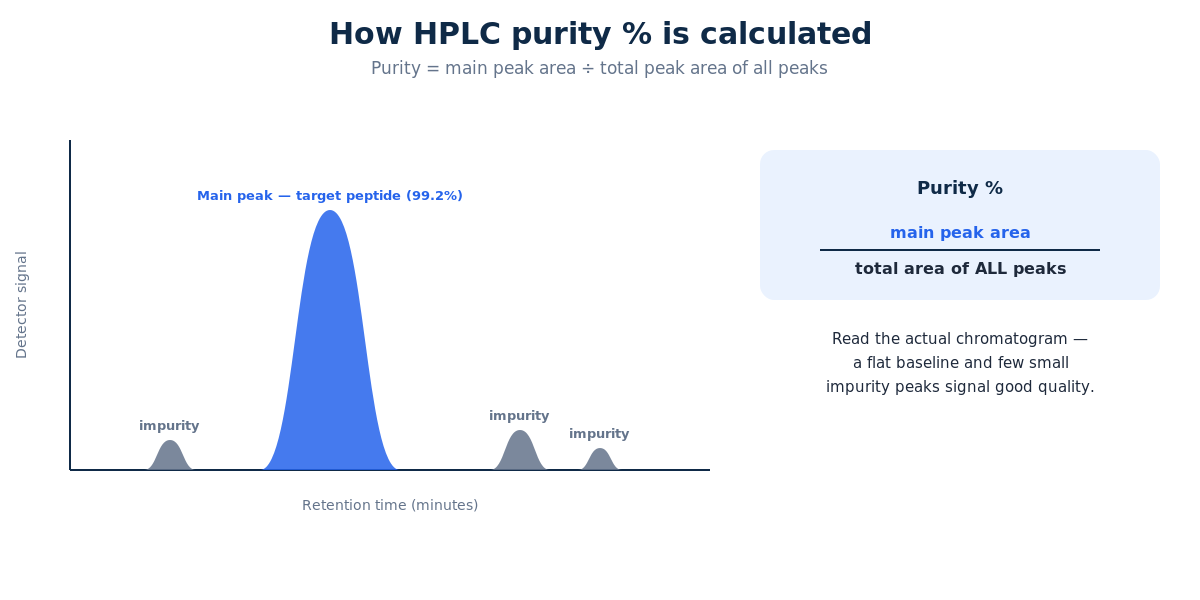
- Purity % = main peak area ÷ total area of all peaks. A specification of ≥98% is the common benchmark for research-grade peptides.
- Read the actual chromatogram, not just the number. Look for a flat, stable baseline and only small impurity peaks. A noisy baseline or large secondary peaks undercut a high headline figure.
- Retention time is when the target elutes from the column; consistent retention time across lots is a sign of a well-controlled process.
Endotoxin
Endotoxins are bacterial fragments (pyrogens) that survive sterilisation. The COA should give an actual number in EU/mg (endotoxin units per milligram), not just the word “pass.” Lower is better. Endotoxin limits for parenteral products are defined per USP <85> and the relevant monograph; the value on a COA lets you compare lots and suppliers objectively.
Counterion: acetate or TFA
Peptides are usually isolated as a salt — commonly acetate or trifluoroacetate (TFA). The counterion is left over from synthesis and purification, and it matters because it contributes to the powder’s weight. That means the net peptide content per milligram of powder is slightly less than the gross weight, which is worth knowing when you calculate concentration precisely.
Water content and appearance
- Water content (Karl Fischer): the percentage of residual moisture. High moisture shortens the shelf life of the dry powder and can indicate poor lyophilisation.
- Appearance: usually “white to off-white lyophilized powder.” It should match what is actually in your vial.
- Dates: manufacture/test date and any retest or expiry date.
A quick COA checklist
- Does the lot number match your vial?
- Is it third-party tested, with the testing lab named?
- Does MS identity conform to the expected mass?
- Is HPLC purity stated and is a chromatogram shown?
- Is endotoxin given as a real EU/mg number?
- Are counterion and water content reported?
Frequently asked questions
What purity is considered good for a research peptide?
≥98% by HPLC is the common research-grade benchmark, but read the chromatogram too — a flat baseline and only small impurity peaks matter as much as the headline number.
What does the counterion (acetate or TFA) mean?
It is the salt form left from synthesis. It adds weight to the powder, so the net peptide content per milligram is slightly less than the gross weight.
Should the COA lot number match my vial?
Yes. A COA describes one specific lot. If the lot number does not match your vial, the certificate does not describe what you have.
References
- USP General Chapter <85> Bacterial Endotoxins Test
- FDA — Bacterial Endotoxins/Pyrogens (Inspection Technical Guide)
- Bachem — Handling and Storage Guidelines for Peptides
Informational only. This guide is for educational and laboratory/measurement purposes and is not medical advice. It does not recommend or instruct personal human use. Consult a qualified healthcare professional for any health decision. Content is intended for adults 21+. Verify scientific details against the primary sources cited.