
IGF-1 LR3
Summary
IGF-1 LR3 (Long R3 Insulin-like Growth Factor-1) is an engineered 83-amino-acid analog of human IGF-1 designed to resist binding by IGF binding proteins. It carries a Glu3-to-Arg3 substitution and a 13-residue N-terminal extension, which together sharply reduce IGFBP affinity while preserving IGF-1 receptor binding. These changes give it greater potency and a longer functional half-life in laboratory systems. It is widely sold as a cell-culture supplement and research reagent, not as an approved therapeutic for people.
Quick facts
| Also known as | Long R3 IGF-1, LR3-IGF-1, LONG R3 IGF-I, IGF-1 Long Arg3 |
| Category | Growth factor analog (IGF family) |
| Status | Research-use cell-culture reagent; not an approved drug and not approved for human use |
| CAS | 946870-92-4 |
| Formula | C400H625N111O115S9 |
| Molecular weight | ~9111.5 Da (reported 9111-9117) |
| Sequence | 83-amino-acid analog of human IGF-1: full 70-aa IGF-1 sequence with a Glu3->Arg3 substitution plus a 13-amino-acid N-terminal extension |
| Half-life | Longer-acting than native IGF-1 in research models (reported ~20-30 h in animal studies vs ~10-15 h for native IGF-1); model-dependent |
| Storage | Lyophilized powder stored desiccated at -20C; reconstituted solution kept at 2-8C short term or aliquoted and frozen; avoid repeated freeze-thaw |
In Plain English
IGF-1 LR3 is a longer-lasting lab-made version of a natural growth factor the body uses to build muscle and tissue. Small changes to it make it stay active much longer than the natural form. Researchers study it for muscle growth and cell experiments; it is a research compound.
IGF-1 LR3 (Long R3 Insulin-like Growth Factor-1) is an engineered analog of human IGF-1 designed to resist capture by IGF binding proteins, and it is most commonly encountered as a laboratory cell-culture reagent rather than an approved medicine. The molecule keeps the full insulin-like growth factor-1 sequence but adds a 13-amino-acid extension at one end and swaps a single residue near the start. Those two changes blunt the molecule’s affinity for the binding proteins that normally sequester IGF-1 in the body, leaving more of it free to engage its receptor in a culture dish. This page is an informational reference only. It is not medical advice, does not endorse any vendor, and does not provide human dosing.
What is IGF-1 LR3?
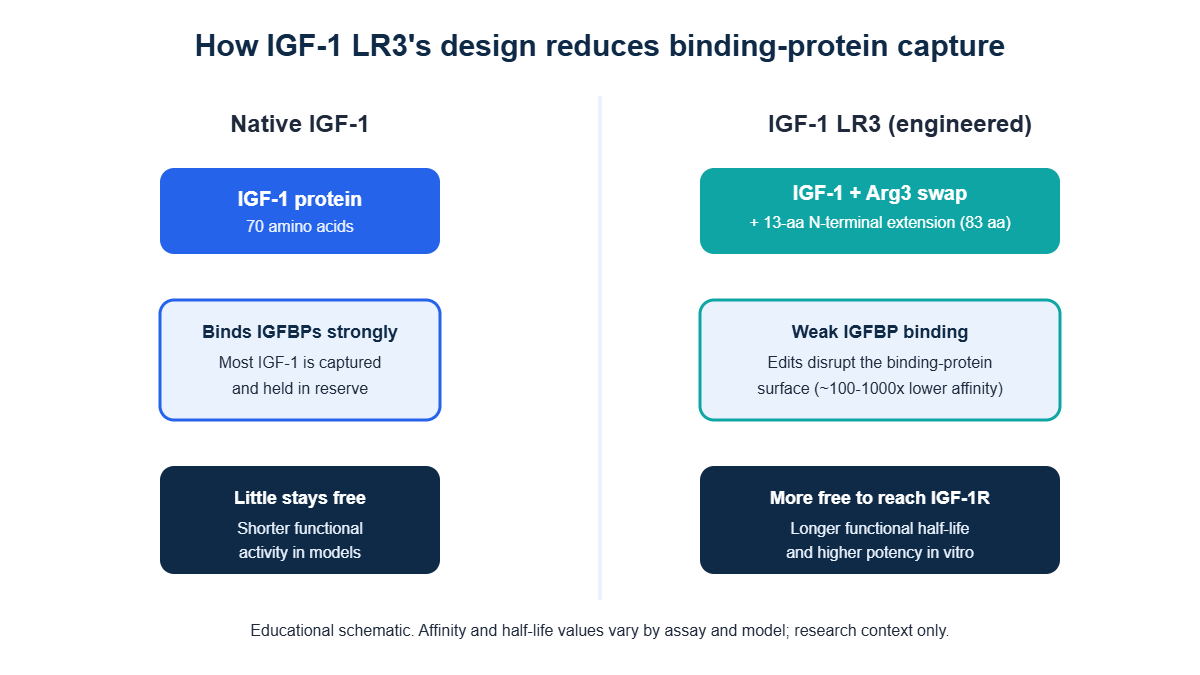
Native insulin-like growth factor-1 (IGF-1) is a 70-amino-acid protein, structurally related to insulin, that plays a central role in cell growth, survival and metabolism. IGF-1 LR3 is a recombinant analog of that protein, 83 amino acids long, produced in E. coli and supplied as a lyophilized (freeze-dried) powder. Its name encodes its two defining modifications: “R3” refers to a substitution of arginine for glutamic acid at position 3 (Glu3-to-Arg3), and “Long” refers to an extra 13-residue peptide stretch added to the N-terminus.
Reported chemical descriptors include CAS number 946870-92-4, the molecular formula C400H625N111O115S9, and a molecular weight near 9,111 Da (sources cite roughly 9,111-9,117 Da depending on calculation method). The compound was originally developed as a more potent, more stable growth-factor supplement for serum-free and low-serum cell culture, and that is the context in which suppliers such as Sigma-Aldrich (Merck) catalog it. It is a research reagent, not a drug approved for human use.
How IGF-1 LR3 is studied to work
In laboratory systems, IGF-1 LR3 acts on the same machinery as native IGF-1, but the structural edits change how much of it stays available. The proposed mechanism, drawn from IGF-1 biology, can be summarized as follows:
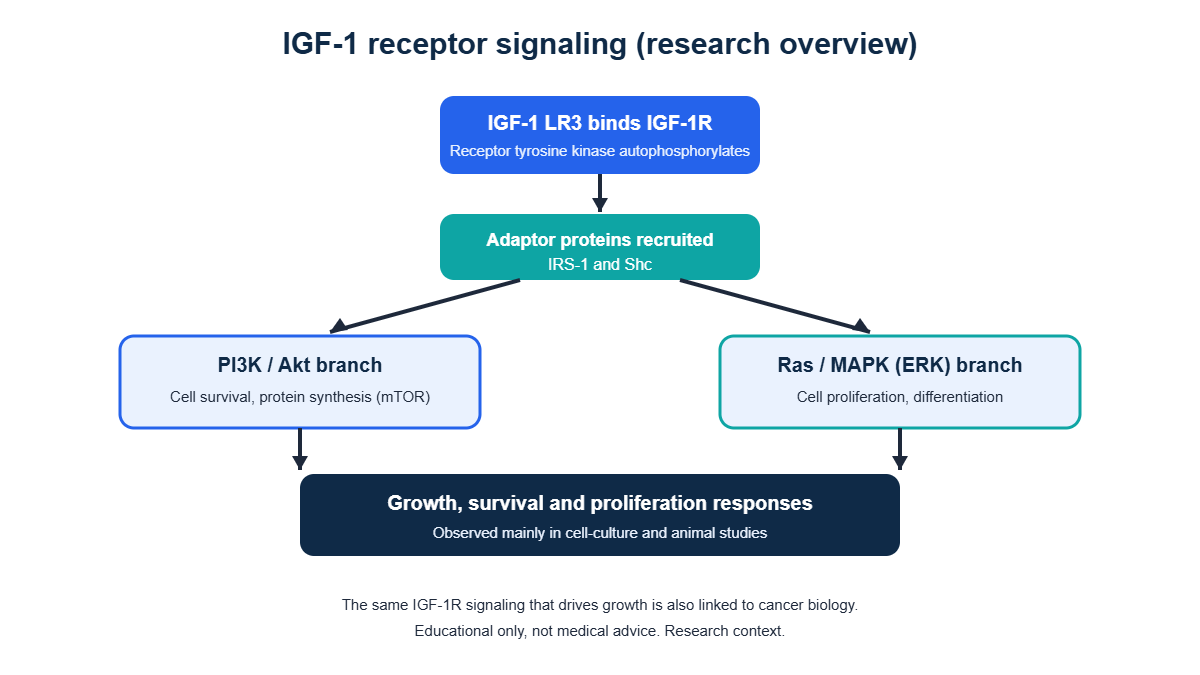
- IGF-1 receptor (IGF-1R) engagement. Like native IGF-1, the analog binds and activates IGF-1R, a receptor tyrosine kinase, triggering receptor autophosphorylation.
- Reduced IGFBP binding. The Arg3 substitution and N-terminal extension together disrupt the surface that IGF binding proteins (IGFBP-1 through -6) recognize, lowering IGFBP affinity by roughly two-to-three orders of magnitude in reported assays.
- Greater free fraction and longer functional half-life. Because less of the molecule is captured by binding proteins, more remains free to act, and it persists longer in research models.
- Downstream PI3K/Akt and MAPK signaling. Activated IGF-1R recruits IRS-1 and Shc adaptor proteins, feeding the PI3K/Akt pathway (cell survival and protein synthesis) and the Ras/MAPK (ERK) pathway (proliferation).
Reported effects in the research literature
Most of what is described for IGF-1 LR3 comes from in-vitro cell culture and animal studies, where its enhanced potency is the main point of interest:
- Increased proliferation and viability of cultured cells in serum-free or low-serum media.
- Higher recombinant-protein yields when used as a growth-factor supplement in bioprocessing cell lines.
- Potency in vitro reported as greater than that of native IGF-1 or insulin in some assays, attributed to reduced IGFBP capture.
- Activation of growth and survival signaling consistent with general IGF-1R biology.
What this does not mean: these observations are from controlled laboratory and animal settings, not from rigorous human trials of IGF-1 LR3. In-vitro potency does not translate directly into a safe or predictable effect in a living person, and the very property that makes the analog useful in a dish, more free growth-factor activity, is also a source of safety concern in whole organisms.
What the human evidence shows
There is no body of controlled human clinical-trial evidence supporting IGF-1 LR3 as a therapy, and it is not an approved drug anywhere as a human medicine. The structurally related, FDA-approved product is mecasermin (Increlex), which is recombinant human IGF-1 (not the LR3 analog), indicated narrowly for growth failure in children with severe primary IGF-1 deficiency. Mecasermin’s labeling is instructive about the hazards of pushing IGF-1 activity in people.
Documented concerns for IGF-1 therapy include hypoglycemia (low blood sugar, sometimes severe), which is why mecasermin must be dosed with food, along with hypersensitivity reactions, fluid retention, intracranial hypertension and tonsillar/adenoid hypertrophy. Because IGF-1 LR3 produces even more sustained, less-regulated IGF-1R signaling, extrapolating its effects to humans is not supported and is potentially riskier than the approved native-sequence drug. Anyone with a genuine medical condition should speak with a licensed clinician; this page does not substitute for medical care.
Handling, storage and reconstitution (research context)
The notes below describe general laboratory handling of a lyophilized peptide reagent and are not instructions for any human use.
- Storage of powder: keep the sealed, lyophilized vial desiccated and cold, commonly at -20C, away from light and moisture until use.
- Reconstitution: peptides of this type are typically dissolved in a small volume of dilute acetic acid or sterile water per the supplier’s datasheet, then diluted into culture medium or buffer.
- Working solution: reconstituted material is generally held briefly at 2-8C or aliquoted and frozen to limit degradation.
- Freeze-thaw: repeated freeze-thaw cycles degrade peptides, so single-use aliquots are preferred.
- Sterility: aseptic technique and clean labware matter, especially for cell-culture applications. See our guides on how to reconstitute peptides and sterile technique.
Cautions and considerations
- Growth-factor / cancer-signaling caution. IGF-1R signaling drives proliferation and survival pathways heavily implicated in tumor biology; sustained, unregulated IGF-1 activity is a recognized safety concern.
- Metabolic effects. IGF-1 activity overlaps with insulin signaling and can lower blood glucose, a hazard well documented for the approved IGF-1 drug.
- Not approved for human use. IGF-1 LR3 is a research reagent; quality, identity and purity of materials sold outside regulated supply chains are not assured.
- Sport status. IGF-1 and its analogs are prohibited in sport by anti-doping rules.
- Informational only, 21+. This content is educational, is not medical advice, and does not recommend, sell or endorse any product or protocol.
Frequently asked questions
Is IGF-1 LR3 the same as IGF-1?
No. IGF-1 LR3 is an engineered analog of native IGF-1. It retains the IGF-1 sequence but adds an arginine-3 substitution and a 13-amino-acid N-terminal extension, which reduce its binding to IGF binding proteins and increase its potency and persistence in laboratory models.
Why is IGF-1 LR3 described as longer-acting?
In the body, native IGF-1 is largely bound by IGFBPs, limiting how much is free and active. The structural changes in IGF-1 LR3 sharply lower IGFBP binding, so more remains free; in animal studies this corresponds to a longer functional half-life. Exact values vary by model.
Is IGF-1 LR3 an approved drug?
No. It is sold as a research reagent and cell-culture supplement, not an approved human medicine. The related FDA-approved product is mecasermin (recombinant human IGF-1), used narrowly in pediatric primary IGF-1 deficiency, not IGF-1 LR3.
What are the main safety concerns?
Based on IGF-1 biology and the labeling of approved IGF-1 therapy, the principal concerns are hypoglycemia and the broad role of IGF-1R signaling in cell proliferation and cancer biology. There is no controlled human trial evidence establishing safe use of IGF-1 LR3 in people.
Related compounds and further reading
Share this article
References
- LONG R3 IGF-I human, recombinant, lyophilized, for cell culture (I1146). Sigma-Aldrich (Merck)
- IGF-1 LR3. Wikipedia 2026
- Werner H. The IGF1 Signaling Pathway: From Basic Concepts to Therapeutic Opportunities. Int J Mol Sci 2023
- The signaling landscape of insulin-like growth factor 1. J Biol Chem 2025
- Mecasermin: Uses, Interactions, Mechanism of Action. DrugBank DB01277
- INCRELEX (mecasermin) injection, prescribing information. U.S. FDA 2025
For informational use only. Not medical advice; consult a qualified healthcare professional. 21+.
IGF-1 LR3 reconstitution calculator
Use the calculator below to find the concentration (mg/mL), draw volume and U-100 syringe units for IGF-1 LR3 once it is reconstituted with bacteriostatic water. IGF-1 LR3 has molecular formula C400H625N111O115S9 and a molecular weight of ~9111.5 Da (reported 9111-9117). Enter your vial amount and the water volume to see the lab math — informational use only, not dosing advice.