
Epitalon
Summary
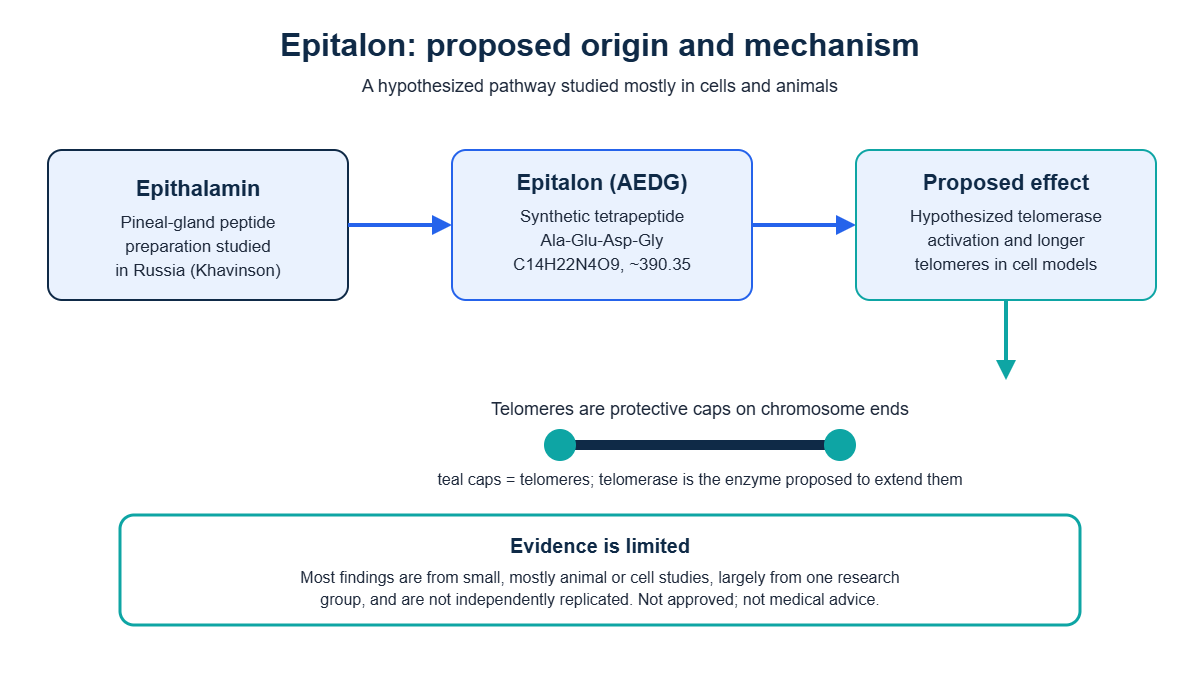
Epitalon (Epithalon, AEDG peptide) is a synthetic tetrapeptide with the sequence Ala-Glu-Asp-Gly, designed to mimic Epithalamin, a peptide preparation from the pineal gland. It is studied in laboratory and animal models for proposed effects on telomerase activity, telomere length, melatonin rhythms, and aging biomarkers. Most published data come from a limited set of mostly preclinical and Russian-origin studies that have not been broadly replicated. Epitalon is an unapproved research compound, not a medicine, and is provided here for educational reference only.
Quick facts
| Also known as | Epithalon, Epithalone, AEDG peptide |
| Category | Synthetic peptide (bioregulator / research peptide) |
| Status | Unapproved research peptide; derived from the pineal peptide preparation Epithalamin and developed in Russia by Khavinson and colleagues. Not approved as a drug by the FDA, EMA, or comparable regulators. |
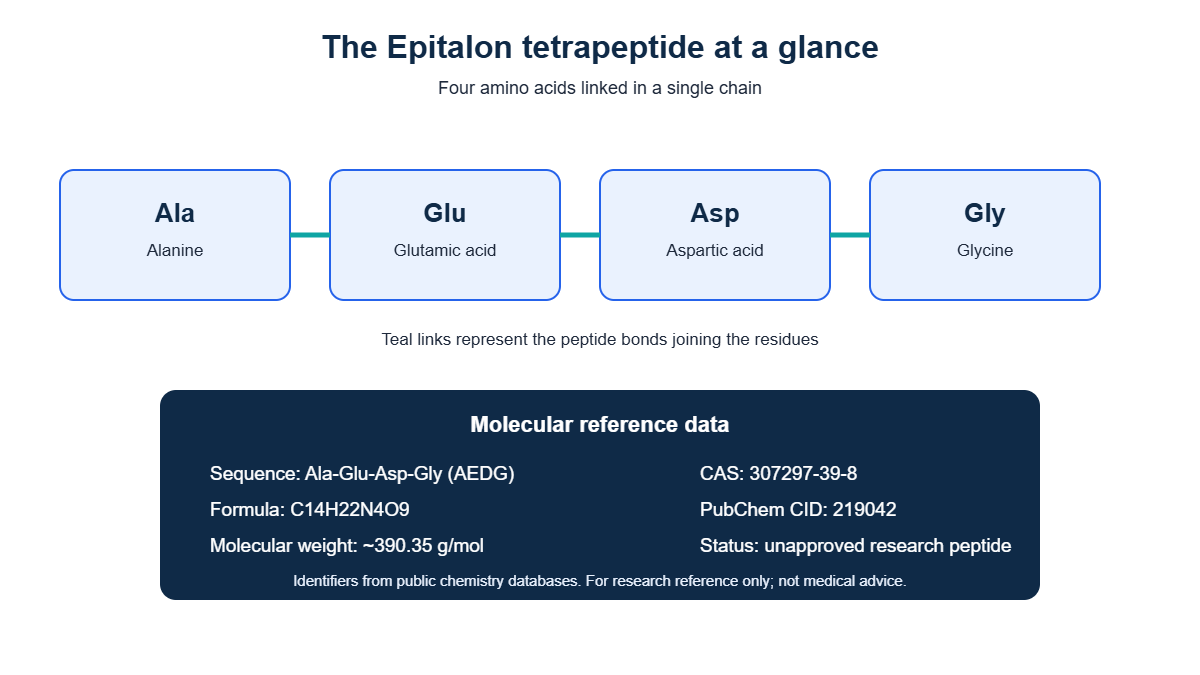
| CAS | 307297-39-8 |
| Formula | C14H22N4O9 |
| Molecular weight | 390.35 g/mol |
| Sequence | Ala-Glu-Asp-Gly (AEDG) |
| Half-life | Not well characterized in humans; small peptides of this type are generally cleared rapidly from plasma (minutes), and reliable human pharmacokinetic data are lacking |
| Storage | Lyophilized powder is typically stored frozen (-20 C) and protected from light and moisture; once reconstituted, kept refrigerated (2-8 C) and used over a short window per laboratory handling norms. |
In Plain English
Epitalon is a short lab-made peptide based on a natural substance from a small gland in the brain. It is studied for effects on the body’s internal clock and aging, including the protective caps on the ends of our DNA. The evidence is early and comes mostly from a few labs.
Epitalon (also written Epithalon or Epithalone, and sometimes called the AEDG peptide) is a synthetic tetrapeptide with the sequence Ala-Glu-Asp-Gly that was designed to copy the active fragment of Epithalamin, a peptide preparation derived from the pineal gland. It was developed in Russia by Vladimir Khavinson and colleagues at the St. Petersburg Institute of Bioregulation and Gerontology, who have published the large majority of the research on it. Epitalon is studied in cell and animal models for proposed effects on telomerase activity, melatonin rhythms, and markers of aging. It is an unapproved research compound, not an approved medicine, and this page is informational only.
What is Epitalon?
Epitalon is one of the shortest peptides in the family of so-called “peptide bioregulators.” Its four amino acids – alanine, glutamic acid, aspartic acid, and glycine – give it the formula C14H22N4O9 and a molecular weight of about 390.35 g/mol (PubChem CID 219042; CAS 307297-39-8). The two acidic residues mean the molecule carries a net negative charge at physiological pH.
The compound traces back to Epithalamin, a complex peptide extract originally prepared from bovine pineal glands and studied in the Soviet and later Russian literature for effects on the neuroendocrine system. Epitalon was synthesized as a defined, single-sequence analog intended to reproduce part of that activity in a reproducible form. It is important to understand that nearly all of the foundational research originates from a single research group, which is a significant caveat when weighing the evidence.
How Epitalon is studied to work
The proposed mechanisms of Epitalon come mostly from in vitro and animal experiments. They are hypotheses supported by limited data, not established facts about how the peptide behaves in humans.
- Proposed telomerase activation. The best-known claim is that Epitalon can switch on telomerase, the enzyme that adds repeats to the ends (telomeres) of chromosomes. Cell-culture work from Khavinson’s group reported induction of telomerase activity and telomere elongation in human somatic cells.
- Pineal and melatonin modulation. Because it is modeled on a pineal peptide, Epitalon has been studied for effects on melatonin production and circadian rhythm, including reports of partially restored melatonin and cortisol cycles in aged animals.
- Gene-expression and antioxidant effects. Researchers have proposed that Epitalon can reach the cell nucleus and influence transcription of certain genes, and have described antioxidant and antimutagenic effects in laboratory systems.
Reported effects in the research literature
Across the published literature, Epitalon has been associated with a wide range of outcomes in laboratory and animal studies:
- Reported increases in lifespan and reductions in age-related tumor incidence in mice and fruit flies.
- Reported normalization of melatonin and cortisol rhythms in aged rhesus monkeys.
- Reported telomerase induction and telomere elongation in cultured human fibroblasts.
- Described antioxidant, neuroprotective, and immune-modulating effects in various preclinical models.
What this does not mean: these are striking headline claims, but the evidence behind them is weak by mainstream standards. Most results come from small studies, animal or cell models, and predominantly from one research group, and many have not been independently replicated by outside laboratories. Effects seen in fruit flies, mice, or petri dishes do not reliably predict effects in humans, and “telomerase activation” is not the same as proven anti-aging benefit. None of these reports establish that Epitalon is safe or effective for any use in people.
What the human evidence shows
Human data on Epitalon are very limited. There are some older Russian clinical reports describing effects on aging biomarkers and patient outcomes, but these are generally small, methodologically dated, and difficult to evaluate against modern standards for clinical trials (such as large sample sizes, blinding, independent replication, and registration). High-quality, independently conducted, peer-reviewed randomized controlled trials in humans are essentially absent.
As a result, Epitalon has no regulatory approval as a drug or therapy in the United States, the European Union, or comparable jurisdictions. It is best understood as an experimental research peptide with an interesting preclinical signal and a thin, largely unreplicated human evidence base – not as a validated anti-aging treatment. Reviews of the field consistently describe the properties as “promising” while emphasizing that much more rigorous study is needed.
Handling, storage and reconstitution (research context)
The following reflects general laboratory handling conventions for lyophilized research peptides and is provided for reference only, not as instructions for human use.
- Lyophilized (freeze-dried) peptide is typically stored frozen, around -20 C, protected from light, heat, and moisture.
- Reconstitution in a laboratory setting is usually done with sterile or bacteriostatic water, adding the diluent slowly down the vial wall rather than directly onto the powder.
- Once reconstituted, peptide solutions are generally refrigerated (2-8 C) and used within a limited window, since small peptides can degrade in solution.
- Repeated freeze-thaw cycles and vigorous agitation are typically avoided to limit degradation.
- Concentration and volume math should be checked carefully; a reconstitution calculator can help confirm figures in a research context.
Cautions and considerations
- Not medical advice. This page is educational. Nothing here recommends use of Epitalon in humans, and VialHelp does not sell peptides or endorse any vendor.
- Unapproved status. Epitalon is not approved by the FDA or other major regulators for any indication, and is not a dietary supplement.
- Limited safety data. Because rigorous human safety studies are lacking, long-term risks, drug interactions, and effects in specific populations are not well understood.
- Product quality varies. Research-grade material sold online is unregulated and can differ widely in purity, identity, and sterility.
- Adults only. Information on this site is intended for adults 21 and over.
- Always consult a qualified healthcare professional before making any health decisions.
Frequently asked questions
Is Epitalon proven to extend human lifespan?
No. Lifespan claims come mainly from animal studies and small, dated human reports, largely from one research group, and have not been confirmed by independent, high-quality clinical trials. There is no robust evidence that Epitalon extends lifespan in people.
Does Epitalon really activate telomerase?
Telomerase induction has been reported in cell-culture experiments, and a 2025 study again examined telomere lengthening in human cell lines. However, demonstrating an effect in cultured cells is very different from proving a safe, beneficial effect in a living person, and the broader claim remains unproven.
Is Epitalon a drug or a supplement?
Neither. It is an experimental research peptide. It has not been approved as a medicine and is not legally marketed as a dietary supplement; material sold online is generally labeled “for research use only.”
Why is the evidence considered weak?
Most published findings rely on small studies, animal or in vitro models, and a single primary research group, with limited independent replication. That combination keeps Epitalon in the category of an interesting but unvalidated research compound.
Related compounds and further reading
Share this article
References
- Epitalon, CID 219042 (formula, molecular weight, names). PubChem (NIH) 2026
- Araj SK, et al. Overview of Epitalon – Highly Bioactive Pineal Tetrapeptide. Int J Mol Sci 2025
- Khavinson VK, Bondarev IE, Butyugov AA. Epithalon peptide induces telomerase activity and telomere elongation in human somatic cells. Bull Exp Biol Med 2003
- Khavinson VK, et al. Peptide promotes overcoming of the division limit in human somatic cell. Bull Exp Biol Med 2004
- Epitalon (overview, history, sequence). Wikipedia 2026
- Epitalon increases telomere length in human cell lines. Biogerontology 2025
For informational use only. Not medical advice; consult a qualified healthcare professional. 21+.
Epitalon reconstitution calculator
Use the calculator below to find the concentration (mg/mL), draw volume and U-100 syringe units for Epitalon once it is reconstituted with bacteriostatic water. Epitalon has molecular formula C14H22N4O9 and a molecular weight of 390.35 g/mol. Enter your vial amount and the water volume to see the lab math — informational use only, not dosing advice.