
TB-500 (Thymosin β4)
Summary
TB-500 is the synthetic, research-grade form of thymosin β4 (Tβ4), one of the most abundant actin-binding peptides in cells. It is studied for its role in regulating the actin cytoskeleton, cell migration, angiogenesis and tissue repair. Most evidence is preclinical; it is not an approved medicine.
Quick facts
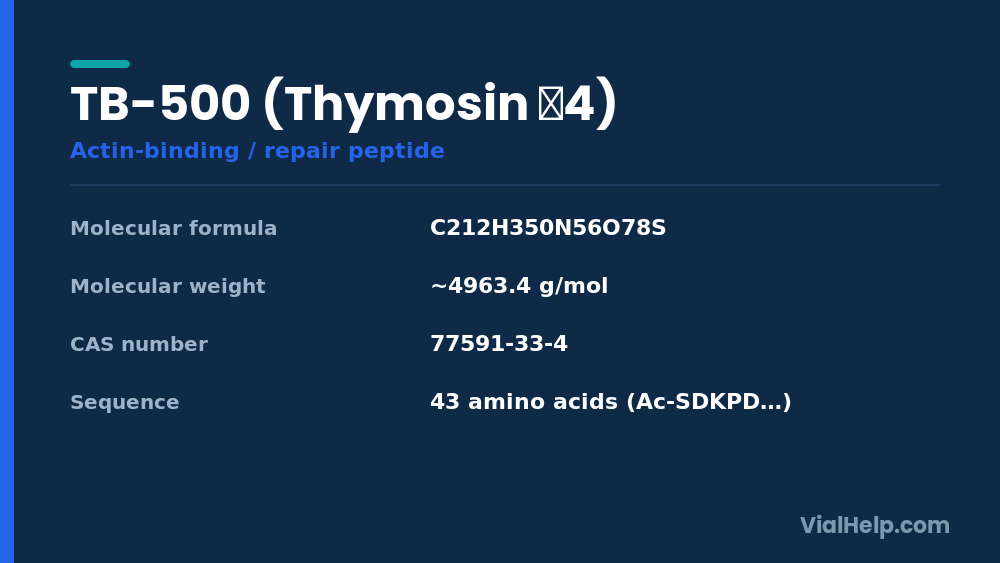
| Also known as | Thymosin β4, Tβ4, Thymosin beta-4 |
| Category | Healing & recovery / actin-binding peptide |
| Status | Research compound — not an approved drug |
| CAS | 77591-33-4 (thymosin β4) |
| Formula | C212H350N56O78S (thymosin β4) |
| Molecular weight | ~4963.4 g/mol |
| Sequence | Ac-SDKPDMAEIEKFDKSKLKKTETQEKNPLPSKETIEQEKQAGES (43 aa) |
| Half-life | Not well established for the synthetic form |
| Storage | Lyophilized: store cold and protected from light. Reconstituted: refrigerate (2–8 °C) and use within a limited window. |
In Plain English
TB-500 is the research-grade version of a protein the body makes naturally called thymosin beta-4. This protein helps cells move to where they are needed and helps tissue rebuild after an injury. Scientists study TB-500 for wound healing, flexibility, and recovery — mostly in animals so far.
TB-500 is the synthetic, research-grade form of a naturally occurring peptide called thymosin β4 (Tβ4), one of the most abundant actin-binding proteins inside cells. In the laboratory it is studied for its role in cell movement, blood-vessel formation, and tissue repair. This page summarizes what TB-500 is and how it is described in the scientific literature, for informational purposes only.
How TB-500 (thymosin β4) works
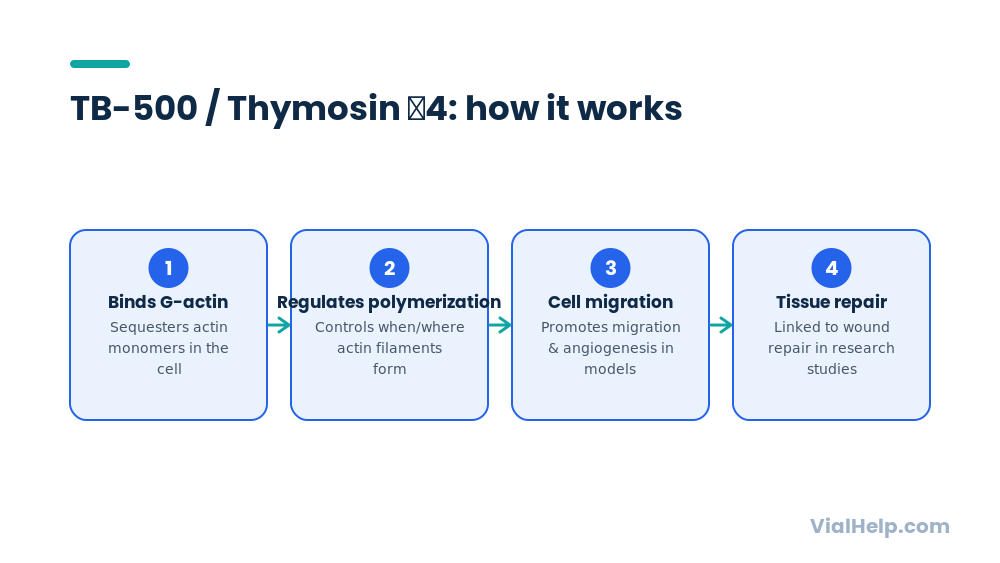
Thymosin β4 is the principal G-actin–sequestering molecule in mammalian cells. By binding free actin monomers, it helps control when and where those monomers polymerize into the actin filaments that drive cell shape and movement. Through this regulation of the actin cytoskeleton, Tβ4 has been linked in research models to cell migration, angiogenesis (new blood-vessel growth), and anti-inflammatory activity — processes central to how tissues remodel after injury.
Reported effects in the research literature
Most published work on thymosin β4 comes from cell-culture and animal studies, with a smaller number of early-stage human trials. In preclinical models, Tβ4 has been reported to accelerate dermal and corneal wound healing, increase reepithelialization and collagen deposition, promote capillary in-growth, and reduce inflammation. It has also been investigated for repair after hypoxic injury to organs such as the heart. Early-phase clinical work has explored topical and injected Tβ4 for wounds such as pressure and stasis ulcers.
It is important to keep this evidence in perspective: results are largely preclinical, human data remain limited, and TB-500 is not an approved medicine. Findings in animals do not necessarily translate to people. The references below point to primary and authoritative sources for readers who want to go deeper.
Handling and storage notes
Like most lyophilized peptides, thymosin β4 is generally kept cold and protected from light before reconstitution, then refrigerated and used within a limited window once dissolved. To work out concentration and volume after reconstitution, use the free VialHelp reconstitution calculator, the concentration & volume converter, and the protocol tracker for record-keeping. See the full peptide library for related compounds.
Related compounds and guides
- BPC-157 — another peptide frequently studied in tissue-repair research.
- GHK-Cu — copper tripeptide investigated for skin and connective-tissue remodeling.
- Browse the full peptide library for more compound profiles.
- How to reconstitute peptides — step-by-step reconstitution method and concentration math.
- Sterile technique — aseptic handling and contamination prevention for research vials.
Share this article
References
For informational use only. Not medical advice; consult a qualified healthcare professional. 21+.
TB-500 (Thymosin β4) reconstitution calculator
Use the calculator below to find the concentration (mg/mL), draw volume and U-100 syringe units for TB-500 (Thymosin β4) once it is reconstituted with bacteriostatic water. TB-500 (Thymosin β4) has molecular formula C212H350N56O78S (thymosin β4) and a molecular weight of ~4963.4 g/mol. Enter your vial amount and the water volume to see the lab math — informational use only, not dosing advice.
Open the full calculator · Back to the TB-500 (Thymosin β4) profile