
BPC-157
Summary
BPC-157 (Body Protection Compound-157) is a synthetic peptide derived from a protein found in gastric juice. It has been studied mostly in animal models for tissue repair and gut protection. It is a research compound and is not FDA-approved; human clinical data is limited.
Quick facts
| Also known as | Body Protection Compound 157, PL 14736, Bepecin |
| Category | Healing / recovery |
| Status | Research (not FDA-approved) |
| CAS | 137525-51-0 |
| Formula | C62H98N16O22 |
| Molecular weight | 1419.5 g/mol |
| Sequence | Gly-Glu-Pro-Pro-Pro-Gly-Lys-Pro-Ala-Asp-Asp-Ala-Gly-Leu-Val |
| Half-life | Short (minutes) in plasma; data limited |
| Storage | Lyophilized: cool & dark, long-term −20°C. Reconstituted: 2–8°C, use within a few weeks. |
In Plain English
BPC-157 is a lab-made copy of a small piece of a protein found naturally in the stomach. In animal studies it appears to help injured tissue — like muscle, tendon, and the gut lining — heal faster. Researchers are interested in it as a possible all-purpose recovery aid, but almost all of the evidence so far comes from animals rather than people.
BPC-157 (Body Protection Compound-157) is a synthetic chain of 15 amino acids based on a sequence found in human gastric juice. First described by a research group in Zagreb in the early 1990s, it has become one of the most-studied “healing” peptides in preclinical science. This profile summarizes what BPC-157 is, how researchers describe its activity, and what the published literature actually shows — for informational purposes only.
What is BPC-157?
BPC-157 is a stable gastric pentadecapeptide — “pentadecapeptide” simply means a peptide of fifteen amino acids. It is a partial sequence derived from a larger body-protection compound isolated from gastric juice, and it is notably stable in human gastric acid, which is part of why it attracted research interest. You may also see it referred to as Body Protection Compound 157, PL 14736, or bepecin. It is a research compound and is not approved by the FDA or other regulators for human use.
How BPC-157 is studied to work
Across animal studies, researchers have proposed several overlapping mechanisms rather than a single mode of action. The most consistently reported is an effect on angiogenesis — the formation of new blood vessels — which supports tissue repair by improving blood supply to an injured area.
- VEGFR2 activation: BPC-157 is reported to up-regulate and activate the VEGFR2 receptor, a central switch in blood-vessel growth.
- Nitric-oxide pathway: downstream signaling through the Src–Caveolin-1–eNOS pathway is described, increasing nitric-oxide availability and influencing vascular tone.
- Growth-factor and Egr-1 signaling: studies also point to interactions with growth-factor pathways and early growth response factor-1, which help coordinate cell migration and repair.

A 2025 narrative review in Current Reviews in Musculoskeletal Medicine organized three decades of work around four mechanistic pillars: VEGFR2-mediated angiogenesis, eNOS coupling, ERK1/2 signaling, and anti-inflammatory modulation. Importantly, almost all of this evidence comes from cell and rodent models.
Reported effects and benefits in the research literature
In published animal research, the effects most often associated with BPC-157 cluster around connective-tissue repair and protection of the gut. These are the outcomes that have driven interest in the peptide:
- Tendon and ligament models: faster healing, tendon-cell outgrowth, and improved cell survival and migration after injury.
- Muscle injury: recovery signaling reported after crush and strain injuries in rodents.
- Gastrointestinal tract: protective effects on the stomach lining and gut in ulcer and inflammatory-bowel models — consistent with its gastric-juice origin.
- Blood vessels and wound healing: pro-angiogenic activity linked to the VEGFR2 / nitric-oxide pathway described above.
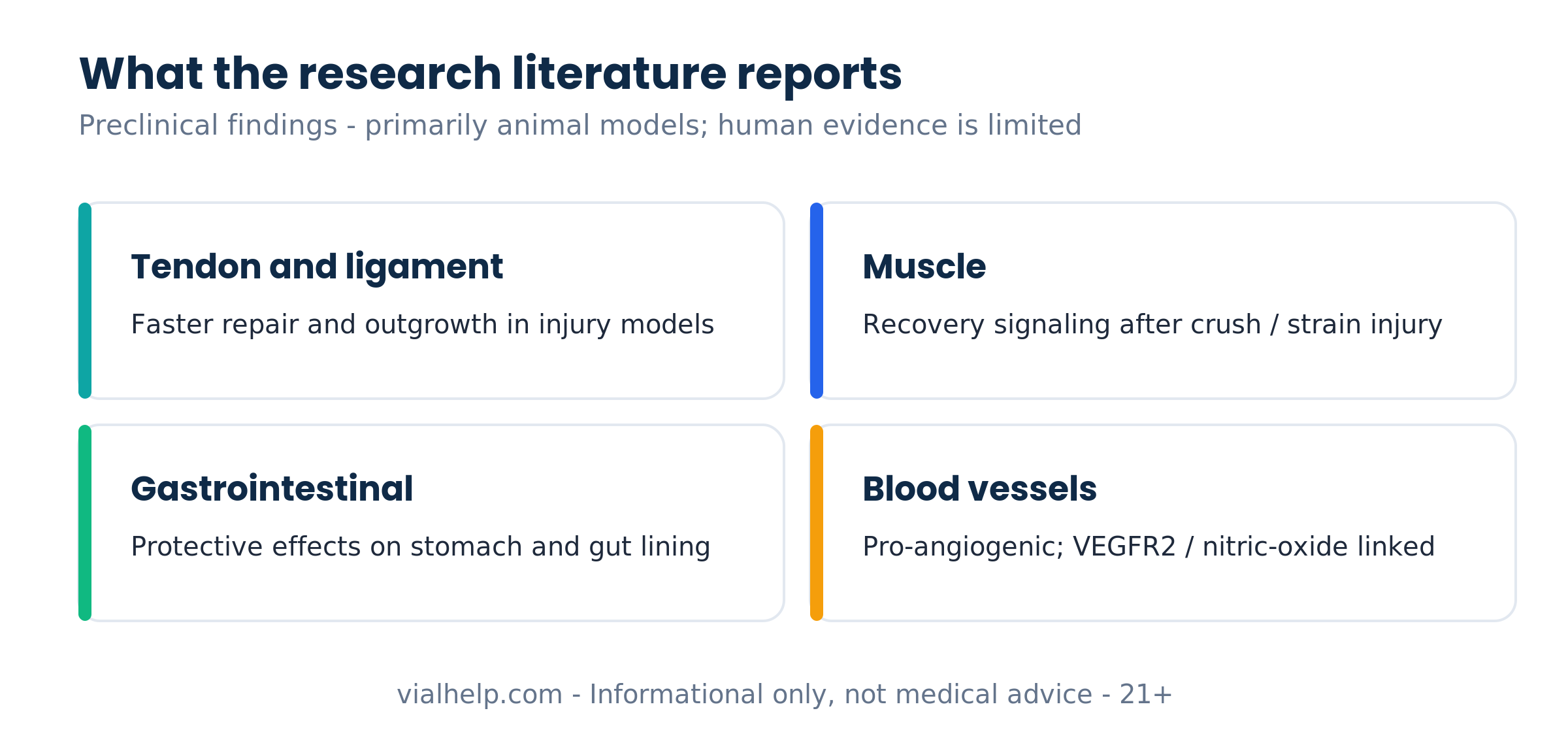
What this does not mean: these are preclinical findings. They should not be read as evidence that BPC-157 is safe or effective in people. The enthusiasm often seen online runs well ahead of the controlled human data, which remains very limited.
What the human evidence shows
Well-controlled human trials of BPC-157 are lacking. The bulk of the literature is animal and laboratory work, much of it from a single research group, with a growing but still small set of independent replications. Because of this evidence gap, regulators have taken a cautious stance.
In September 2023, the U.S. FDA placed BPC-157 in its Category 2 list of bulk drug substances for compounding — substances flagged as potentially presenting significant safety risks. The agency cited concerns including possible immunogenicity for certain routes of administration and difficulty characterizing peptide-related impurities, alongside limited safety data. In practice this restricts traditional compounding pharmacies from preparing it.
Handling, storage and reconstitution (research context)
Like most research peptides, BPC-157 is typically supplied as a lyophilized (freeze-dried) powder that is reconstituted with bacteriostatic water before use in the lab.
- Lyophilized powder: store cool and dark; long-term storage is usually at −20°C.
- After reconstitution: refrigerate at 2–8°C and use within a few weeks.
- Measurement: work in concentration (mg/mL) and volume rather than “units.” Our reconstitution calculator turns vial mg + water volume into concentration and draw volume, and the explainer IU vs mL: why “units” are not a dose clears up the most common measurement mistake.
Cautions and considerations
- BPC-157 is a research compound and is not FDA-approved; it is not a medicine.
- Human safety and efficacy are not established — most evidence is preclinical.
- Purity and identity vary between sources; a Certificate of Analysis (COA) showing purity and identity is essential for any research-grade material.
- This page is informational only and is not medical advice.
Frequently asked questions
Is BPC-157 FDA-approved?
No. BPC-157 is not approved for human use, and in 2023 the FDA placed it on its Category 2 bulk-substances list, citing safety concerns and limited data.
What is BPC-157’s molecular weight and formula?
BPC-157 has the molecular formula C62H98N16O22 and a molecular weight of about 1419.5 g/mol (CAS 137525-51-0).
What is its half-life?
Reported plasma half-life is short — on the order of minutes — though detailed human pharmacokinetic data are limited.
How is BPC-157 stored?
As a lyophilized powder it is kept cool and dark (long-term −20°C); once reconstituted it is refrigerated at 2–8°C and used within a few weeks.
Related compounds and further reading
- Ipamorelin — a selective growth-hormone secretagogue studied in a different research area.
- Browse the full peptide library for more compound profiles.
- Storage, stability and handling guides for research peptides.
- IU vs mL: why “units” are not a dose — the measurement basics behind every calculation.
- How to reconstitute peptides — step-by-step reconstitution method and concentration math.
- Sterile technique — aseptic handling and contamination prevention for research vials.
- Wolverine Blend — a research blend of BPC-157 and TB-500 studied for tissue repair.
Share this article
References
- Wikipedia: BPC-157
- PubChem: BPC-157 (CID 9941957)
- Seiwerth S. et al., Stable Gastric Pentadecapeptide BPC 157 and Wound Healing (Front. Pharmacol., 2021)
- Regeneration or Risk? A Narrative Review of BPC-157 for Musculoskeletal Healing (Curr Rev Musculoskelet Med, 2025)
- FDA: Certain Bulk Drug Substances for Compounding That May Present Significant Safety Risks (BPC-157, Category 2)
For informational use only. Not medical advice; consult a qualified healthcare professional. 21+.
BPC-157 reconstitution calculator
Use the calculator below to find the concentration (mg/mL), draw volume and U-100 syringe units for BPC-157 once it is reconstituted with bacteriostatic water. BPC-157 has molecular formula C62H98N16O22 and a molecular weight of 1419.5 g/mol. Enter your vial amount and the water volume to see the lab math — informational use only, not dosing advice.