
Ipamorelin
Summary
Ipamorelin is a synthetic pentapeptide and selective growth-hormone secretagogue (a ghrelin/GHS-R agonist) studied for stimulating growth-hormone release with minimal effect on cortisol or prolactin in research settings. It is a research compound.
Quick facts
| Also known as | NNC 26-0161 |
| Category | GH secretagogue |
| Status | Research |
| CAS | 170851-70-4 |
| Formula | C38H49N9O5 |
| Molecular weight | 711.85 g/mol |
| Sequence | Aib-His-D-2-Nal-D-Phe-Lys-NH2 |
| Half-life | ~2 hours (reported) |
| Storage | Lyophilized: cool & dark, long-term −20°C. Reconstituted: 2–8°C, use within a few weeks. |
In Plain English
Ipamorelin is a lab-made peptide that gently nudges the body to release more of its own natural growth hormone. In studies it does this in a fairly targeted way, without raising stress hormones much. Researchers study it for questions around muscle, recovery, and growth-hormone release.
Ipamorelin is a synthetic five-amino-acid peptide and one of the most-cited growth-hormone secretagogues in research. Developed in the 1990s (originally coded NNC 26-0161), it became known as the “first selective” GH secretagogue because, in studies, it raised growth hormone with very little effect on other hormones. This profile covers what Ipamorelin is, how it is described in the literature, and what the human data show — for informational purposes only.
What is Ipamorelin?
Ipamorelin is a pentapeptide with the sequence Aib-His-D-2-Nal-D-Phe-Lys-NH2 (CAS 170851-70-4). It belongs to the growth-hormone-releasing peptide (GHRP) family and was identified from a series of compounds that lacked the central dipeptide of GHRP-1. It is a research compound and is not approved by the FDA for human use.
How Ipamorelin is studied to work
Ipamorelin acts as an agonist at the growth-hormone secretagogue receptor (GHS-R) — the same receptor targeted by the natural hunger hormone ghrelin. By binding GHS-R in the pituitary gland, it prompts the release of growth hormone in pulses, mimicking the body’s own pattern rather than producing one flat elevation.

The landmark paper here is Raun and colleagues (1998), which established Ipamorelin as the first GHS-R agonist with GH selectivity comparable to GHRH. In that work, even at doses far above the threshold for GH release, Ipamorelin did not meaningfully raise ACTH or cortisol — and none of the secretagogues tested altered FSH, LH, prolactin or TSH. That selectivity is the single feature most responsible for ongoing research interest.
Reported effects and benefits in the research literature
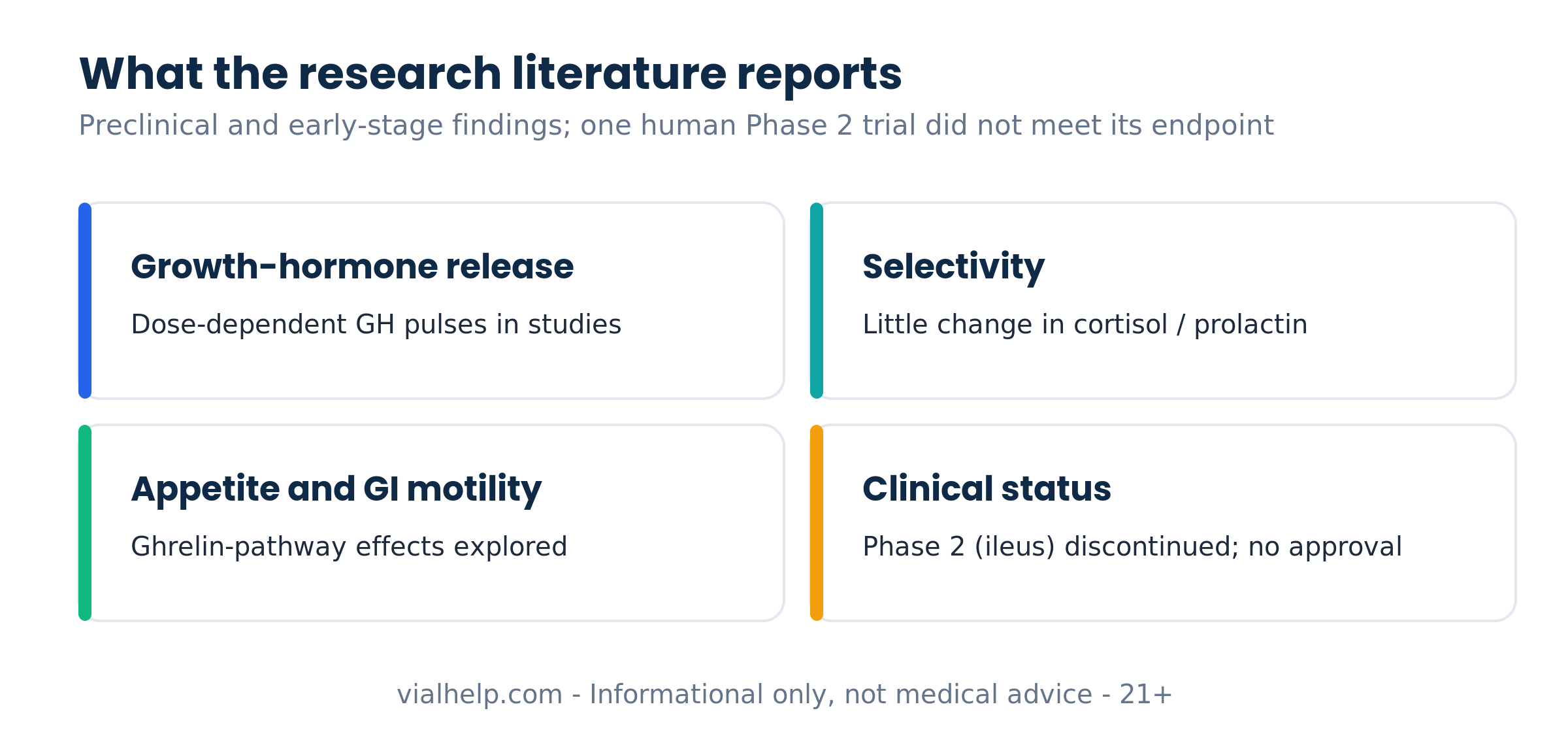
The findings most consistently associated with Ipamorelin in studies are:
- Growth-hormone release: dose-dependent increases in GH, delivered as pulses, in both animal and early human work.
- Selectivity: little to no change in cortisol, prolactin or ACTH — the property that distinguishes it from earlier GHRPs.
- Ghrelin-pathway effects: because it targets the ghrelin receptor, research has also explored effects on appetite and gastrointestinal motility.
What this does not mean: these are research findings, largely preclinical and early-stage. They are not evidence that Ipamorelin is safe or effective as a treatment, and this is not dosing or medical guidance.
What the human evidence shows
Human data on Ipamorelin are limited. A 1999 pharmacokinetic study (Gobburu et al.) characterized its behavior in volunteers, and its main clinical test came later: Ipamorelin was advanced into Phase 2 trials for post-operative ileus (slowed gut function after surgery). That program, registered as NCT00672074, was discontinued after it did not meet its efficacy endpoint. No regulator has approved Ipamorelin for any use.
Handling, storage and reconstitution (research context)
Ipamorelin is typically supplied as a lyophilized powder and reconstituted with bacteriostatic water for laboratory work.
- Lyophilized powder: store cool and dark; long-term storage is usually at −20°C.
- After reconstitution: refrigerate at 2–8°C and use within a few weeks.
- Measurement: express results as concentration (mg/mL) and volume. Our reconstitution calculator converts vial mg and water volume into concentration and draw volume, and IU vs mL: why “units” are not a dose explains why syringe “units” are a volume, not an amount.
Cautions and considerations
- Ipamorelin is a research compound and is not FDA-approved; it is not a medicine.
- Its only published human efficacy trial (post-operative ileus) did not meet its endpoint.
- Purity and identity vary between sources; insist on a Certificate of Analysis (COA) for any research-grade material.
- This page is informational only and is not medical advice.
Frequently asked questions
Is Ipamorelin FDA-approved?
No. Ipamorelin is not approved for any use. It reached Phase 2 trials for post-operative ileus, which were discontinued for lack of efficacy.
Why is Ipamorelin called “selective”?
Because in research it stimulates growth-hormone release while leaving cortisol, prolactin and ACTH largely unchanged — unlike some earlier growth-hormone-releasing peptides.
What is Ipamorelin’s molecular weight and formula?
The molecular formula is C38H49N9O5 and the molecular weight is about 711.85 g/mol (CAS 170851-70-4).
What is its half-life?
Reported half-life is roughly 2 hours, though published human pharmacokinetic data are limited.
Related compounds and further reading
- BPC-157 — a peptide studied mainly in tissue-repair research.
- Browse the full peptide library for more compound profiles.
- Storage, stability and handling guides for research peptides.
- IU vs mL: why “units” are not a dose — the measurement basics behind every calculation.
- How to reconstitute peptides — step-by-step reconstitution method and concentration math.
- Sterile technique — aseptic handling and contamination prevention for research vials.
Share this article
References
- Wikipedia: Ipamorelin
- Raun K. et al., Ipamorelin, the first selective growth hormone secretagogue (Eur J Endocrinol, 1998; PMID 9849822)
- PubChem: Ipamorelin (CID 9831659)
- DrugBank: Ipamorelin (DB12370)
- ClinicalTrials.gov: Ipamorelin for Post-Operative Ileus (NCT00672074)
- Gobburu J.V. et al., Pharmacokinetics of ipamorelin (J Clin Pharmacol, 1999; PMID 10496658)
For informational use only. Not medical advice; consult a qualified healthcare professional. 21+.
Ipamorelin reconstitution calculator
Use the calculator below to find the concentration (mg/mL), draw volume and U-100 syringe units for Ipamorelin once it is reconstituted with bacteriostatic water. Ipamorelin has molecular formula C38H49N9O5 and a molecular weight of 711.85 g/mol. Enter your vial amount and the water volume to see the lab math — informational use only, not dosing advice.