
Wolverine (BPC-157 + TB-500 blend)
Summary
Wolverine is a research-peptide blend combining BPC-157 and TB-500, two compounds studied for tissue repair and recovery. It is not a single compound and has no blend-specific human evidence; the data lives on each component page.
Quick facts
| Also known as | Wolverine blend; BPC-157/TB-500 recovery blend |
| Category | Peptide blend (combination of individual compounds) |
| Status | Research blend – not a single compound; composition and ratios vary by source |
| Formula | Not applicable – a blend of separate peptides |
| Molecular weight | Not applicable – blend (see each component) |
| Sequence | Not applicable – blend |
| Half-life | Varies by component |
| Storage | Follow the most fragile component: lyophilized cold and dry; reconstituted at 2-8 C, protected from light; avoid freeze-thaw. |
In Plain English
The Wolverine blend combines two research peptides, BPC-157 and TB-500, that scientists study for how the body repairs itself. Researchers are interested in whether these compounds can speed the healing of muscle, tendon, and gut tissue in laboratory and animal studies. It is not a single approved medicine — “Wolverine” is just a nickname for the two peptides mixed together, and no human trials have tested the blend itself.
Wolverine is a popular research-peptide “blend” — not a single compound, but a pre-combined vial of BPC-157 and TB-500, two peptides studied for tissue repair and recovery. The nickname refers to the comic-book character known for rapid healing; on a label it simply means these two recovery peptides have been combined in one vial. As with all blends, there is no blend-specific human evidence: what is known comes from studies of each individual peptide.
What is the Wolverine blend?
The Wolverine blend is a combination of separate research peptides supplied pre-mixed in a single vial, sold under the Wolverine nickname. It is not an approved drug, not a single molecule, and has no molecular formula, molecular weight or sequence of its own — each of those belongs to the individual compounds inside it. Because it is a blend, the most reliable information lives on the component pages, which this page links to throughout.
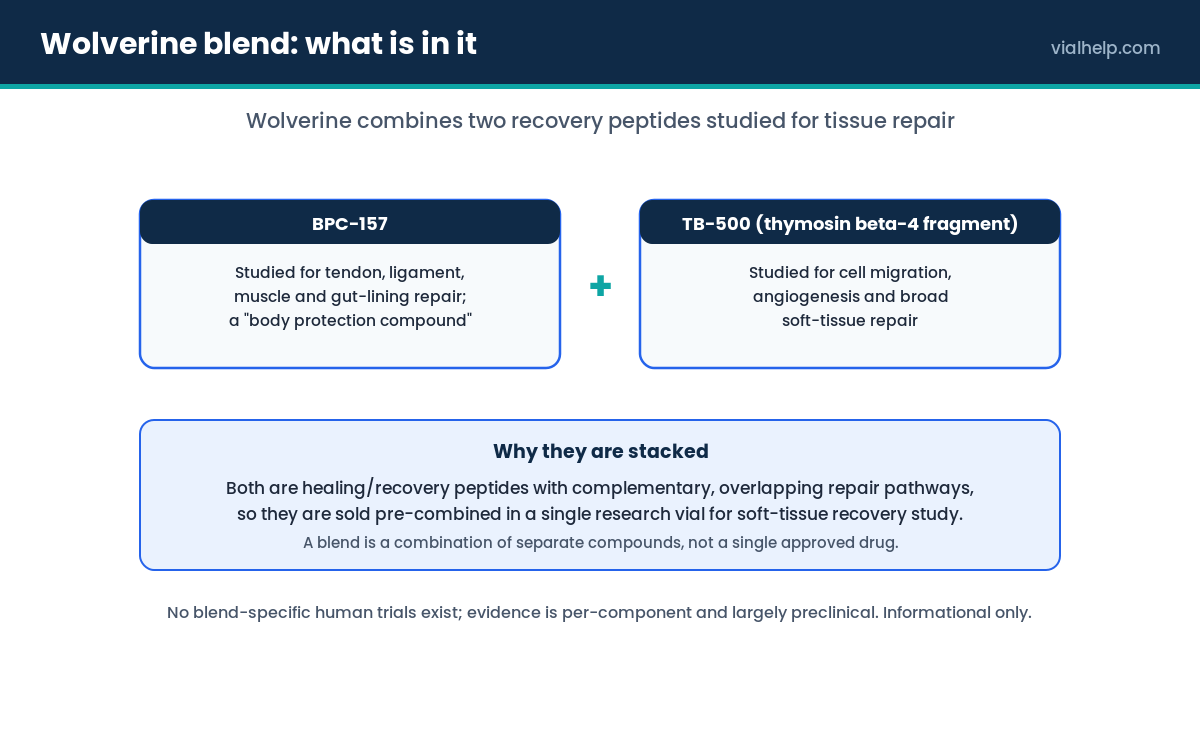
What is in it, and what each part contributes
- BPC-157 — a “body protection compound” studied for tendon, ligament, muscle and gut-lining repair.
- TB-500 — a thymosin beta-4 fragment studied for cell migration, angiogenesis and broad soft-tissue repair.
Follow any component link above for its verified data — formula, molecular weight, sequence, mechanism, the research evidence, and storage. This page only summarizes how they are combined.
How the components are stacked
Wolverine pairs two compounds whose studied roles overlap and complement each other in soft-tissue repair. BPC-157 is associated with tendon, ligament and gut-lining repair, while TB-500 is associated with cell migration and broad tissue remodeling. Combining them in one vial is the entire idea of the “stack” — a single preparation aimed at recovery research, rather than two separate vials.
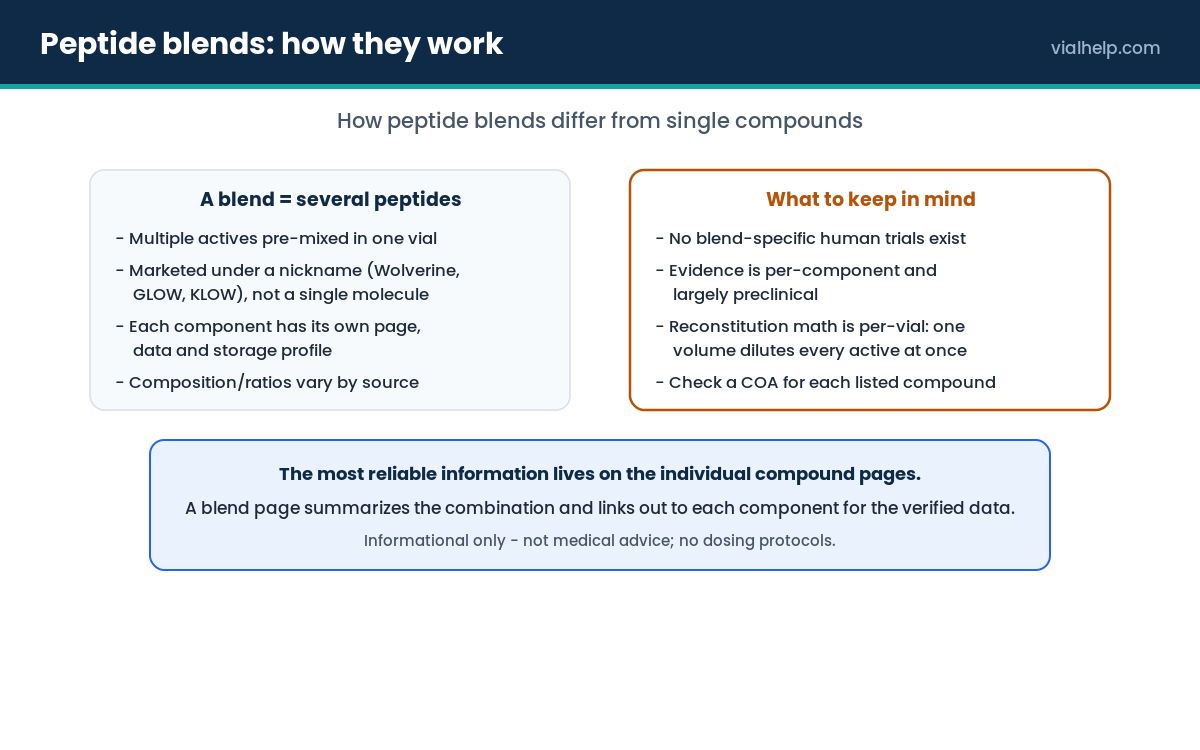
What the evidence shows
There are no human clinical trials of the Wolverine blend itself. Blends are marketed combinations, not studied drug products, so there is no trial data for the specific mixture or its ratios. The available evidence is per-component and largely preclinical (cell and animal studies), and you can review it on each compound’s page. Treat any claim about what the blend “does” with caution: combining compounds does not create new proven effects, and it can complicate interpretation rather than simplify it.
Handling, storage and reconstitution (research context)
- A blend is multiple actives in one vial, so a single volume of bacteriostatic water dilutes every component at once — the concentration math applies to the vial as a whole, and the per-component amounts depend on the (often unpublished) ratio.
- Storage follows the most fragile component: keep lyophilized powder cold and dry; refrigerate reconstituted material and protect it from light; avoid repeated freeze-thaw.
- Because ratios are not standardized, a certificate of analysis should ideally list and verify each compound present.
Our reconstitution calculator handles the vial-level mg/mL math, and IU vs mL explains why a syringe “unit” is a volume mark rather than an amount of peptide — a point that matters even more when several actives share one vial.
Cautions and considerations
- Not a single compound — Wolverine is a combination; there is no single approved “Wolverine” drug.
- No blend-specific human evidence — data is per-component and mostly preclinical.
- Composition and ratios vary by source — two vials labelled “Wolverine” may not contain the same amounts.
- Quality matters — verify identity, purity (HPLC) and endotoxin for each listed compound on a COA.
- Informational only — not medical advice; no dosing protocols are provided here.
Frequently asked questions
Is Wolverine a single peptide?
No. It is a blend of 2 separate research peptides combined in one vial, which is why it has no single formula, molecular weight or sequence.
Does the Wolverine blend have its own research?
No. There are no clinical trials of the blend itself; the evidence comes from studies of each component, which are largely preclinical.
What are the components of Wolverine?
BPC-157, TB-500. Each has its own page with verified data.
Why are these peptides combined?
The idea of the stack is to put compounds with complementary studied roles into one preparation. Combining them does not create new proven effects.
Related compounds and further reading
- BPC-157
- TB-500
- How to reconstitute peptides
- Sterile technique
- Browse the full peptide library
- All guides
- IU vs mL: why units are not a dose
Share this article
References
For informational use only. Not medical advice; consult a qualified healthcare professional. 21+.
Wolverine (BPC-157 + TB-500 blend) reconstitution calculator
Use the calculator below to find the concentration (mg/mL), draw volume and U-100 syringe units for Wolverine (BPC-157 + TB-500 blend) once it is reconstituted with bacteriostatic water. Enter your vial amount and the water volume to see the lab math — informational use only, not dosing advice.
Open the full calculator · Back to the Wolverine (BPC-157 + TB-500 blend) profile