
GHK-Cu
Summary
GHK-Cu is the copper(II) complex of the tripeptide glycyl-L-histidyl-L-lysine (GHK), first isolated from human plasma. It is studied as a copper carrier and signaling peptide that supports collagen and glycosaminoglycan synthesis and tissue remodeling, and is common in skincare. Most evidence is preclinical or cosmetic; it is not an approved medicine.
Quick facts
| Also known as | Copper tripeptide-1, GHK-Cu, Gly-His-Lys:copper, copper peptide |
| Category | Healing / skin & connective tissue / copper tripeptide |
| Status | Research & cosmetic compound — not an approved drug |
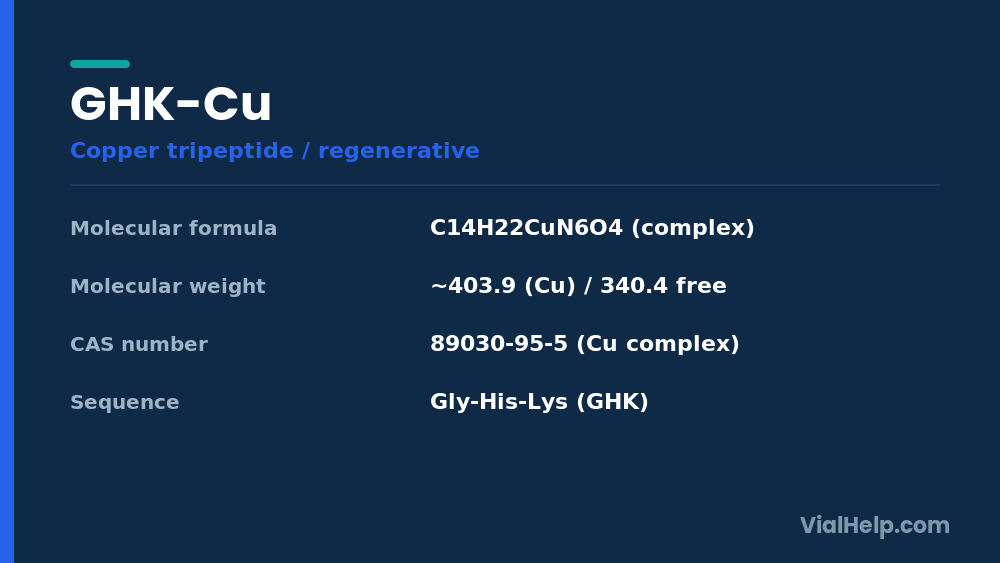
| CAS | 89030-95-5 (Cu complex); 49557-75-7 (free GHK) |
| Formula | C14H22CuN6O4 (complex); C14H24N6O4 (free GHK) |
| Molecular weight | ~403.9 g/mol (complex); 340.4 g/mol (free GHK) |
| Sequence | Gly-His-Lys (GHK) |
| Half-life | Not well established |
| Storage | Lyophilized: store cold and protected from light. Reconstituted: refrigerate (2–8 °C) and use within a limited window. |
In Plain English
GHK-Cu is a tiny peptide that carries copper and is found naturally in human blood. It seems to signal skin and connective tissue to make more collagen and repair themselves, which is why it shows up in many skincare products. Researchers study it for skin renewal, wound healing, and anti-aging.
GHK-Cu is a small copper-binding peptide — the tripeptide glycyl-L-histidyl-L-lysine (GHK) complexed with a copper(II) ion. First isolated from human plasma, GHK-Cu is widely studied in skin-science and tissue-repair research and is a common ingredient in cosmetic formulations. This page summarizes what GHK-Cu is and how it is described in the scientific literature, for informational purposes only.
How GHK-Cu works
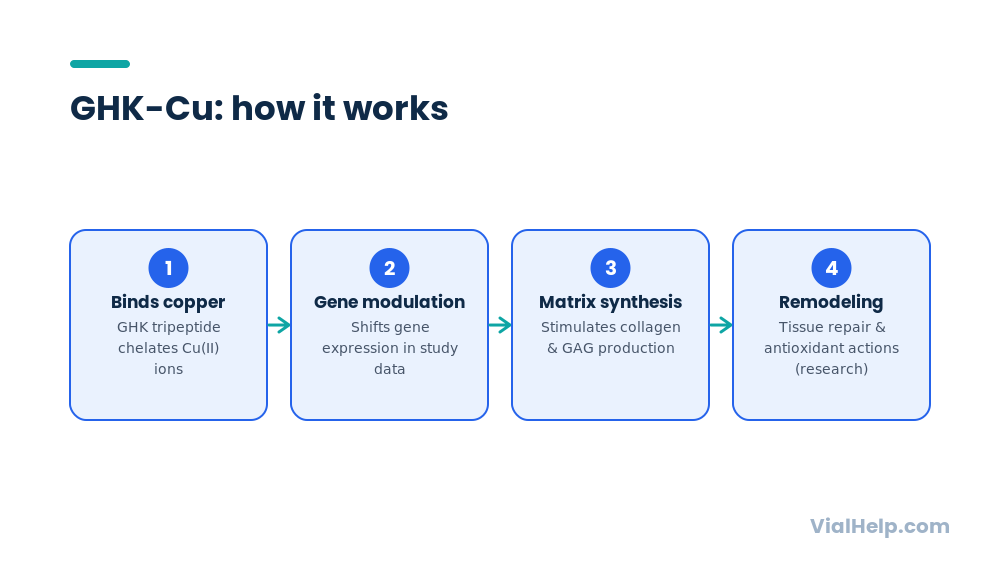
The GHK tripeptide has a strong affinity for copper(II) and readily forms the GHK-Cu complex. Researchers have proposed that GHK and GHK-Cu act partly as copper carriers and partly as signaling molecules: in study data the peptide influences the expression of large numbers of genes and supports dermal fibroblast function, stimulating synthesis of collagen, elastin, and glycosaminoglycans. These activities are why GHK-Cu is so often discussed in the context of skin and connective-tissue remodeling.
Reported effects in the research literature
Reviews of GHK and GHK-Cu describe a broad range of reported actions in cell and animal models, including stimulation of blood-vessel and nerve outgrowth, increased collagen and glycosaminoglycan synthesis, improved tissue repair in skin and other tissues, and antioxidant and anti-inflammatory activity. Levels of GHK in human plasma decline with age, which has prompted interest in its regenerative roles.
As with other research peptides, much of the strongest evidence is preclinical or relates to topical cosmetic use; broad clinical claims are not established, and GHK-Cu is not an approved medicine for treating any condition. The references below link to peer-reviewed reviews and compound data for further reading.
Handling and storage notes
Lyophilized GHK-Cu is typically stored cold and away from light, then refrigerated once reconstituted and used within a limited window. The characteristic blue color reflects the bound copper. To calculate concentration and volume after reconstitution, use the free VialHelp reconstitution calculator, the concentration & volume converter, and the protocol tracker. Browse the full peptide library for related compounds.
Related compounds and guides
- BPC-157 — a peptide commonly studied in tissue-repair research.
- TB-500 (thymosin β4) — actin-binding peptide investigated for cell migration and repair.
- Browse the full peptide library for more compound profiles.
- How to reconstitute peptides — step-by-step reconstitution method and concentration math.
- Sterile technique — aseptic handling and contamination prevention for research vials.
Share this article
References
For informational use only. Not medical advice; consult a qualified healthcare professional. 21+.
GHK-Cu reconstitution calculator
Use the calculator below to find the concentration (mg/mL), draw volume and U-100 syringe units for GHK-Cu once it is reconstituted with bacteriostatic water. GHK-Cu has molecular formula C14H22CuN6O4 (complex); C14H24N6O4 (free GHK) and a molecular weight of ~403.9 g/mol (complex); 340.4 g/mol (free GHK). Enter your vial amount and the water volume to see the lab math — informational use only, not dosing advice.