
Retatrutide
Summary
Retatrutide (LY3437943) is an investigational once-weekly triple agonist of the GLP-1, GIP and glucagon receptors, studied for obesity and metabolic disease with some of the largest weight reductions reported to date.
Quick facts
| Also known as | LY3437943 |
| Category | Metabolic / incretin (GIP/GLP-1/glucagon triple agonist) |
| Status | Investigational (Phase 3); not FDA-approved |
| CAS | 2381089-83-2 |
| Formula | C221H342N46O68 |
| Molecular weight | 4731.3 g/mol |
| Sequence | 39-residue synthetic analog of GIP (contains Aib residues and a C20 fatty-diacid chain) |
| Half-life | ~6 days (supports once-weekly dosing) |
| Storage | Lyophilized: store at -20C, protect from light. Reconstituted: 2-8C, avoid freeze-thaw. |
In Plain English
Retatrutide is an experimental peptide that copies three natural hormones involved in appetite and blood sugar. In early trials it produced very large weight loss. It is still being tested and is not yet an approved medicine.
Retatrutide (development code LY3437943) is an investigational, once-weekly peptide that has produced some of the largest weight reductions yet reported in obesity research. Developed by Eli Lilly, Retatrutide is the first “triple” hormone-receptor agonist to reach late-stage human trials, simultaneously activating the GLP-1, GIP and glucagon receptors. This page explains what Retatrutide is, how researchers describe its mechanism, and what the published human evidence actually shows.
What is Retatrutide?
Retatrutide is a 39-amino-acid synthetic peptide built on a modified GIP (glucose-dependent insulinotropic polypeptide) backbone. It is engineered with non-natural amino-acid residues (such as Aib) for enzymatic stability and carries a C20 fatty-diacid chain that binds albumin, extending its half-life to roughly six days and supporting once-weekly administration.
It belongs to the incretin/glucagon class of metabolic peptides and is frequently grouped with GLP-1 medicines such as semaglutide and the dual GIP/GLP-1 agonist tirzepatide. What sets Retatrutide apart is the addition of a third target, the glucagon receptor, layered on top of GLP-1 and GIP activity.
How Retatrutide is studied to work
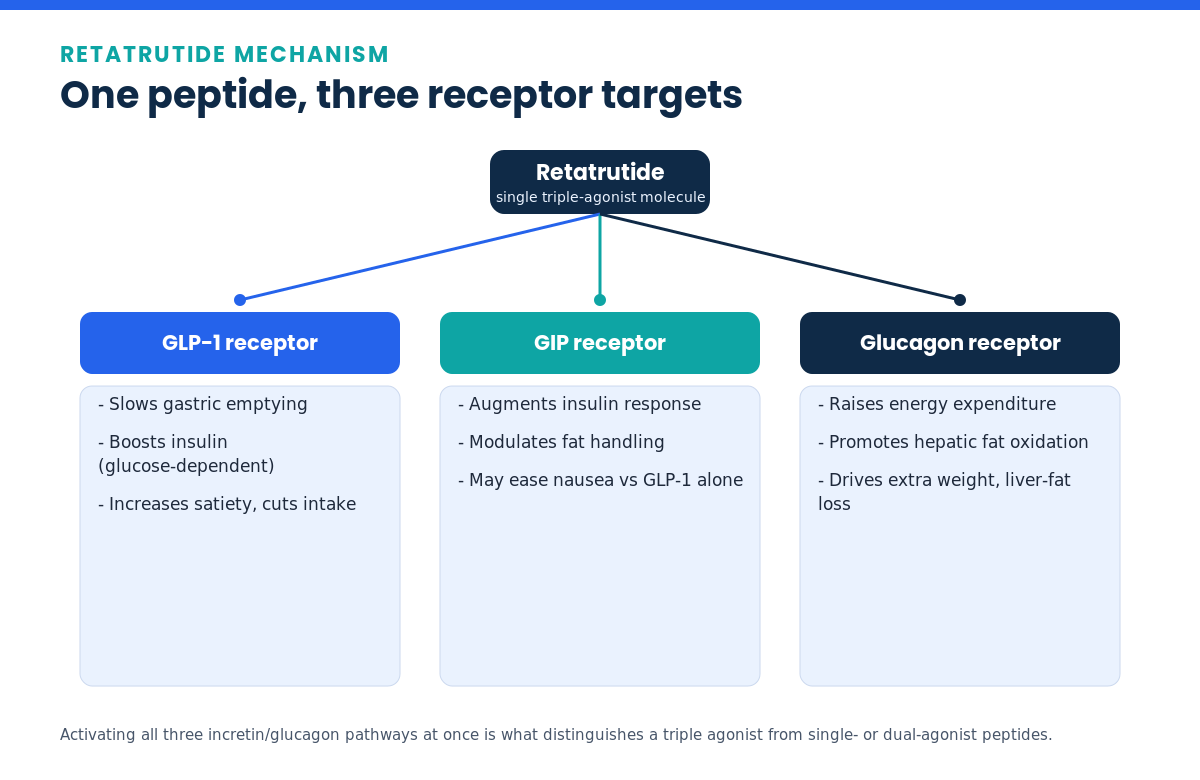
Retatrutide is described as a balanced triple agonist: a single molecule that switches on three different receptors that the body normally uses to regulate appetite, insulin and energy balance. Researchers propose that combining all three signals produces complementary effects that single- or dual-agonist peptides cannot match.
- GLP-1 receptor – slows gastric emptying, increases glucose-dependent insulin release, and promotes satiety, lowering food intake.
- GIP receptor – augments the insulin response to meals, influences fat handling, and may help temper the nausea associated with strong GLP-1 signaling.
- Glucagon receptor – increases energy expenditure and promotes breakdown of liver fat, a mechanism thought to drive the additional weight and hepatic-fat loss seen with Retatrutide.
- Albumin binding – the C20 fatty-diacid chain prolongs circulation time, enabling once-weekly dosing.
Reported effects and benefits in the research literature
In published clinical studies, the effects most commonly reported with Retatrutide include:
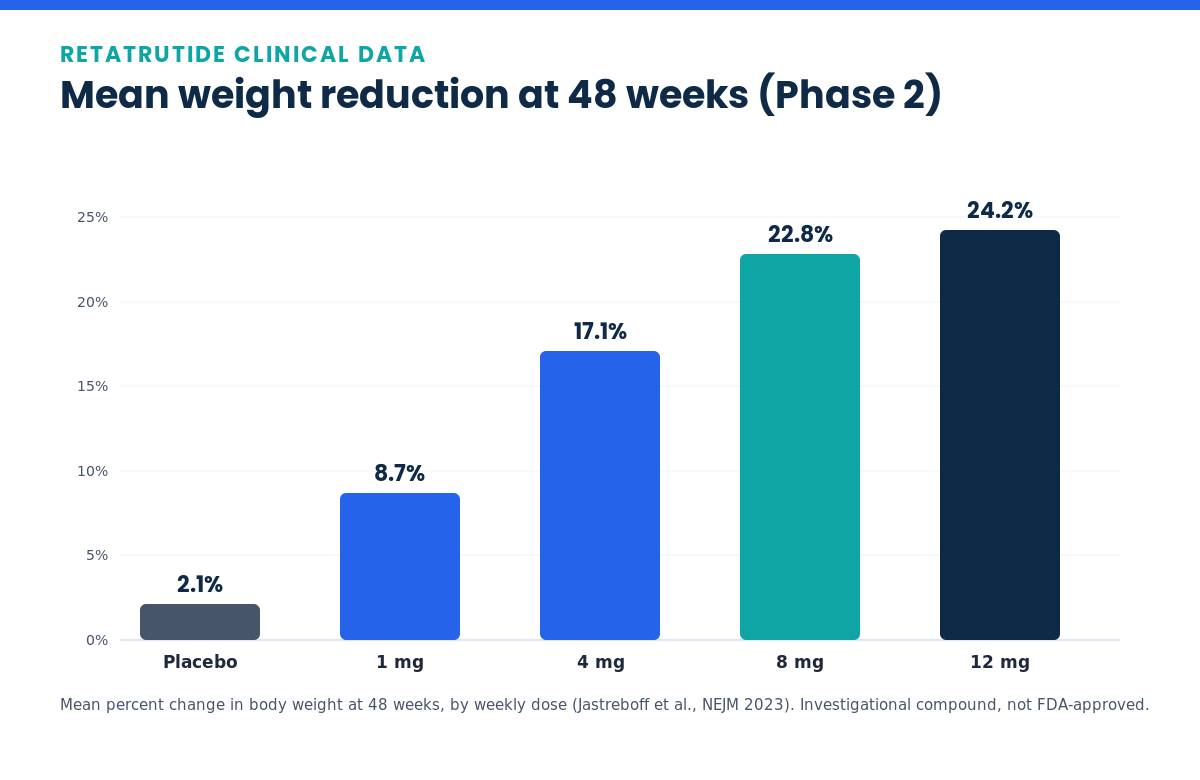
- Large body-weight reductions – mean reductions of roughly 24% at the highest dose over 48 weeks in the Phase 2 trial.
- Marked liver-fat reduction – substantial decreases in liver fat content, with most higher-dose participants reaching normal liver-fat levels.
- Improved glycemic markers – reductions in blood glucose and HbA1c in participants with type 2 diabetes.
- Cardiometabolic shifts – reported improvements in blood pressure, triglycerides and other lipid measures.
What this does not mean: these findings come from controlled clinical trials under medical supervision. Retatrutide is investigational and not approved for any use; the data do not establish long-term safety, and they are not a recommendation or a dosing protocol. This page is informational only and not medical advice.
What the human evidence shows
The pivotal Phase 2 trial, published in the New England Journal of Medicine in 2023 (Jastreboff et al.), randomized 338 adults with obesity to escalating doses or placebo over 48 weeks. The highest dose produced a mean weight reduction of about 24.2%, with a clear dose-response relationship and large reductions in liver fat.
Eli Lilly’s Phase 3 program, known as TRIUMPH, is underway and comprises multiple large trials enrolling thousands of participants across obesity, type 2 diabetes and cardiovascular-disease populations. As of 2026, Retatrutide remains investigational and has not been approved by the FDA or other major regulators. The most common adverse effects reported in trials are gastrointestinal – nausea, vomiting and diarrhea – consistent with the GLP-1 drug class and generally dose-related.
Handling, storage and reconstitution (research context)
- Lyophilized (freeze-dried): store cold and protected from light; long-term storage is typically at around -20°C.
- Reconstituted: keep refrigerated at 2–8°C and protect from light and repeated freeze-thaw cycles.
- Reconstitution: add bacteriostatic water gently down the vial wall and swirl rather than shake. Use the reconstitution calculator to work out concentration in mg/mL.
- Measurement: remember that syringe “units” are a volume mark, not a dose – see why units are not a dose.
Cautions and considerations
- Retatrutide is an investigational research compound, not an approved medicine.
- No standardized human dosing exists outside of clinical trials; this page provides no dosing guidance.
- Material sold outside regulated channels may vary in purity and identity – review a current Certificate of Analysis.
- Content here is informational only and not medical advice; consult a qualified healthcare professional. Intended for those 21 and over.
Frequently asked questions
Is Retatrutide FDA-approved?
No. As of 2026 Retatrutide is investigational and in Phase 3 trials; it has not been approved by the FDA or other major regulators.
How is Retatrutide different from semaglutide and tirzepatide?
Semaglutide targets the GLP-1 receptor and tirzepatide targets GLP-1 and GIP. Retatrutide adds a third target, the glucagon receptor, making it a triple agonist.
Why is Retatrutide dosed once weekly?
Its C20 fatty-diacid chain binds to albumin and extends the half-life to roughly six days, allowing once-weekly administration.
What are the most common side effects reported?
Gastrointestinal effects – nausea, vomiting and diarrhea – were the most common adverse events in trials, typically dose-related and consistent with the GLP-1 class.
Related compounds and further reading
- How to reconstitute peptides
- Sterile technique guide
- Semaglutide and Tirzepatide – related incretin compounds
- Browse the full peptide library
- VialHelp guides and how-tos
- IU vs mL: why units are not a dose
Share this article
References
- Jastreboff AM et al. Triple-Hormone-Receptor Agonist Retatrutide for Obesity – A Phase 2 Trial. NEJM 2023
- Retatrutide – Wikipedia
- Lilly Phase 2 retatrutide NEJM results (press release)
- ClinicalTrials.gov NCT05882045 – Retatrutide in obesity and cardiovascular disease (TRIUMPH)
- ClinicalTrials.gov NCT05929066 – Retatrutide in obesity or overweight
- Incretin triple agonist retatrutide – review (PMC11908972)
For informational use only. Not medical advice; consult a qualified healthcare professional. 21+.
Retatrutide reconstitution calculator
Use the calculator below to find the concentration (mg/mL), draw volume and U-100 syringe units for Retatrutide once it is reconstituted with bacteriostatic water. Retatrutide has molecular formula C221H342N46O68 and a molecular weight of 4731.3 g/mol. Enter your vial amount and the water volume to see the lab math — informational use only, not dosing advice.