
Cagrilintide
Summary
Cagrilintide (AM833) is a long-acting, once-weekly amylin analog developed as an investigational weight-management agent and the amylin component of CagriSema (with semaglutide). It activates amylin and calcitonin receptors to increase satiety. It is investigational and not FDA-approved.
Quick facts
| Also known as | AM833; NNC0174-0833; long-acting amylin analog |
| Category | Amylin analog (dual amylin & calcitonin receptor agonist) |
| Status | Investigational — not FDA-approved (Novo Nordisk phase 3 pipeline) |
| CAS | 1415456-99-3 |
| Formula | C194H312N54O59S2 |
| Molecular weight | ~4409 g/mol |
| Sequence | 37-amino-acid acylated amylin analog (C20 fatty-diacid acylation) |
| Half-life | ~7-8 days (supports once-weekly dosing) |
| Storage | Lyophilized: -20C, protect from light/moisture. Reconstituted: 2-8C, protect from light, avoid freeze-thaw. |
In Plain English
Cagrilintide is an experimental peptide that copies a natural hormone called amylin, which helps you feel full. It is being tested for weight loss, often alongside semaglutide. It is not yet an approved medicine.
Cagrilintide (development codes AM833 and NNC0174-0833) is a long-acting, once-weekly amylin analog developed by Novo Nordisk as an investigational weight-management agent. It is best known as the amylin half of CagriSema, the combination with semaglutide that has produced some of the largest weight-loss figures yet reported in obesity trials.
What is cagrilintide?
Cagrilintide is a synthetic analog of amylin, a hormone co-secreted with insulin by pancreatic beta cells that signals fullness after eating. It is a 37-amino-acid peptide built on an amylin-derived backbone and modified with a long (C20) fatty-diacid chain so that it binds albumin and lasts about a week in the body, allowing once-weekly subcutaneous dosing. Pharmacologically it is described as a dual amylin and calcitonin receptor agonist. Cagrilintide is investigational and is not an approved medicine.
How cagrilintide is studied to work
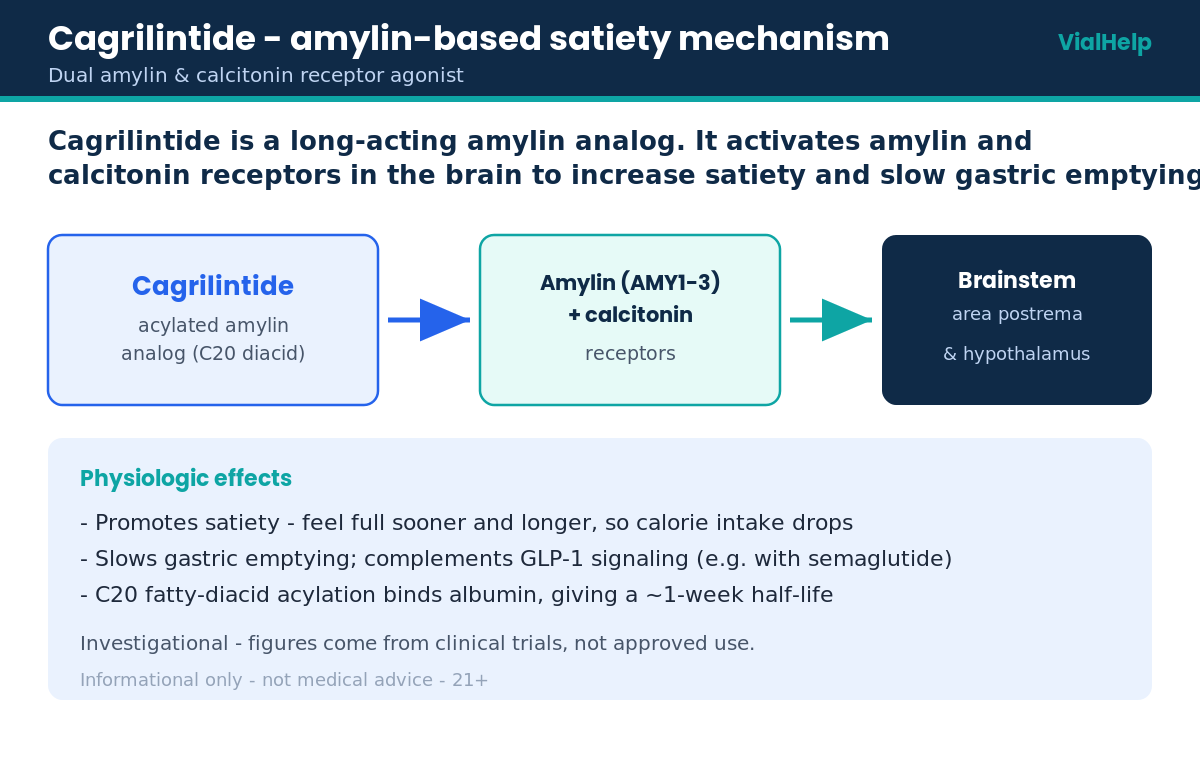
In plain terms, cagrilintide makes the body feel full sooner and stay full longer, so people tend to eat less. It does this by activating amylin and calcitonin receptors in brain regions that govern appetite.
- Amylin receptors (AMY1-3): formed by the calcitonin receptor paired with receptor-activity-modifying proteins (RAMPs).
- Calcitonin receptor: also directly activated, hence the “dual” description.
- Brainstem area postrema and hypothalamus: the central sites that control satiety and energy balance.
- Slowed gastric emptying and increased satiety: the core physiologic effects, which lower calorie intake.
- C20 acylation: reversible albumin binding that extends the half-life to about a week (the same strategy used by semaglutide).
Reported effects and benefits in the research literature
Cagrilintide has been studied both on its own and combined with semaglutide. Reported clinical findings include:
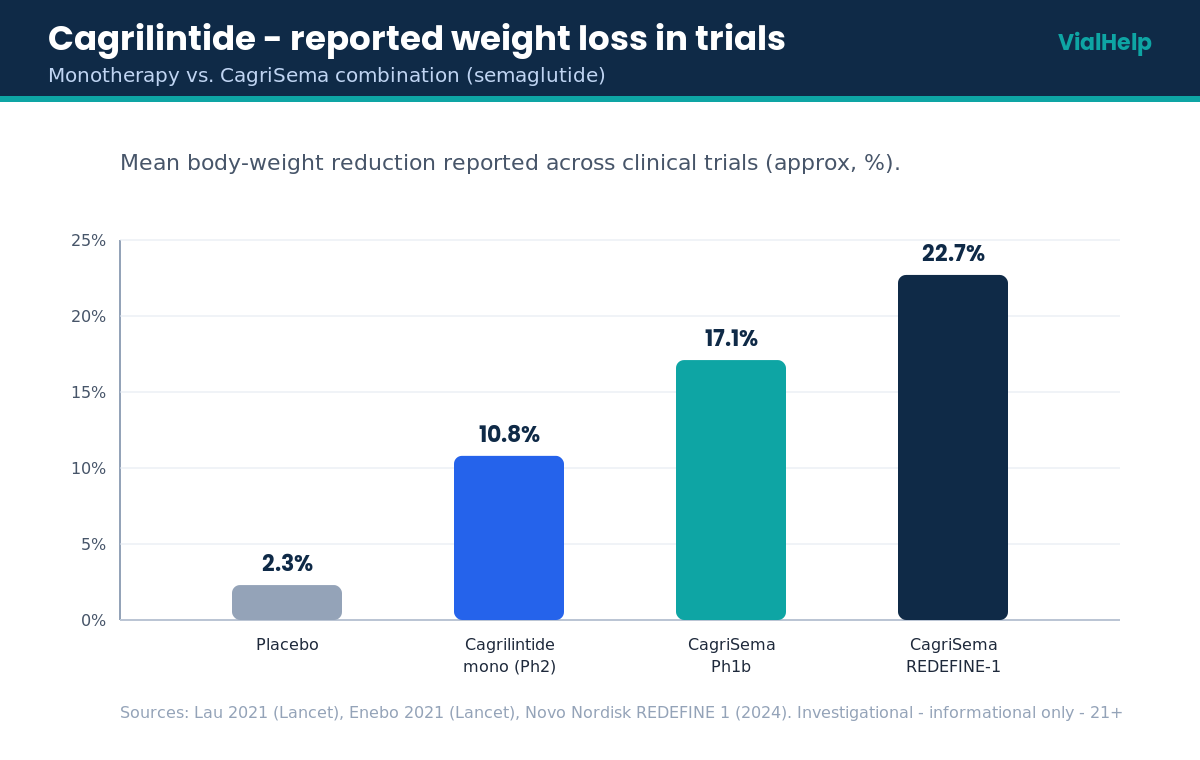
- Monotherapy weight loss: up to about 10.8% mean body-weight reduction at the 4.5 mg dose over 26 weeks in a phase 2 dose-finding trial (Lau 2021).
- Combination with semaglutide (CagriSema): about 17.1% over 20 weeks in an early phase 1b study (Enebo 2021).
- Phase 3 REDEFINE 1: roughly 22.7% weight loss at 68 weeks (trial-product estimand), versus about 16% for semaglutide alone and 2.3% for placebo.
- Appetite and satiety: reduced hunger and increased fullness, lowering food intake.
What this does not mean: cagrilintide is investigational, and these figures come from controlled clinical trials with medical supervision and gradual dose titration — not from approved, real-world use. In REDEFINE 1 only about 57% of participants reached the highest dose, and the combination fell short of the roughly 25% loss the company had signaled. The most common adverse events are gastrointestinal (usually mild to moderate), in line with the GLP-1/amylin class.
What the human evidence shows
Cagrilintide has a substantial and growing clinical dataset. A phase 1b study combined it with semaglutide 2.4 mg; a 706-participant phase 2 trial established monotherapy dose-response; and the large phase 3 REDEFINE program is evaluating CagriSema in obesity (REDEFINE 1, published in NEJM in 2025), in type 2 diabetes (REDEFINE 2), in a cardiovascular outcomes trial (REDEFINE 3), and head-to-head against tirzepatide (REDEFINE 4). As of 2025 cagrilintide and CagriSema remain investigational and are not FDA-approved; they are still in clinical development.
Handling, storage and reconstitution (research context)
- Lyophilized powder: reference-standard material is generally stored at -20°C, protected from light and moisture.
- Reconstituted solution: refrigerate at 2-8°C, protect from light, minimise agitation, and avoid repeated freeze-thaw cycles.
- Concentration math: calculate milligrams per millilitre before reconstituting with the reconstitution calculator; see IU vs mL for why a syringe unit is a volume.
- Compound-specific reconstituted-stability data are not published; the above are general handling norms for acylated peptide analogs.
Cautions and considerations
- Cagrilintide is investigational and not FDA-approved; reported outcomes occur under medical supervision in trials.
- The class is associated with gastrointestinal effects such as nausea, usually transient.
- Research material purity and identity vary; a Certificate of Analysis should accompany it.
- This page is informational only and is not medical advice.
Frequently asked questions
What is the difference between cagrilintide and semaglutide?
They are different hormone classes. Semaglutide is a GLP-1 receptor agonist; cagrilintide is an amylin analog. They are combined as CagriSema because they reduce appetite through complementary pathways.
What is CagriSema?
CagriSema is the fixed combination of cagrilintide and semaglutide. In the REDEFINE 1 trial it produced larger weight loss than either agent alone.
Is cagrilintide approved?
No. As of 2025 it is investigational and has not received FDA approval; it remains in phase 3 development.
How often is it dosed in trials?
Once weekly by subcutaneous injection — the long C20-acylated structure gives it an approximately one-week half-life.
Related compounds and further reading
- How to reconstitute peptides
- Sterile technique
- Semaglutide
- Tirzepatide
- Retatrutide
- Browse the full peptide library
- VialHelp guides
Share this article
References
- Cagrilintide (C194H312N54O59S2), CID 171397054 — PubChem
- Lau DCW, et al. Once-weekly cagrilintide for weight management: phase 2 dose-finding trial. Lancet 2021
- Enebo LB, et al. Cagrilintide with semaglutide 2.4 mg for weight management (phase 1b). Lancet 2021
- Novo Nordisk: CagriSema superior weight loss in REDEFINE 1 (Dec 2024)
- Kruse T, et al. Development of Cagrilintide, a Long-Acting Amylin Analogue. J Med Chem 2021
- Structural and mechanistic insights into dual activation of cagrilintide. Acta Pharmacol Sin 2025
For informational use only. Not medical advice; consult a qualified healthcare professional. 21+.
Cagrilintide reconstitution calculator
Use the calculator below to find the concentration (mg/mL), draw volume and U-100 syringe units for Cagrilintide once it is reconstituted with bacteriostatic water. Cagrilintide has molecular formula C194H312N54O59S2 and a molecular weight of ~4409 g/mol. Enter your vial amount and the water volume to see the lab math — informational use only, not dosing advice.