
PT-141
Summary
PT-141 (bremelanotide) is a cyclic seven-amino-acid melanocortin receptor agonist and the active metabolite of Melanotan II. Marketed as Vyleesi and FDA-approved in 2019 for hypoactive sexual desire disorder in premenopausal women, it acts centrally via MC4 receptors rather than on blood vessels.
Quick facts
| Also known as | Bremelanotide, PT-141, Vyleesi |
| Category | Melanocortin receptor (MC4) agonist |
| Status | FDA-approved (Vyleesi, 2019, for premenopausal HSDD); active research compound |
| CAS | 189691-06-3 |
| Formula | C50H68N14O10 |
| Molecular weight | 1025.2 g/mol |
| Sequence | Ac-Nle-cyclo[Asp-His-D-Phe-Arg-Trp-Lys]-OH (cyclic heptapeptide) |
| Half-life | ~2.7 hours (plasma) |
| Storage | Lyophilized: cold, dry, dark. Reconstituted: refrigerate 2–8 °C, protect from light, use promptly. |
In Plain English
PT-141 is a lab-made peptide that works in the brain rather than on blood vessels. It is an approved medicine for low sexual desire in some women. Researchers study it for sexual arousal and desire.
PT-141 (bremelanotide) is a melanocortin‑receptor‑agonist peptide best known as the active ingredient in Vyleesi, an FDA‑approved treatment from 2019. What makes it unusual is where it acts: rather than working on blood vessels like erectile‑function drugs, PT-141 acts centrally in the brain.
What is PT-141?
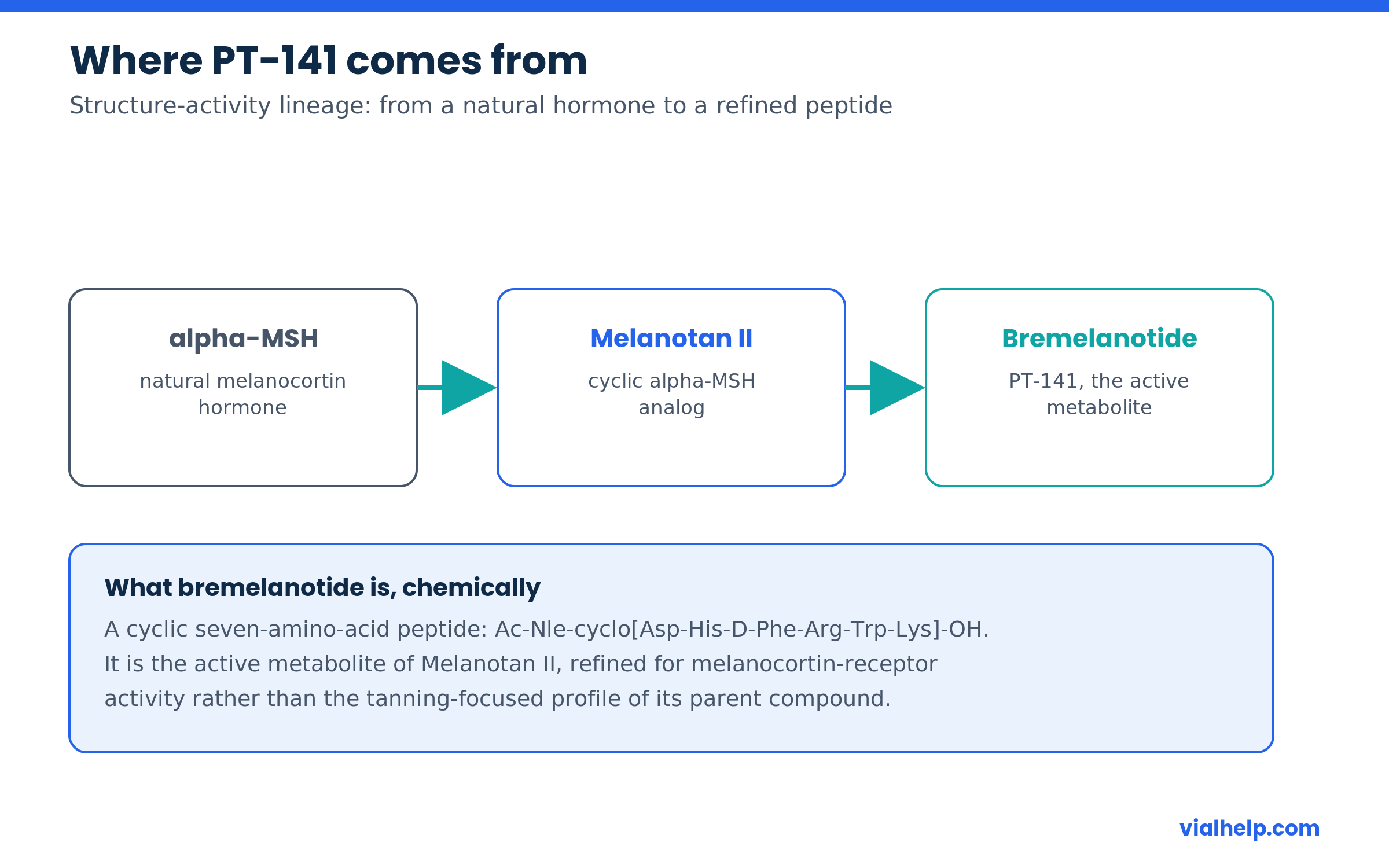
PT-141, generic name bremelanotide, is a cyclic seven‑amino‑acid peptide. It is the active metabolite of Melanotan II, which is itself a synthetic analog of alpha‑melanocyte‑stimulating hormone (α‑MSH), a natural melanocortin hormone. Chemically it is written Ac‑Nle‑cyclo[Asp‑His‑D‑Phe‑Arg‑Trp‑Lys]‑OH, with a ring closed by a lactam bridge between aspartate and lysine side chains.
It belongs to the melanocortin‑receptor‑agonist class. Under the brand Vyleesi it is supplied as a single‑use subcutaneous autoinjector delivering 1.75 mg in 0.3 mL, used on demand rather than daily.
How PT-141 is studied to work
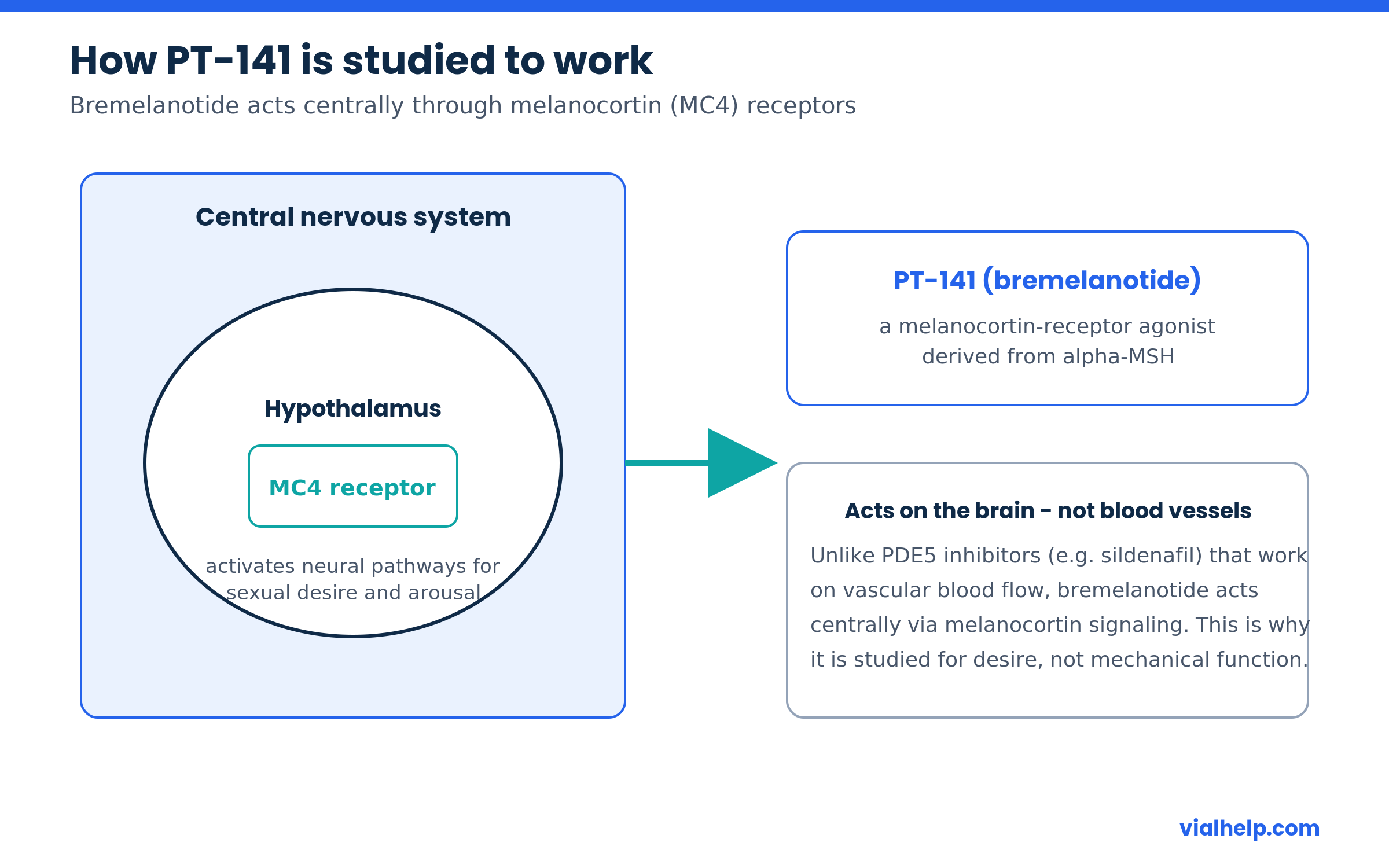
Bremelanotide is derived from α‑MSH and binds several melanocortin receptor subtypes, but its clinically relevant action is at the MC4 receptor in the central nervous system. Researchers describe its activity through these points:
- Melanocortin receptor binding — engages MC1R, MC3R and MC4R, with MC4R being the key target for its studied effects.
- Central (brain) action — activates MC4R in the hypothalamus and related limbic circuitry that governs sexual desire and arousal.
- Not a vascular mechanism — unlike PDE5 inhibitors (e.g. sildenafil), it does not work primarily by increasing genital blood flow.
- On‑demand pharmacology — a short plasma half‑life (about 2.7 hours) suits episodic, as‑needed use.
Reported effects and benefits in the research literature
In the published literature and regulatory record, bremelanotide has been associated with:
- Improvements in measures of sexual desire in premenopausal women with hypoactive sexual desire disorder (HSDD).
- Reductions in the distress associated with low desire, a co‑primary endpoint in its pivotal trials.
- A centrally‑mediated profile that distinguishes it from blood‑flow‑based therapies.
What this does not mean: the approved indication is narrow (premenopausal HSDD), the effect sizes in trials were modest, and much of the wider “research community” interest goes beyond what controlled human studies have established. Reported effects are not a guarantee of individual results, and this is not usage guidance.
What the human evidence shows
Bremelanotide’s pivotal evidence comes from the two Phase 3 RECONNECT trials in premenopausal women with HSDD, which supported FDA approval of Vyleesi on June 21, 2019. It became one of only a small number of approved therapies for female sexual dysfunction. The trials showed statistically significant improvements in desire and distress scores versus placebo, though the average benefit was modest and discontinuation due to side effects (notably nausea) was common.
The most frequently reported adverse effects in trials were nausea, flushing and headache; the label also notes transient increases in blood pressure and a decrease in heart rate after dosing, so it is not recommended for people with uncontrolled hypertension or known cardiovascular disease. A subset of users experienced focal skin hyperpigmentation, consistent with melanocortin activity.
Handling, storage and reconstitution (research context)
- Lyophilized powder: store cold, dry and away from light until reconstituted.
- Reconstituted solution: refrigerate at 2–8 °C, protect from light, and discard if discolored or cloudy.
- Introduce diluent gently down the vial wall and swirl rather than shake.
- Confirm concentration before measuring with our reconstitution calculator, and review the IU vs mL explainer to understand syringe markings.
Cautions and considerations
- Material sold as a “research compound” is not a quality‑controlled medicine; verify identity and purity against a Certificate of Analysis.
- The label warns of transient blood‑pressure increases; it is contraindicated in uncontrolled hypertension or cardiovascular disease.
- Nausea is the most common reported effect and a frequent reason for discontinuation in trials.
- Informational use only — not medical advice. Consult a qualified healthcare professional. 21+.
Frequently asked questions
Is PT-141 the same as Vyleesi?
Yes — Vyleesi is the brand name for bremelanotide (PT-141), supplied as a 1.75 mg subcutaneous autoinjector for premenopausal women with HSDD.
How is PT-141 different from drugs like sildenafil?
Sildenafil (a PDE5 inhibitor) acts on vascular blood flow. Bremelanotide acts centrally on melanocortin (MC4) receptors in the brain, which is why it is studied for desire rather than purely mechanical function.
What is PT-141 derived from?
It is the active metabolite of Melanotan II, a synthetic analog of the natural hormone α‑MSH.
Why is its half-life so short?
Bremelanotide clears from plasma in roughly 2–3 hours, which is why it is used on demand rather than on a daily schedule.
Related compounds and further reading
- How to reconstitute peptides
- Sterile technique
- Peptide storage and stability
- Browse the full peptide library · All guides
- IU vs mL: why units are not a dose
Share this article
References
For informational use only. Not medical advice; consult a qualified healthcare professional. 21+.
PT-141 reconstitution calculator
Use the calculator below to find the concentration (mg/mL), draw volume and U-100 syringe units for PT-141 once it is reconstituted with bacteriostatic water. PT-141 has molecular formula C50H68N14O10 and a molecular weight of 1025.2 g/mol. Enter your vial amount and the water volume to see the lab math — informational use only, not dosing advice.