
Semax
Summary
Semax is a synthetic heptapeptide developed in Russia as an analog of the ACTH(4–10) fragment, with a Pro-Gly-Pro tail that slows enzymatic breakdown. It is studied as a neuroprotective and nootropic compound and is a registered medicine in Russia, but has no FDA approval.
Quick facts
| Also known as | ACTH(4–10) Pro-Gly-Pro; Met-Glu-His-Phe-Pro-Gly-Pro |
| Category | Synthetic ACTH(4–10) analog (heptapeptide) |
| Status | No FDA approval (registered medicine in Russia); on the FDA PCAC July 23–24, 2026 agenda for the 503A bulks list |
| CAS | 80714-61-0 |
| Formula | C37H51N9O10S |
| Molecular weight | ≈813.9 g/mol (free acid) |
| Sequence | Met-Glu-His-Phe-Pro-Gly-Pro |
| Half-life | Parent peptide reported very short (minutes range); downstream effects persist longer (figures from secondary sources) |
| Storage | Generally lyophilized and frozen for long-term storage; reconstituted solutions refrigerated (specifics not from primary sources) |
In Plain English
Semax is a lab-made peptide developed in Russia, based on a small piece of a natural brain-and-stress hormone. It is studied for effects on focus, memory, and protecting brain cells. It is used as a medicine in Russia but is treated as a research compound elsewhere.
What is Semax?
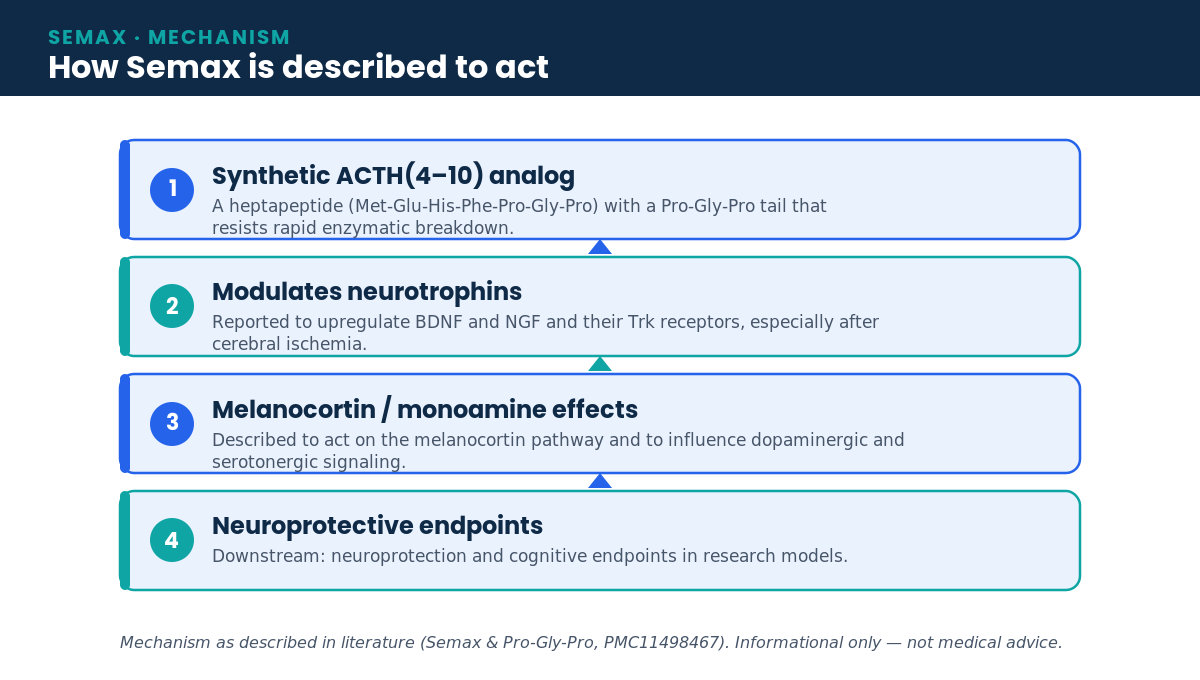
Semax is a synthetic heptapeptide (seven amino acids) developed in Russia at the Institute of Molecular Genetics of the Russian Academy of Sciences. Its design is based on a short fragment of adrenocorticotropic hormone, ACTH(4–10), with an added Pro-Gly-Pro tail. That tail is important: it slows the enzymatic breakdown that would otherwise rapidly destroy such a small peptide, giving Semax a longer-lasting biological signal than the bare ACTH fragment.
Semax is studied chiefly as a neuroprotective and nootropic (cognition-related) compound. It is a registered medicine in Russia and some neighboring countries, but it has not been approved by the FDA and is not an approved drug in the United States.
How Semax is described to work
A central theme in the Semax literature is modulation of neurotrophins — the growth factors that support neurons. Research reports that Semax upregulates the expression of brain-derived neurotrophic factor (BDNF) and nerve growth factor (NGF), along with their Trk receptors, particularly in models of cerebral ischemia. Because Semax derives from an ACTH fragment, it is also described as acting on the melanocortin/ACTH pathway.
Beyond neurotrophins, studies describe neuroprotective, anti-inflammatory, and monoaminergic effects (influencing dopamine and serotonin signaling). The Pro-Gly-Pro tail and its metabolites are thought to contribute both to stability and to some of the observed activity. As with most peptides, these are mechanistic descriptions from research models rather than settled clinical facts.
Reported effects and research areas
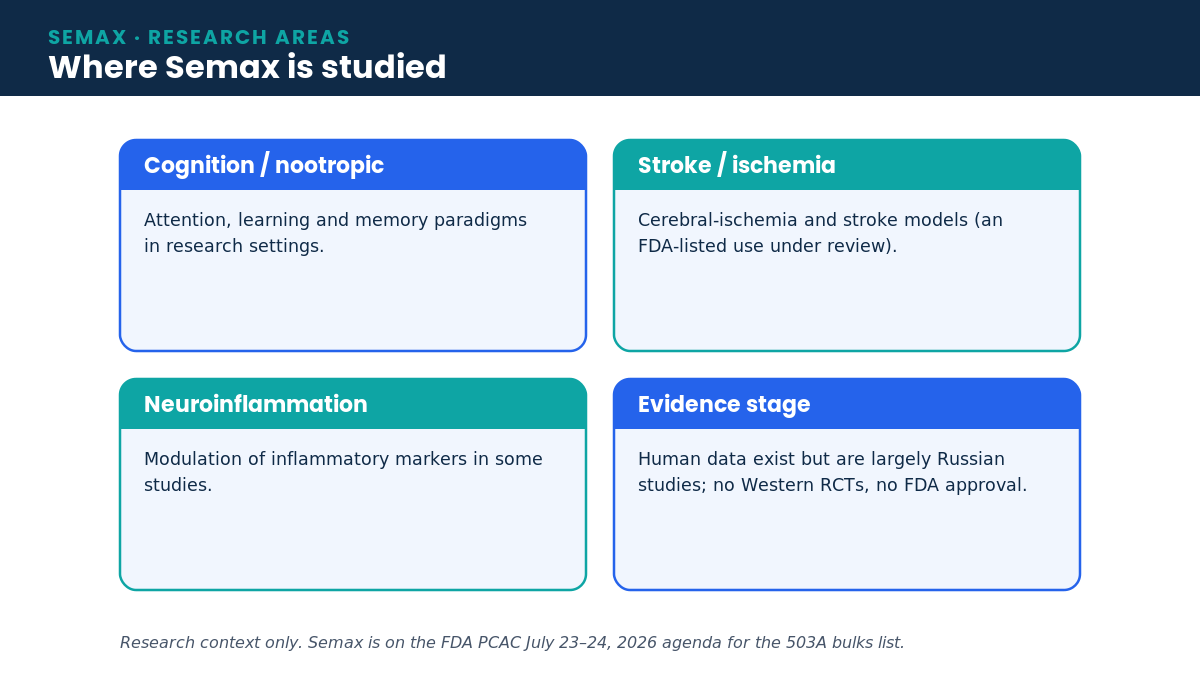
The Semax research literature spans cognitive and nootropic endpoints (attention, learning, and memory paradigms), neuroprotection in stroke and cerebral-ischemia models, and modulation of neuroinflammatory markers in some studies. These describe laboratory and clinical-research findings and are not claims that Semax treats or prevents any condition.
What the evidence shows
Human data on Semax exist, but they are predominantly from Russian-language studies and clinical practice (for example, in acute ischemic stroke and cognitive rehabilitation). There are no Western randomized controlled trials and no FDA evaluation or approval, and much of the mechanistic work is preclinical (rodent). Readers should weigh the evidence base accordingly.
Semax is one of seven peptides on the agenda for the FDA’s Pharmacy Compounding Advisory Committee (PCAC) meeting on July 23–24, 2026 (scheduled for Day 2), which is considering eligibility for compounding under section 503A. The uses listed for the Semax review include cerebral ischemia, migraine, and trigeminal neuralgia. PCAC recommendations are advisory and non-binding, and any 503A listing would require separate rulemaking.
Handling and storage
The parent peptide is reported to have a very short plasma half-life (described in the minutes range), while downstream neurotrophin effects are reported to persist longer; precise pharmacokinetic figures come largely from secondary sources and should be treated cautiously. Research peptides are generally kept lyophilized and frozen for longer-term storage, with reconstituted solutions refrigerated. This page does not provide human-use or dosing directions; for concentration math, see the tools linked below.
Cautions
Semax is discussed here strictly as a research compound, and nothing here is medical advice or guidance for human use. Because source quality varies, a batch-matched Certificate of Analysis covering identity, purity, and endotoxin testing is the most relevant document when evaluating any research peptide.
Frequently asked questions
What is Semax derived from?
It is a synthetic analog of the ACTH(4–10) fragment of adrenocorticotropic hormone, with an added Pro-Gly-Pro tail that improves its stability.
Is Semax FDA-approved?
No. Semax is a registered medicine in Russia but has no FDA approval. Its compounding status under 503A is what the July 23–24, 2026 PCAC meeting is reviewing. This page is informational only.
Why is BDNF mentioned so often with Semax?
Much of the Semax research focuses on its reported ability to raise BDNF and NGF expression, which is the basis for the neuroprotective and cognition-related effects studied in models.
Related compounds and further reading
Other peptides on the 2026 PCAC agenda include BPC-157 and TB-500. Browse the full peptide library and the latest peptide news on the PCAC review. Working with a vial? Use the reconstitution calculator, and read how to reconstitute peptides and sterile technique.
Share this article
References
For informational use only. Not medical advice; consult a qualified healthcare professional. 21+.
Semax reconstitution calculator
Use the calculator below to find the concentration (mg/mL), draw volume and U-100 syringe units for Semax once it is reconstituted with bacteriostatic water. Semax has molecular formula C37H51N9O10S and a molecular weight of ≈813.9 g/mol (free acid). Enter your vial amount and the water volume to see the lab math — informational use only, not dosing advice.