
MOTS-c
Summary
MOTS-c (Mitochondrial ORF of the 12S rRNA type-c) is a 16-amino-acid mitochondrial-derived peptide first described in 2015. It is studied as a regulator of metabolism and cellular stress, largely through activation of the energy sensor AMPK.
Quick facts
| Also known as | Mitochondrial ORF of the 12S rRNA type-c; MOTSc |
| Category | Mitochondrial-derived peptide (16 amino acids) |
| Status | Not FDA-approved; on the FDA PCAC July 23–24, 2026 agenda for the 503A bulks list |
| CAS | 1627580-64-6 |
| Formula | C101H152N28O22S2 |
| Molecular weight | ≈2,174.6 g/mol |
| Sequence | Met-Arg-Trp-Gln-Glu-Met-Gly-Tyr-Ile-Phe-Tyr-Pro-Arg-Lys-Leu-Arg (MRWQEMGYIFYPRKLR) |
| Half-life | Reported short (minutes range in rodent data); not firmly established in primary literature |
| Storage | Typically lyophilized and frozen for long-term storage; reconstituted solutions refrigerated and protected from freeze-thaw (specifics from secondary sources) |
In Plain English
MOTS-c is a tiny peptide made inside our cells’ energy factories (the mitochondria). It appears to help the body handle sugar and stay metabolically healthy, and natural levels drop as we age. Researchers study it for metabolism, exercise, and aging.
What is MOTS-c?
MOTS-c — short for “Mitochondrial ORF of the 12S rRNA type-c” — is a 16-amino-acid peptide that is unusual in where it comes from. Rather than being encoded by DNA in the cell nucleus, it is encoded within the mitochondrial genome, in a small open reading frame inside the 12S ribosomal RNA gene. It belongs to a class called mitochondrial-derived peptides (MDPs) and was first described by Lee and colleagues in 2015.
Because mitochondria are the cell’s energy hubs, MOTS-c has been studied as a signal that links mitochondrial status to whole-body metabolism. It is an investigational research compound with no approved therapeutic use.
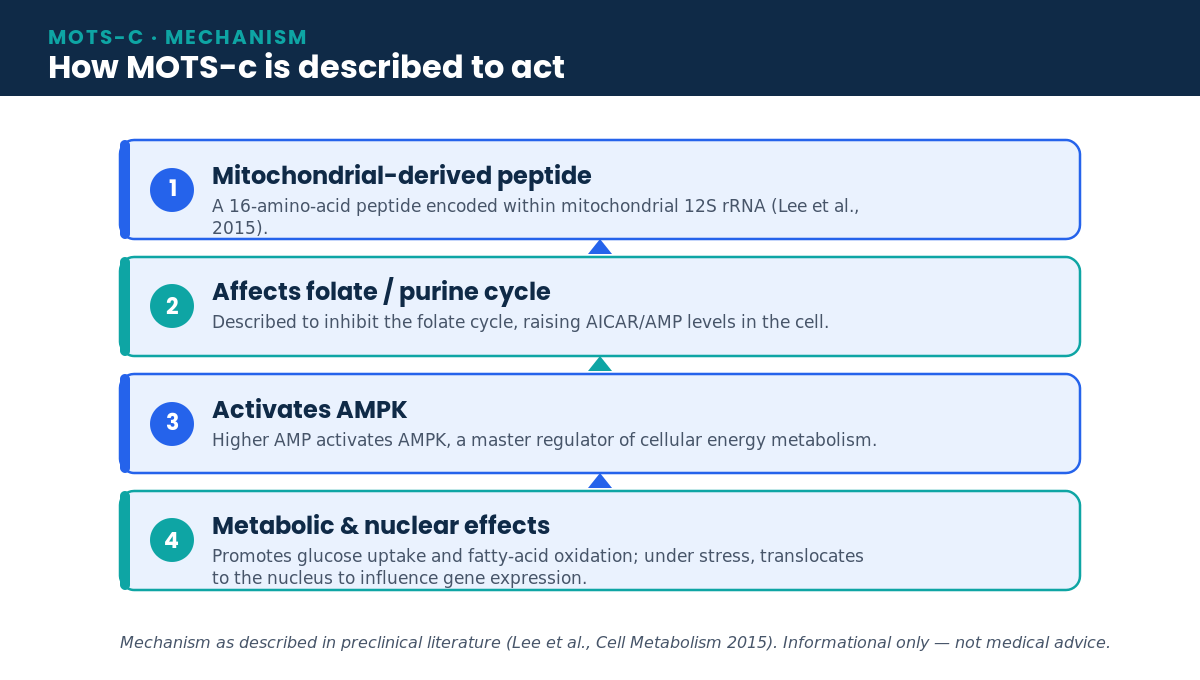
How MOTS-c is described to work
The most-cited mechanism centers on AMPK (AMP-activated protein kinase), a master regulator that cells use to sense and respond to low energy. Research describes MOTS-c interfering with the folate cycle and the linked de novo purine-synthesis pathway, which raises levels of intermediates such as AICAR and AMP and, in turn, activates AMPK.
Through AMPK and related signaling, MOTS-c is reported to promote glucose uptake and fatty-acid oxidation in metabolic tissues. Under metabolic stress, studies also describe MOTS-c translocating from the cytoplasm into the cell nucleus, where it is reported to influence stress-adaptive gene expression. Together these observations frame MOTS-c as a metabolic-regulator peptide in the research literature.
Reported effects and research areas
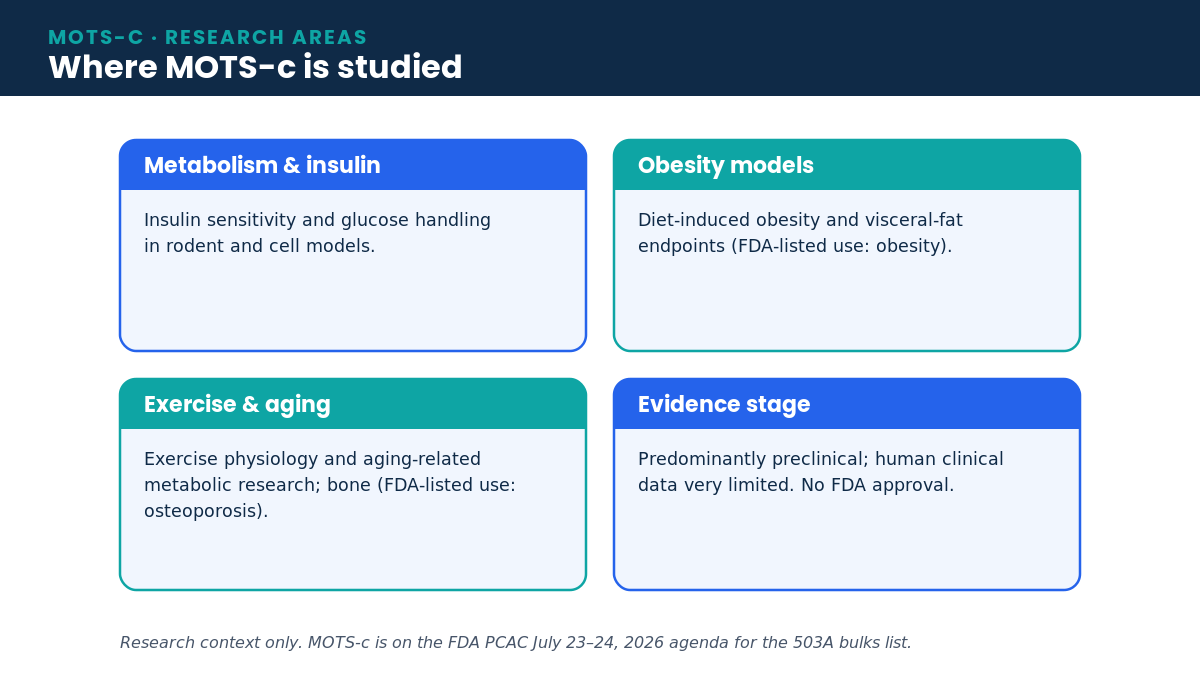
In rodent and cell models, the MOTS-c literature reports improvements in insulin sensitivity and glucose handling, reductions in diet-induced obesity and visceral fat, and roles in exercise physiology and aging-related metabolic research. These are descriptions of laboratory findings; they are not claims that MOTS-c treats or prevents any human condition.
What the evidence shows
MOTS-c research is predominantly preclinical, built on cell systems and animal models; human clinical-trial data are very limited. There is no FDA approval for MOTS-c. The mechanistic and metabolic findings above should be read as research observations rather than established clinical effects.
MOTS-c is one of seven peptides on the agenda for the FDA’s Pharmacy Compounding Advisory Committee (PCAC) meeting on July 23–24, 2026, which is considering whether certain peptides should be eligible for compounding under section 503A. In the FDA materials, the uses listed for the MOTS-c review are “obesity and osteoporosis.” PCAC recommendations are advisory and non-binding, and any 503A listing would require separate rulemaking.
Handling and storage
Reported plasma half-life for MOTS-c is short (described in the minutes range in some rodent data), but a firmly established value from primary pharmacokinetic studies is limited, so circulating figures should be treated cautiously. As with other research peptides, lyophilized material is generally kept frozen for longer-term storage, with reconstituted solutions refrigerated and protected from repeated freeze-thaw. For concentration and reconstitution math, see the tools linked below; this page does not provide human-use directions.
Cautions
MOTS-c is presented here only as a research compound, and none of this is medical advice or guidance for human use. Source quality varies, so a batch-matched Certificate of Analysis covering identity, purity, and endotoxin is the key document for evaluating any research peptide.
Frequently asked questions
What makes MOTS-c a “mitochondrial-derived” peptide?
Its coding sequence sits inside the mitochondrial 12S rRNA gene rather than in nuclear DNA, which is why it is grouped with mitochondrial-derived peptides (MDPs).
Is MOTS-c approved or legal to use?
MOTS-c is not FDA-approved. Whether it should be eligible for compounding under 503A is precisely what the July 23–24, 2026 PCAC meeting is reviewing. This page is informational only.
Why is AMPK central to MOTS-c research?
AMPK is a cellular energy sensor that boosts glucose uptake and fat oxidation when activated. Because MOTS-c is reported to activate AMPK, most of its studied metabolic effects are framed through that pathway.
Related compounds and further reading
Other peptides on the 2026 PCAC agenda: BPC-157, TB-500. Browse the full peptide library and the latest peptide news. Working with a vial? Use the reconstitution calculator, and read how to reconstitute peptides and sterile technique. For the other widely studied mitochondrial-derived peptide, see Humanin.
Share this article
References
- Mots-c (C101H152N28O22S2), PubChem CID 146675088
- Lee C et al., The Mitochondrial-Derived Peptide MOTS-c Promotes Metabolic Homeostasis, Cell Metabolism 2015
- MOTS-c: an equal opportunity insulin sensitizer (review), PMC
- FDA — July 23–24, 2026 PCAC Meeting agenda
- FDA PCAC Notice of Meeting (503A bulk substances), Federal Register 2026
- MOTS-c, CAS 1627580-64-6 — ChemicalBook
For informational use only. Not medical advice; consult a qualified healthcare professional. 21+.
MOTS-c reconstitution calculator
Use the calculator below to find the concentration (mg/mL), draw volume and U-100 syringe units for MOTS-c once it is reconstituted with bacteriostatic water. MOTS-c has molecular formula C101H152N28O22S2 and a molecular weight of ≈2,174.6 g/mol. Enter your vial amount and the water volume to see the lab math — informational use only, not dosing advice.