
Adipotide
Summary
Adipotide (FTPP) is an experimental peptidomimetic studied for fat loss. It targets the blood vessels feeding white fat, causing them to die back so fat is starved and resorbed. It showed strong weight loss in obese mice and monkeys but was barely tested in humans and is not FDA-approved.
Quick facts
| Also known as | FTPP; Prohibitin-targeting peptide 1; Prohibitin-TP01; CKGGRAKDC-GG-D(KLAKLAK)2 |
| Category | Metabolic / fat-loss (experimental) |
| Status | Investigational research compound — not FDA-approved |
| CAS | 859216-15-2 |
| Formula | C111H206N36O28S2 |
| Molecular weight | ~2611 g/mol (free peptide) |
| Sequence | CKGGRAKDC-GG-D(KLAKLAK)2 |
| Half-life | Not established in the published literature |
| Storage | Lyophilized: store frozen, desiccated, protected from light. Reconstituted: refrigerate and use within a short window (general peptide-handling guidance, not compound-specific data). |
In Plain English
Adipotide is an experimental peptide that researchers built to shrink body fat in an unusual way. Instead of acting on fat cells directly, it targets the tiny blood vessels that keep fat tissue alive and shuts them down, so the fat is starved of its blood supply and reabsorbed. In obese mice and monkeys it caused real weight loss, but it has barely been tested in people and caused kidney problems at higher doses. That mix of dramatic animal results and serious unanswered safety questions is why it is still studied and discussed.
Adipotide is an experimental fat-targeting peptide first described by researchers at MD Anderson Cancer Center in the mid-2000s. Rather than acting on fat cells themselves, it was designed to home in on the blood vessels that keep white fat tissue alive and shut them down. The approach produced dramatic weight loss in obese mice and monkeys, but human testing barely got off the ground, leaving Adipotide one of the most striking yet cautionary stories in metabolic peptide research.
What is Adipotide?
Adipotide is a synthetic peptidomimetic, also catalogued as FTPP or prohibitin-targeting peptide 1 (Prohibitin-TP01). It belongs to a class of chimeric, proapoptotic homing peptides built from two functional halves joined together. The first half is a short targeting sequence, CKGGRAKDC, that recognizes markers on the blood vessels supplying fat. The second half is a proapoptotic sequence, D(KLAKLAK)2, that can rupture a cell from the inside once it is delivered there. The concept and the targeting sequence trace back to work by Kolonin, Pasqualini, Arap and colleagues published in Nature Medicine in 2004. Because it carries D-amino acids and its mass depends on salt form, suppliers sometimes list slightly different molecular weights; the free-peptide formula catalogued by PubChem is C111H206N36O28S2.
How Adipotide is studied to work
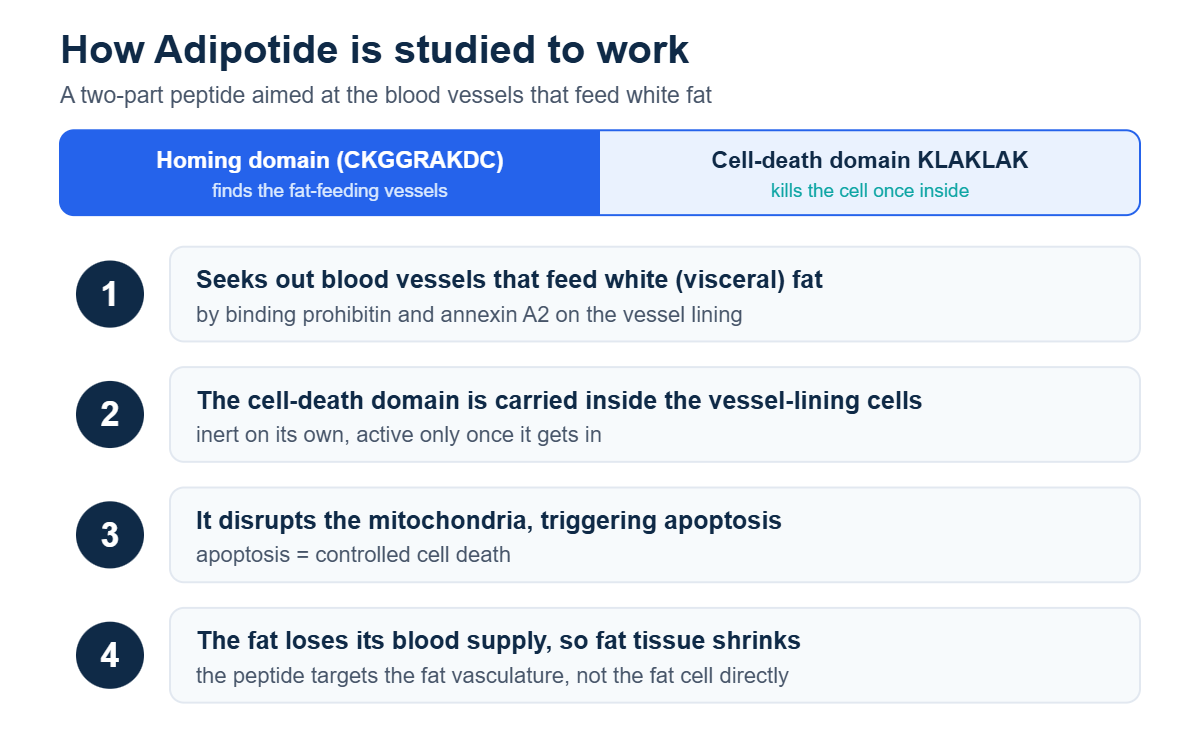
The design works like a guided delivery system. The targeting half seeks out prohibitin and annexin A2, two proteins that are unusually abundant on the lining of the blood vessels that feed white (visceral) fat. Once the peptide docks there, the cell-death half is carried inside the vessel-lining cells, where it disrupts their mitochondria and triggers apoptosis, a controlled form of cell death. As those vessels die back, the fat tissue they supplied loses its blood supply and gradually shrinks and is reabsorbed. In short, Adipotide is studied as a way to starve fat rather than to act on fat cells directly.
- Targets prohibitin and annexin A2 on the vasculature of white adipose tissue
- Delivers the proapoptotic D(KLAKLAK)2 sequence into vessel-lining (endothelial) cells
- Disrupts mitochondria, driving apoptosis of those cells
- Prunes the blood supply to fat, leading to fat resorption and weight loss
Reported effects and benefits in the research literature
In animal studies, the reported effects have been substantial:
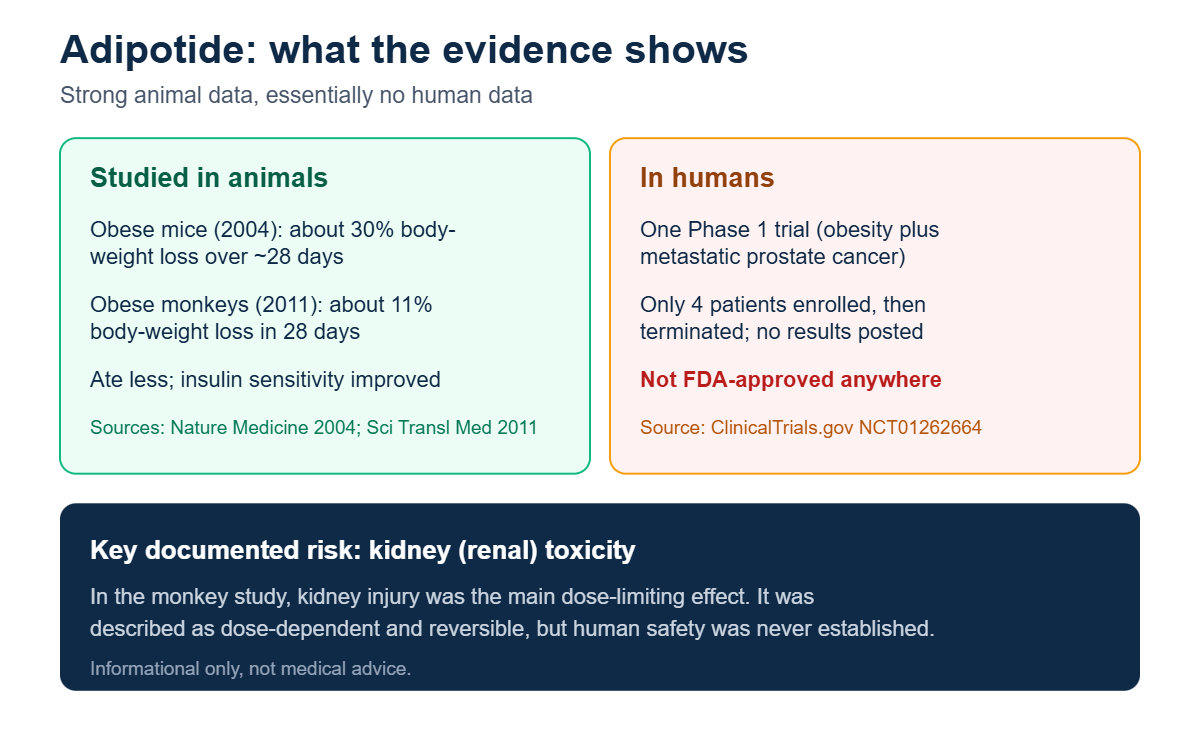
- Obese mice (Nature Medicine, 2004): roughly a 30% reduction in body weight over about four weeks of dosing, with resorption of white fat
- Spontaneously obese rhesus monkeys (Science Translational Medicine, 2011): about 11% body-weight loss over 28 days of daily subcutaneous dosing
- Reduced food intake and smaller abdominal circumference in the monkey study
- Improved insulin sensitivity alongside the fat loss
- Imaging indicated the loss was of fat mass rather than lean tissue
What this does not mean: these are animal findings from small studies, not evidence that Adipotide is a safe or effective weight-loss treatment in humans. The animal results are striking, but striking preclinical data frequently fail to carry over to people, and in Adipotide’s case human testing was never completed.
What the human evidence shows
Human evidence is essentially absent. A single Phase 1 trial (NCT01262664), run by MD Anderson, tested Adipotide in patients who had both obesity and metastatic prostate cancer, using a low starting dose given under the skin. The study was designed for roughly 39 participants but enrolled only 4 before it was terminated, and no results were ever posted or published in a peer-reviewed journal. As a result, there is no confirmed human data on how well it works or how safe it is. Adipotide is not approved by the FDA, or any regulator, for any use, and the trial record itself described the compound as experimental and for research purposes only.
Handling, storage and reconstitution (research context)
There is no established, compound-specific stability or pharmacokinetic data for Adipotide in the published literature, so any handling guidance is general peptide practice rather than verified fact:
- Lyophilized (freeze-dried) material is generally stored frozen, kept dry (desiccated) and protected from light
- Once reconstituted, peptide solutions are typically refrigerated and used within a limited window
- Bacteriostatic water is the usual diluent for multi-use reconstitution in a research setting
- Concentration is what matters for any measurement: use the reconstitution calculator to turn vial mass and diluent volume into mg/mL, and the units explainer for why the marks on a syringe are a volume, not a dose
Cautions and considerations
- Research compound only: Adipotide is investigational and not approved for human use anywhere
- Kidney risk: the main dose-limiting toxicity in the monkey study was dose-dependent kidney (renal) injury, described as reversible in that study but never characterized in humans
- No human safety profile: with only four patients ever dosed and no published results, human risks are genuinely unknown
- Purity and identity: as with any research peptide, a certificate of analysis (COA) and third-party testing matter, since identity and purity cannot be assumed
- Informational only: this page summarizes published research and is not medical advice
Frequently asked questions
Is Adipotide approved or available as a weight-loss drug?
No. It is an experimental research compound with no regulatory approval anywhere, and it is not a prescribed or over-the-counter weight-loss medicine.
How is Adipotide different from GLP-1 drugs like semaglutide?
Completely different. GLP-1 receptor agonists work through appetite and metabolic signaling, while Adipotide was designed to destroy the blood vessels that feed fat tissue. Adipotide also lacks the human trial evidence that GLP-1 drugs have.
What happened in the human trial?
A single Phase 1 study enrolled only 4 of a planned ~39 patients and was terminated with no results posted, so it produced no usable efficacy or safety data.
What is the biggest documented risk?
In animals, dose-dependent kidney toxicity was the key concern. It appeared reversible in the monkey study, but its effect in humans was never established.
Related compounds and further reading
- How to reconstitute peptides
- Sterile technique
- AOD-9604 — another fragment studied for fat loss
- Semaglutide and Tirzepatide — approved metabolic peptides
- Retatrutide — an investigational triple agonist
- Browse the full Library and Guides
- IU vs mL: why units are not a dose
Share this article
References
- Kolonin MG, et al. Reversal of obesity by targeted ablation of adipose tissue. Nature Medicine 2004.
- Barnhart KF, et al. A peptidomimetic targeting white fat causes weight loss and improved insulin resistance in obese monkeys. Science Translational Medicine 2011.
- PubChem — Adipotide, CID 163360068.
- ClinicalTrials.gov — NCT01262664 (Phase 1, terminated).
- Wikipedia — Prohibitin-targeting peptide 1 (Adipotide).
- MD Anderson / ScienceDaily (2011) — Obese monkeys lose weight on adipotide.
For informational use only. Not medical advice; consult a qualified healthcare professional. 21+.
Adipotide reconstitution calculator
Use the calculator below to find the concentration (mg/mL), draw volume and U-100 syringe units for Adipotide once it is reconstituted with bacteriostatic water. Adipotide has molecular formula C111H206N36O28S2 and a molecular weight of ~2611 g/mol (free peptide). Enter your vial amount and the water volume to see the lab math — informational use only, not dosing advice.