
Gonadorelin
Summary
Gonadorelin is a synthetic decapeptide identical to natural gonadotropin-releasing hormone (GnRH/LHRH) that, when delivered in pulses, stimulates the pituitary to release LH and FSH; it has a documented diagnostic history as the GnRH stimulation agent Factrel.
Quick facts
| Also known as | GnRH; LHRH; Gonadotropin-releasing hormone; Luteinizing hormone-releasing hormone; Factrel; Gonadorelin acetate |
| Category | GnRH / hypothalamic releasing peptide |
| Status | Research/reference compound; historically FDA-approved (Factrel) for diagnostic GnRH stimulation testing; original branded product withdrawn from the U.S. market |
| CAS | 9034-40-6 (gonadorelin); 71447-49-9 (acetate salt) |
| Formula | C55H75N17O13 |
| Molecular weight | 1182.3 g/mol |
| Sequence | Pyr-His-Trp-Ser-Tyr-Gly-Leu-Arg-Pro-Gly-NH2 (pyroglutamyl decapeptide) |
| Half-life | ~2-10 min distribution; ~10-40 min terminal (very short) |
| Storage | Lyophilized: refrigerate 2-8 C (or freeze -20 C) protected from light; reconstituted: refrigerate 2-8 C, avoid freeze-thaw |
In Plain English
Gonadorelin is a lab-made copy of the natural signal that tells the body to start making sex hormones. Doctors have used it to test or jump-start that hormone system. Researchers study it for fertility and hormone questions.
Gonadorelin is a synthetic decapeptide that is structurally identical to gonadotropin-releasing hormone (GnRH), the small hypothalamic hormone that controls the body’s reproductive axis. Because Gonadorelin reproduces the exact ten-amino-acid sequence of natural GnRH, it has been used for decades as a research and diagnostic tool for probing how the pituitary gland responds to GnRH stimulation. This page is an informational reference profile and is not medical advice.
What is Gonadorelin?
Gonadorelin (also written GnRH or LHRH, luteinizing hormone-releasing hormone) is the manufactured equivalent of the gonadotropin-releasing hormone produced naturally in the hypothalamus. It is a short peptide of ten amino acids with the sequence Pyr-His-Trp-Ser-Tyr-Gly-Leu-Arg-Pro-Gly-NH2, where the N-terminus is a pyroglutamate and the C-terminus is amidated. Its molecular formula is C55H75N17O13 with a molecular weight of approximately 1182.3 g/mol (PubChem CID 638793; CAS 9034-40-6).
Unlike the long-acting GnRH analogs used in oncology and fertility medicine, Gonadorelin is not chemically modified to resist breakdown. It is the native sequence, so the body clears it very quickly. Historically it reached the clinic under the brand name Factrel as a diagnostic agent for evaluating pituitary gonadotrope function, although the original branded product was later withdrawn from the U.S. market. In a research context it is most often encountered as the lyophilized acetate salt.

How Gonadorelin is studied to work
Gonadorelin sits at the top of the hypothalamic-pituitary-gonadal (HPG) axis. In the literature its action is described through a well-characterized signaling cascade:
- Gonadorelin binds GnRH receptors (also called LHRH receptors) on the gonadotrope cells of the anterior pituitary.
- This binding triggers the synthesis and release of two gonadotropins: luteinizing hormone (LH) and follicle-stimulating hormone (FSH).
- LH and FSH then act on the gonads, where in males they support testosterone and sperm production and in females they regulate the menstrual cycle and ovulation.
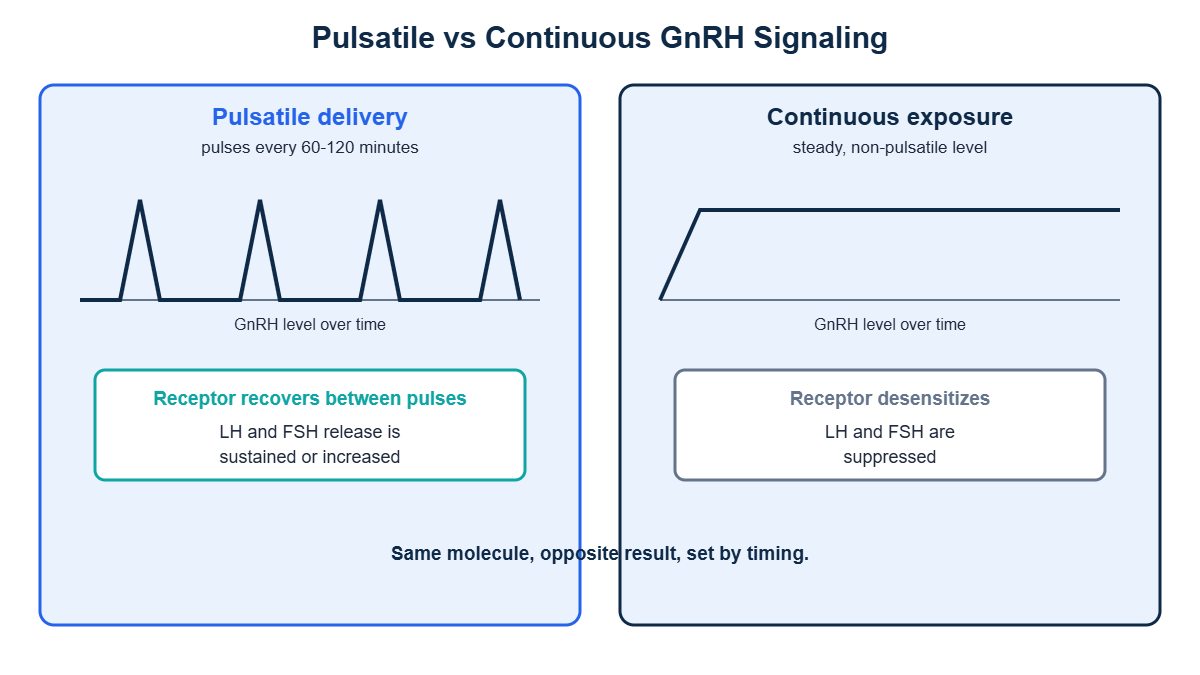
- The critical variable is timing. Natural GnRH is released in discrete pulses roughly every 60-120 minutes, and the receptor recovers between pulses.
- Pulsatile delivery sustains or upregulates the GnRH receptor and keeps LH and FSH output going, whereas continuous, non-pulsatile exposure desensitizes the receptor and paradoxically suppresses LH and FSH.
This pulsatile-versus-continuous distinction is the single most important concept in GnRH pharmacology. The same molecule can either stimulate or shut down the reproductive axis depending entirely on how it is delivered over time.
Reported effects in the research literature
Across endocrinology research and the historical clinical record, Gonadorelin is associated with several reproducible observations:
- A single dose produces a measurable, time-limited rise in serum LH (and a smaller FSH response) in subjects with an intact, responsive pituitary, which is the basis of the GnRH stimulation test.
- When delivered by pump in physiological pulses, it has been studied for restoring gonadotropin secretion in certain forms of hypothalamic dysfunction.
- Its effects are inherently transient because of its very short half-life: a distribution half-life of roughly 2-10 minutes and a terminal half-life on the order of 10-40 minutes.
- Response magnitude depends on background sex-steroid feedback and on the prior pulse history of the axis, so identical doses can yield different LH outputs in different physiological states.
What this does not mean: a documented LH/FSH response in a controlled study does not establish that Gonadorelin is safe or effective for self-administered use, performance enhancement, or any unsupervised purpose. The diagnostic and pulsatile uses described here occurred under clinical supervision with monitoring. Nothing on this page is a protocol or a recommendation to use Gonadorelin.
What the human evidence shows
The strongest human evidence for Gonadorelin is in the diagnostic domain. Its FDA-approved historical indication (as Factrel) was to evaluate the functional capacity and reserve of the anterior-pituitary gonadotropes: a single injection followed by serial LH measurements helps distinguish a pituitary problem from a hypothalamic one and can assess residual function after pituitary surgery or irradiation. This is a well-established, decades-old clinical use rather than a speculative one.
Pulsatile Gonadorelin delivered by programmable pump has also been studied and used in select reproductive-medicine settings to induce ovulation or support spermatogenesis in patients whose hypothalamus fails to generate adequate GnRH pulses. Because it requires specialized equipment, continuous supervision, and physiological pulse timing, this remains a narrow, specialist application. Beyond these contexts, rigorous human outcome data supporting other claimed benefits are limited, and much of the broader interest in Gonadorelin is extrapolated from its mechanism rather than from controlled trials.
Handling, storage and reconstitution (research context)
The following reflects general peptide-handling practice reported for research material and is provided for informational completeness, not as a usage instruction:
- Lyophilized Gonadorelin is typically stored cold and protected from light. Refrigeration at 2-8 C is common for near-term storage, and freezing at -20 C is used for longer-term storage.
- Published stability work on gonadorelin acetate found the lyophilized powder remarkably stable, retaining quality for extended periods even at room temperature, though cold storage remains the conservative default.
- After reconstitution with an appropriate sterile diluent, the solution is generally kept refrigerated at 2-8 C and used within a limited window.
- Repeated freeze-thaw cycles of the reconstituted solution are avoided because they can degrade peptide integrity.
- High-purity, well-characterized material is emphasized in research settings because degradation products and impurities have been discussed as potential contributors to adverse reactions.
Cautions and considerations
- This is reference information for adults 21 and older. It is not medical advice, and it is not an endorsement, recommendation, or protocol for using Gonadorelin.
- VialHelp does not sell peptides and does not direct readers to vendors.
- The stimulating versus suppressing behavior of GnRH depends entirely on delivery pattern; misjudging pulsatile versus continuous exposure can produce the opposite of an intended effect.
- Reported adverse events in the clinical and infusion literature include local injection reactions and, rarely, hypersensitivity.
- GnRH-axis manipulation interacts with the entire reproductive and endocrine system, so any human use belongs under qualified medical supervision with appropriate monitoring.
Frequently asked questions
Is Gonadorelin the same as GnRH?
Yes, in sequence. Gonadorelin is a synthetic decapeptide with the identical amino-acid sequence to natural gonadotropin-releasing hormone (GnRH, also called LHRH). It is the native sequence rather than a modified long-acting analog, which is why it is cleared from the body very quickly.
Why does pulsatile delivery matter so much?
The GnRH receptor needs to recover between exposures. Pulses spaced roughly 60-120 minutes apart keep the receptor responsive and maintain LH and FSH release. Continuous exposure desensitizes the receptor and suppresses gonadotropins, so the same molecule can stimulate or shut down the axis depending on timing.
What was Gonadorelin historically used for?
Its established clinical role was diagnostic: as Factrel it was used in the GnRH stimulation test to assess anterior-pituitary gonadotrope function and to evaluate residual pituitary function after surgery or radiation. Pulsatile-pump delivery was also studied in select reproductive-medicine settings.
How is Gonadorelin stored?
Lyophilized material is generally refrigerated at 2-8 C or frozen at -20 C and protected from light. Once reconstituted, solutions are typically refrigerated and used within a limited window while avoiding freeze-thaw cycles. This is general handling information, not a usage instruction.
Related compounds and further reading
- How to reconstitute peptides
- Sterile technique
- Browse the full peptide library
- Reconstitution calculator
Share this article
References
- Gonadorelin. PubChem Compound Summary, CID 638793. NLM 2026
- Gonadorelin (DB00644). DrugBank Online 2026
- FACTREL (gonadorelin hydrochloride) injection – prescribing information. DailyMed, NLM 2024
- Gonadorelin. Wikipedia 2026
- Stability and purity profile of gonadorelin acetate. J Pharm Biomed Anal 1990
- Determination of half-lives of circulating FSH and LH glycoforms during GnRH receptor blockade. J Endocr Soc 2022
For informational use only. Not medical advice; consult a qualified healthcare professional. 21+.
Gonadorelin reconstitution calculator
Use the calculator below to find the concentration (mg/mL), draw volume and U-100 syringe units for Gonadorelin once it is reconstituted with bacteriostatic water. Gonadorelin has molecular formula C55H75N17O13 and a molecular weight of 1182.3 g/mol. Enter your vial amount and the water volume to see the lab math — informational use only, not dosing advice.