
Selank
Summary
Selank is a synthetic anxiolytic heptapeptide derived from the immune peptide Tuftsin, developed at the Institute of Molecular Genetics of the Russian Academy of Sciences. Adding a C-terminal Pro-Gly-Pro sequence to Tuftsin greatly improves its metabolic stability. In research it is studied for effects on the GABA and serotonin systems, BDNF expression, and enkephalin metabolism. Selank is approved as a medicine in Russia but is not FDA-approved. This profile is informational only and not medical advice.
Quick facts
| Also known as | TP-7, Tuftsin-PGP |
| Category | Anxiolytic / nootropic heptapeptide (Tuftsin analog) |
| Status | Approved as a medicine in the Russian Federation for anxiety/neurasthenia; not FDA-approved; not an approved drug or supplement in the U.S. Research/reference use only. |
| CAS | 129954-34-3 |
| Formula | C33H57N11O9 |
| Molecular weight | 751.9 g/mol |
| Sequence | Thr-Lys-Pro-Arg-Pro-Gly-Pro (TKPRPGP) |
| Half-life | Very short in plasma (~minutes); the C-terminal Pro-Gly-Pro extension makes it markedly more stable than parent Tuftsin |
| Storage | Lyophilized powder stored frozen and protected from light; reconstituted peptide kept refrigerated and used within a short window per laboratory practice |
In Plain English
Selank is a lab-made peptide based on a natural calming molecule in the body. It is studied for easing anxiety and supporting focus without the drowsiness of typical anti-anxiety drugs. It is used in Russia but is a research compound elsewhere.
Selank is a synthetic anxiolytic heptapeptide developed in Russia and studied for its calming and cognitive effects without the sedation associated with conventional anxiety medicines. It was designed at the Institute of Molecular Genetics of the Russian Academy of Sciences as a stabilized analog of Tuftsin, a naturally occurring four-amino-acid immune peptide. By attaching a C-terminal Pro-Gly-Pro sequence to the Tuftsin core, researchers created a molecule (sometimes called TP-7) that resists rapid enzymatic breakdown far better than Tuftsin itself. This page is an informational reference profile only and is not medical advice.
What is Selank?
Selank is a seven-amino-acid peptide with the sequence Thr-Lys-Pro-Arg-Pro-Gly-Pro (TKPRPGP). Its first four residues correspond to Tuftsin (Thr-Lys-Pro-Arg), a peptide fragment that occurs naturally as part of the antibody molecule and has long been studied for immune-modulating activity. Tuftsin on its own is broken down extremely quickly in the body, which limits its usefulness. The added Pro-Gly-Pro tail in Selank shields the molecule from peptidases, giving it greater metabolic stability and a more sustained biological effect.
In its catalogued form Selank has the molecular formula C33H57N11O9, a molecular weight of roughly 752 g/mol, and the CAS registry number 129954-34-3; it is indexed in PubChem under compound ID 11765600. Several acetate and N-acetyl salt forms appear in chemical databases as well, which is why reported formulas and weights can differ between sources. In Russia, Selank has been registered as a medicine for anxiety-related conditions, but it has no marketing approval from the U.S. Food and Drug Administration.
How Selank is studied to work
Selank does not have a single well-defined receptor target. Instead, the research literature describes several overlapping mechanisms, most of them characterized in cell-culture and rodent models rather than in large human studies.
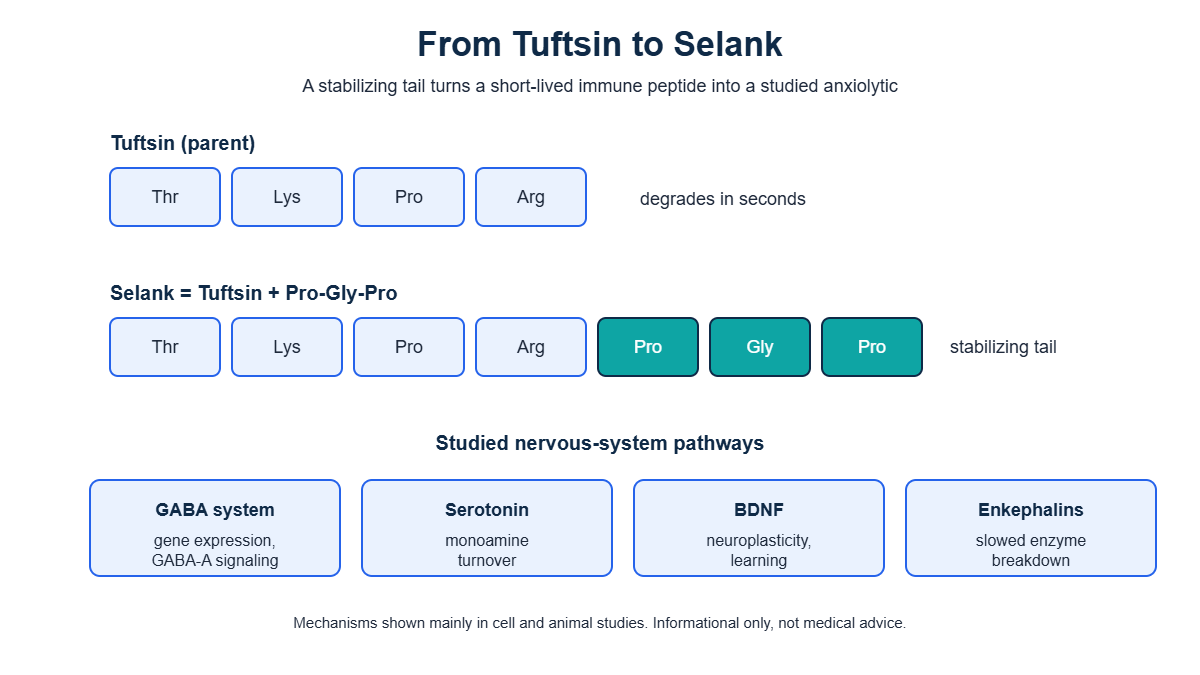
- GABAergic modulation: Gene-expression studies report that Selank alters the expression of genes tied to GABA signaling, and it is often described as influencing the GABA-A receptor system, the same broad system targeted by benzodiazepines.
- Serotonin and monoamine turnover: Animal work has documented changes in serotonin metabolism in brain regions such as the raphe nuclei, amygdala and hippocampus.
- BDNF and neuroplasticity: Selank has been reported to increase brain-derived neurotrophic factor (BDNF) expression in rodent hippocampal tissue, a pathway linked to learning, memory and neuronal resilience.
- Enkephalin metabolism: Preclinical studies suggest Selank slows the breakdown of endogenous enkephalins by inhibiting degrading enzymes such as aminopeptidases.
- Immune signaling: Reflecting its Tuftsin origin, Selank has also been examined for effects on cytokines such as interleukin-6.
Reported effects in the research literature
Across preclinical and limited clinical reports, the most commonly described properties of Selank include the following:
- Anxiolytic (anxiety-reducing) activity in animal anxiety models, sometimes compared to benzodiazepines but reportedly without strong sedation.
- Possible cognitive or attention-supporting effects, including improved performance on rodent learning and memory tasks.
- Antiasthenic or mild stimulating effects reported in some human studies, meaning reduced fatigue rather than drowsiness.
- An apparent lack of the dependence and withdrawal effects associated with classic anxiolytics in the studies conducted to date.
What this does not mean: these are descriptions of findings in laboratory animals and small clinical cohorts, not established outcomes for the general population. Reported effects do not establish that Selank is safe or effective for any human use, and individual responses, long-term safety and effects outside controlled studies are not well characterized. Nothing here should be read as a recommendation to use Selank.
What the human evidence shows
Most clinical data on Selank come from Russian studies. The most frequently cited is a comparative trial by Zozulia, Neznamov and colleagues that evaluated Selank against the benzodiazepine medazepam in patients with generalized anxiety disorder and neurasthenia, using standardized scales such as the Hamilton and Zung anxiety measures. That work reported broadly comparable anxiolytic effects with additional antiasthenic activity for Selank.
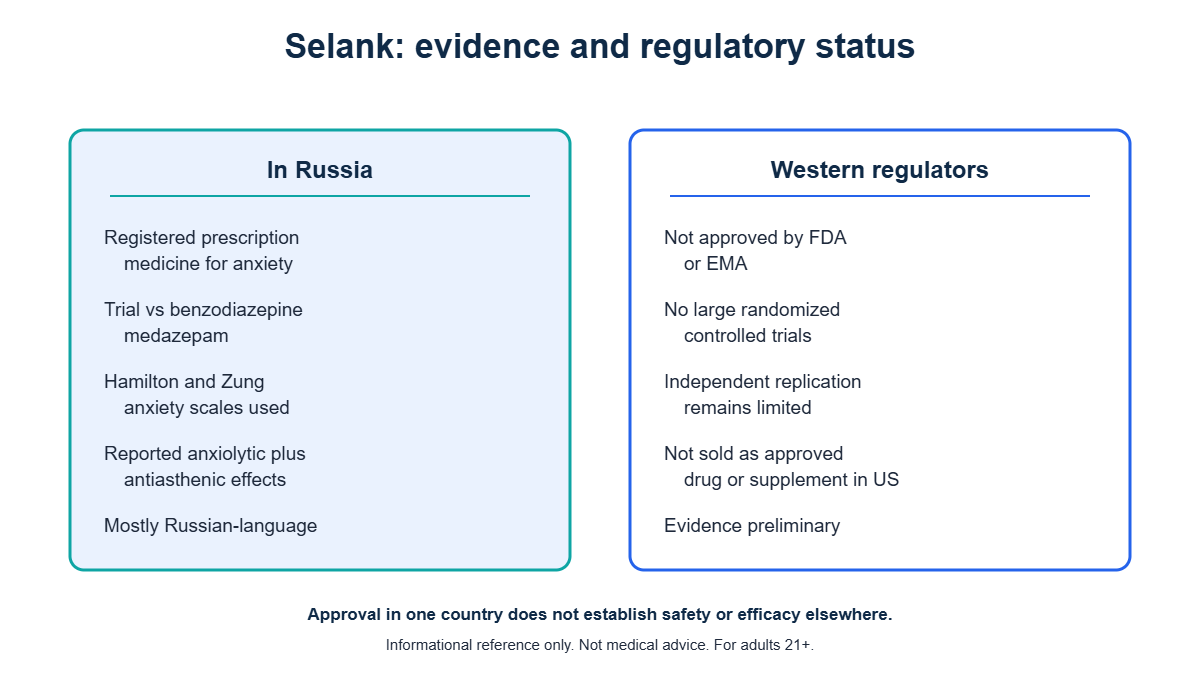
On the strength of such studies, Selank is registered as a prescription medicine in the Russian Federation. However, the body of evidence is small by Western standards, much of it is published in Russian-language journals, and there are no completed large-scale randomized controlled trials conducted under U.S. or European regulatory frameworks. Selank is not approved by the FDA, the EMA or comparable agencies outside Russia, and independent replication of the clinical findings remains limited.
Handling, storage and reconstitution (research context)
The following reflects general laboratory handling practice for research peptides and is provided for informational completeness, not as a usage protocol.
- Lyophilized (freeze-dried) peptide is typically stored frozen, protected from light and moisture, until it is prepared for an experiment.
- Reconstitution is usually performed with an appropriate sterile diluent added gently down the side of the vial, avoiding direct forceful streams onto the powder.
- Once reconstituted, peptide solutions are generally kept refrigerated and used within a limited window because peptides degrade over time in solution.
- Sterile technique is essential when handling any reconstituted material to avoid contamination.
- Concentrations and volumes for any research preparation should follow a documented, validated laboratory plan rather than guesswork.
Cautions and considerations
- Selank is not an FDA-approved drug or dietary supplement in the United States and is not intended to diagnose, treat, cure or prevent any disease.
- Human safety data are limited and come largely from small studies; long-term effects are not well established.
- Interactions with prescription medicines, supplements or other peptides have not been thoroughly characterized.
- Information on this page is for adults 21 and over and is educational only.
- Anyone with health questions should consult a qualified, licensed healthcare professional. This content is not a substitute for medical advice.
Frequently asked questions
Is Selank the same as Tuftsin?
No. Selank is built from the Tuftsin sequence but adds a Pro-Gly-Pro tail at the C-terminus. This extension makes Selank far more resistant to enzymatic breakdown than Tuftsin, which is degraded almost immediately in the body.
Is Selank approved for use?
Selank is registered as a medicine in the Russian Federation for anxiety-related conditions. It is not approved by the FDA or other Western regulators and is not marketed as an approved drug or supplement in the United States.
How is Selank thought to reduce anxiety?
Research suggests it acts through several pathways at once, including modulation of the GABA and serotonin systems, increased BDNF expression and slowed breakdown of endogenous enkephalins. The exact primary mechanism is still debated.
Does Selank cause dependence like benzodiazepines?
In the studies conducted so far, Selank has not shown the dependence and withdrawal patterns typical of benzodiazepines. However, this does not prove it is risk-free, and long-term human data are limited.
Related compounds and further reading
Share this article
References
- Selank, CID 11765600. PubChem (NLM) 2024
- Selank. Wikipedia 2025
- Volkova A, et al. Selank Administration Affects the Expression of Some Genes Involved in GABAergic Neurotransmission. Front Pharmacol 2016
- Kasian A, et al. GABA, Selank, and Olanzapine Affect Genes Involved in GABAergic Neurotransmission in IMR-32 Cells. Front Pharmacol 2017
- Zozulia AA, Neznamov GG, et al. Efficacy and possible mechanisms of action of the peptide anxiolytic selank. Zh Nevrol Psikhiatr 2008
- Kolomin T, et al. Synthetic Peptides Based on Natural Regulatory Peptides (Selank/Semax review). Neurosci Med 2013
For informational use only. Not medical advice; consult a qualified healthcare professional. 21+.
Selank reconstitution calculator
Use the calculator below to find the concentration (mg/mL), draw volume and U-100 syringe units for Selank once it is reconstituted with bacteriostatic water. Selank has molecular formula C33H57N11O9 and a molecular weight of 751.9 g/mol. Enter your vial amount and the water volume to see the lab math — informational use only, not dosing advice.