
Thymalin
Summary
Thymalin is a low-molecular-weight polypeptide extract of calf thymus (a mixture of peptides <10 kDa, not a single molecule) studied as an immune-modulating thymomimetic. Approved in Russia since 1982; not FDA-approved. Human evidence is real but mostly old, small and single-group.
Quick facts
| Also known as | Thymalinum; thymus polypeptide extract; (distinct from thymosin alpha-1 and thymulin) |
| Category | Immune / thymic peptide (research) |
| Status | Approved in Russia since 1982; not FDA-approved (research-use-only in US) |
| CAS | Not applicable – polypeptide mixture (CAS 63958-90-7 belongs to thymulin, not Thymalin) |
| Formula | Not applicable – polypeptide mixture |
| Molecular weight | Peptides below ~10 kDa (mixture; no single value) |
| Sequence | Not applicable – mixture of short peptides (e.g. KE, EW/Glu-Trp, EDP) |
| Half-life | Not established |
| Storage | Lyophilized: dry, dark; 0-4 C short term, ~-20 C long term. Reconstituted: keep cold, minimise freeze-thaw. |
In Plain English
Thymalin is a natural extract made from the thymus gland of calves — a mix of small proteins, not a single chemical. The thymus trains the immune system, and researchers have studied Thymalin as a way to nudge a weakened or unbalanced immune system back toward normal. It has been used as a medicine in Russia since 1982, but it is not approved in the United States, and most of the human research is decades old and comes from one group of scientists.
Thymalin is a low-molecular-weight polypeptide extract prepared from calf thymus that has been used in Russia since 1982 as an immune-modulating drug. Unlike a single, defined peptide, Thymalin is a mixture of short peptides — which is why it has no one molecular formula, molecular weight or sequence. Researchers study it as a “thymomimetic”: something that stands in for the immune-training signals of a healthy thymus. Its human track record is genuine, but its evidence quality is limited and largely un-replicated outside its country of origin.
What is Thymalin?
Thymalin (Latinised “Thymalinum”; Russian &Timalin) is a complex of polypeptides isolated from the thymus of calves, consisting of peptides below about 10 kDa. Because it is an extract rather than a pure compound, it has no single molecular formula, molecular weight, CAS number or amino-acid sequence — on a data sheet these are best marked “not applicable (mixture).” Peer-reviewed descriptions list several short peptides among its active components (for example KE, EW/Glu-Trp and EDP). It was developed in the 1970s by Vladimir Khavinson and Vyacheslav Morozov and approved as a drug in the USSR in 1982.
Thymalin is frequently confused with two single, defined molecules, and it is neither of them: Thymosin alpha-1 (thymalfasin, brand Zadaxin) is one synthetic 28-amino-acid peptide, and thymulin (“nonathymulin,” a 9-amino-acid peptide) is another. A CAS number such as 63958-90-7 that you may see attached to “Thymalin” actually belongs to thymulin, not to the extract — a well-known mix-up worth avoiding.
How Thymalin is studied to work
Thymalin is studied as a “thymomimetic”: its peptides are proposed to substitute for signalling normally provided by a healthy thymus, encouraging immune-cell development and rebalancing an over- or under-active immune system. The main pathways described in the literature are:
- Promoting differentiation of precursor cells into mature T-lymphocytes (a thymus-like maturation signal).
- Modulating T-lymphocyte subpopulations and helping normalise the T-helper/T-suppressor (CD4/CD8) balance.
- Regulating cooperation between T- and B-lymphocytes.
- Activating phagocytosis (neutrophils, macrophages) and NK-cell activity.
- A proposed gene-expression / “peptide bioregulation” mechanism in which very short peptides influence gene activity — largely the hypothesis of the originating group and not broadly independently confirmed.

Reported effects and benefits in the research literature
Reported effects, drawn mainly from Russian/Eastern-European studies:
- Immune restoration / correction of secondary immunodeficiency (after infection, surgery, or radiation/chemotherapy).
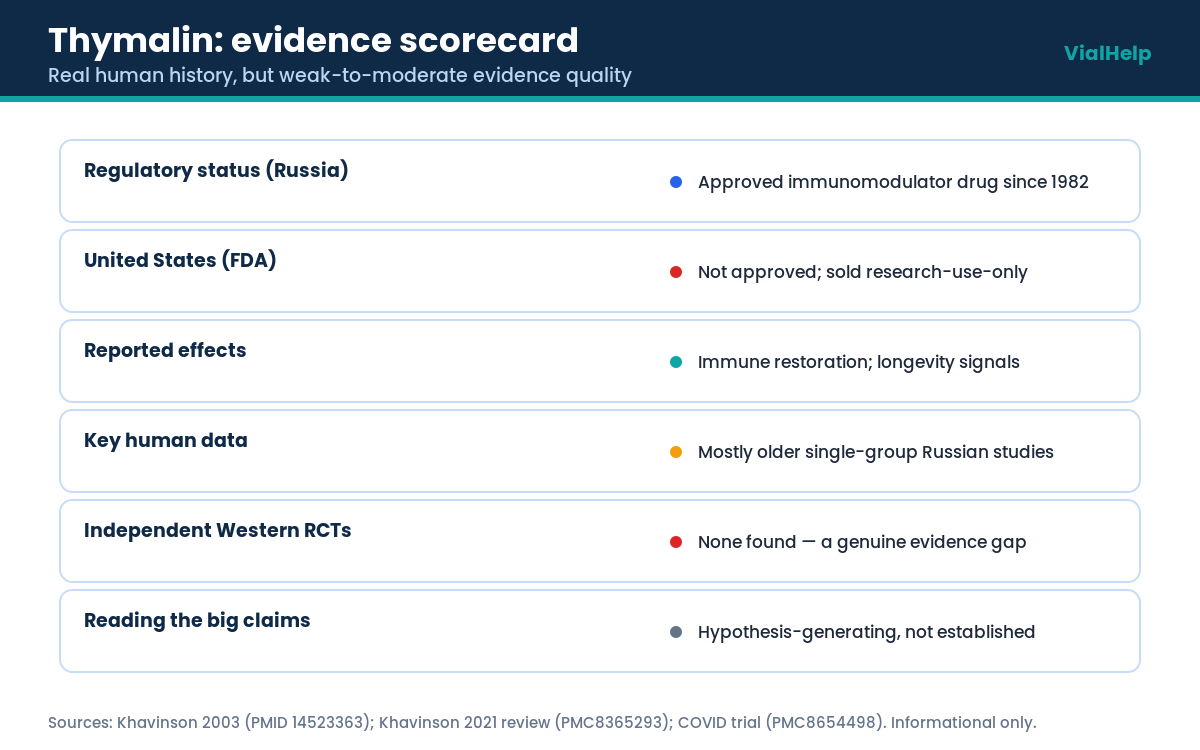
- A reported 2–2.4-fold decrease in acute respiratory infection incidence in an elderly cohort.
- Geroprotection signals: Khavinson and Morozov reported lower mortality over 6–8 years in elderly participants given Thymalin (and larger effects combined with Epithalamin).
- A single small COVID-19 randomised trial reported faster clinical improvement and recovery of lymphocyte counts when Thymalin was added to standard care.
What this does not mean: these are mostly decades-old studies from a single research group, small and single-centre, with very large reported effect sizes and no independent Western replication. Treat them as hypothesis-generating, not established fact.
What the human evidence shows
Human use in Russia and the former USSR dates to 1982 across immunodeficiency, infection, post-surgical and geriatric indications, and clinical publications exist. The limitations are important: the bulk of the evidence is older Russian/Soviet literature, much of it not available in English, predominantly from the originating group, small or single-centre, and lacking independent Western randomised trials. In regulatory terms, Thymalin remains approved and used in Russia and some post-Soviet states but is not FDA-approved in the United States, where it is sold research-use-only. Overall evidence quality is best described as weak-to-moderate by modern standards.
Handling, storage and reconstitution (research context)
- As a lyophilized peptide extract, store dry and dark: refrigerated (0–4 °C) short term, frozen (around -20 °C) for longer periods.
- Reconstituted stock is less stable — keep cold and minimise freeze-thaw cycles.
- Being an animal-tissue extract, batch composition can vary; it is not standardised to a single characterised active ingredient.
- For turning a labelled powder mass into a working concentration, see the reconstitution calculator and why units are not a dose.
Cautions and considerations
- Not FDA-approved; distributed research-use-only in the United States.
- It is an animal-derived extract, not a single defined molecule — purity, allergenicity and batch variability are real considerations.
- The strongest efficacy claims (longevity/mortality) rest on old, single-group, un-replicated data.
- Do not attach a single CAS/formula/MW to Thymalin — those figures belong to thymulin, a different molecule.
- This page is informational only and is not medical advice.
Frequently asked questions
Is Thymalin the same as thymosin alpha-1?
No. Thymosin alpha-1 (Zadaxin) is a single, synthetic 28-amino-acid peptide. Thymalin is a crude multi-peptide extract of calf thymus, not a defined single molecule.
Does Thymalin have a molecular formula or CAS number?
Not as an extract. Because it is a mixture of peptides, it has no single formula, molecular weight or sequence. A CAS you may see (e.g. 63958-90-7) actually refers to thymulin, a different compound.
Is Thymalin approved anywhere?
It has been an approved immunomodulatory drug in Russia/the former USSR since 1982 and is still used there. It is not approved by the FDA in the United States.
How strong is the human evidence?
Limited. Most studies are older, small, single-centre and from one research group, without independent Western replication, so the large longevity and mortality claims should be read cautiously.
Related compounds and further reading
- How to reconstitute peptides
- Sterile technique
- Thymosin alpha-1, KPV and LL-37 (other immune-related compounds)
- Browse the full peptide library and the guides
- IU vs mL: why units are not a dose
Share this article
References
- Khavinson & Morozov 2003, Neuro Endocrinol Lett (PMID 14523363)
- Khavinson et al. 2021, Biology Bulletin Reviews (PMC8365293)
- Kuznik & Khavinson 2021, Advances in Gerontology (COVID-19 trial, PMC8654498)
- Khavinson & Morozov 2002, Uspekhi Gerontologii (PMID 12577695)
- The Use of Thymalin for Immunocorrection — Springer (DOI 10.1134/S2079086421040046)
For informational use only. Not medical advice; consult a qualified healthcare professional. 21+.
Thymalin reconstitution calculator
Use the calculator below to find the concentration (mg/mL), draw volume and U-100 syringe units for Thymalin once it is reconstituted with bacteriostatic water. Thymalin has a molecular weight of Peptides below ~10 kDa (mixture; no single value). Enter your vial amount and the water volume to see the lab math — informational use only, not dosing advice.