
Semaglutide
Summary
Semaglutide is a long-acting GLP-1 receptor agonist studied and FDA-approved for type 2 diabetes, chronic weight management and cardiovascular risk reduction.
Quick facts
| Also known as | Ozempic, Wegovy, Rybelsus, NN9535 |
| Category | Metabolic / GLP-1 receptor agonist |
| Status | FDA-approved (multiple indications) |
| CAS | 910463-68-2 |
| Formula | C187H291N45O59 |
| Molecular weight | ≈4113.6 g/mol |
| Sequence | 31-residue acylated analog of human GLP-1(7-37); Aib at position 8, C18 diacid chain at Lys26 |
| Half-life | ≈7 days (about 165 hours) |
| Storage | Lyophilized: keep cold, protect from light. Reconstituted: refrigerate 2–8°C, do not freeze. |
In Plain English
Semaglutide is a peptide that copies a natural gut hormone which makes you feel full and helps keep blood sugar steady. It is the active ingredient in several well-known, approved diabetes and weight-loss medicines. Researchers and doctors study it for blood-sugar control and weight management.
Semaglutide is a long-acting glucagon-like peptide-1 (GLP-1) receptor agonist that has become one of the most studied metabolic peptides of the decade. First developed by Novo Nordisk and approved by the U.S. FDA in 2017, semaglutide is the active molecule behind the brand names Ozempic and Rybelsus (type 2 diabetes) and Wegovy (chronic weight management). It is engineered from the human incretin hormone GLP-1 but modified so it resists rapid breakdown, giving it a half-life of roughly one week.
What is semaglutide?
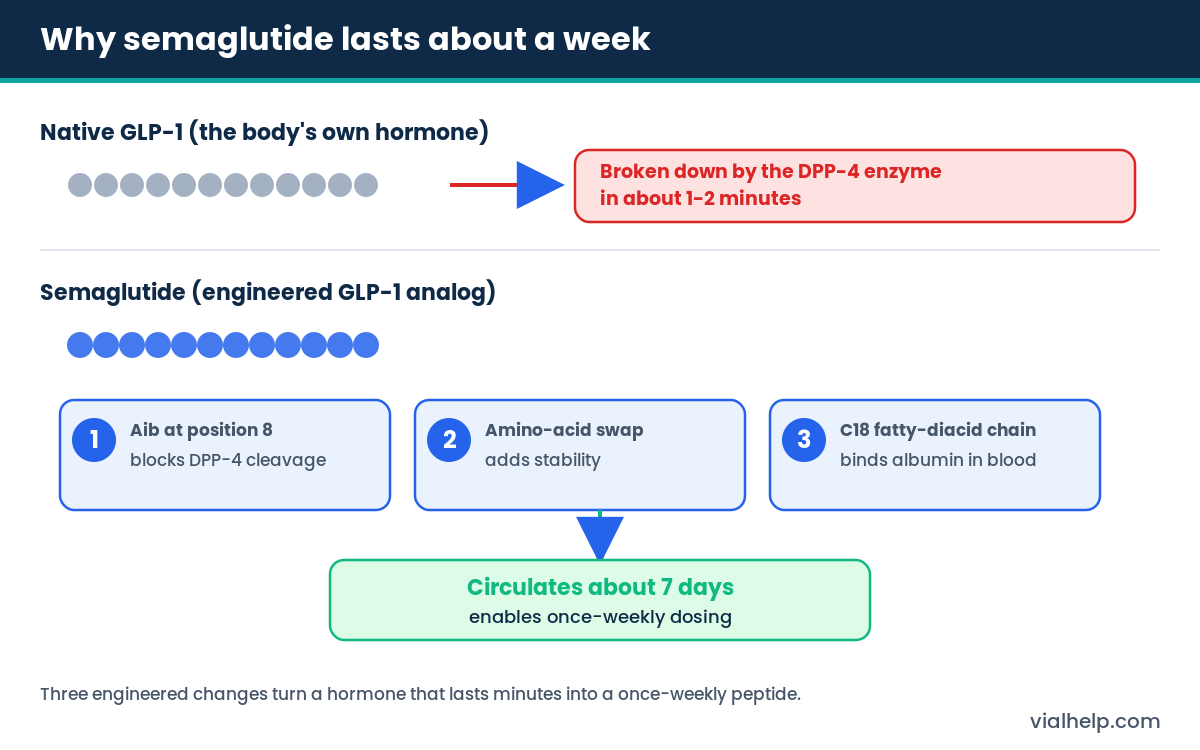
Semaglutide is a synthetic analog of human GLP-1(7-37), a gut hormone (an “incretin”) that the body releases after eating. In its natural form GLP-1 is degraded within minutes by the enzyme DPP-4. Semaglutide carries three key modifications that make it far more durable: an alpha-aminoisobutyric acid (Aib) substitution at position 8 that blocks DPP-4 cleavage, a single amino-acid swap, and a long C18 fatty-diacid chain attached through a linker at position 26 that binds tightly to albumin in the blood. Together these changes extend its circulating half-life from minutes to about seven days, allowing once-weekly injection (Ozempic, Wegovy) or, in a specially formulated tablet, once-daily oral dosing (Rybelsus). Chemically it is a 31-residue acylated peptide with the molecular formula C187H291N45O59 and a molecular weight near 4,114 g/mol.
How semaglutide is studied to work
Semaglutide mimics GLP-1 and binds to the GLP-1 receptor, a G-protein-coupled receptor found on cells throughout the pancreas, brain, gut and cardiovascular system. Activating that receptor produces several coordinated, glucose-dependent effects:
- Pancreas: enhances insulin secretion when blood glucose is elevated and suppresses glucagon, lowering blood sugar without driving it dangerously low.
- Brain (hypothalamus): acts on appetite-regulating centers to increase satiety and reduce hunger and food intake.
- Stomach: slows gastric emptying, so meals leave the stomach more gradually and fullness lasts longer.
- Cardiovascular system: associated with reduced major adverse cardiovascular events in large outcome trials, through mechanisms only partly explained by weight loss.
Reported effects and benefits in the research literature
Across an unusually large body of randomized trials, semaglutide has shown:
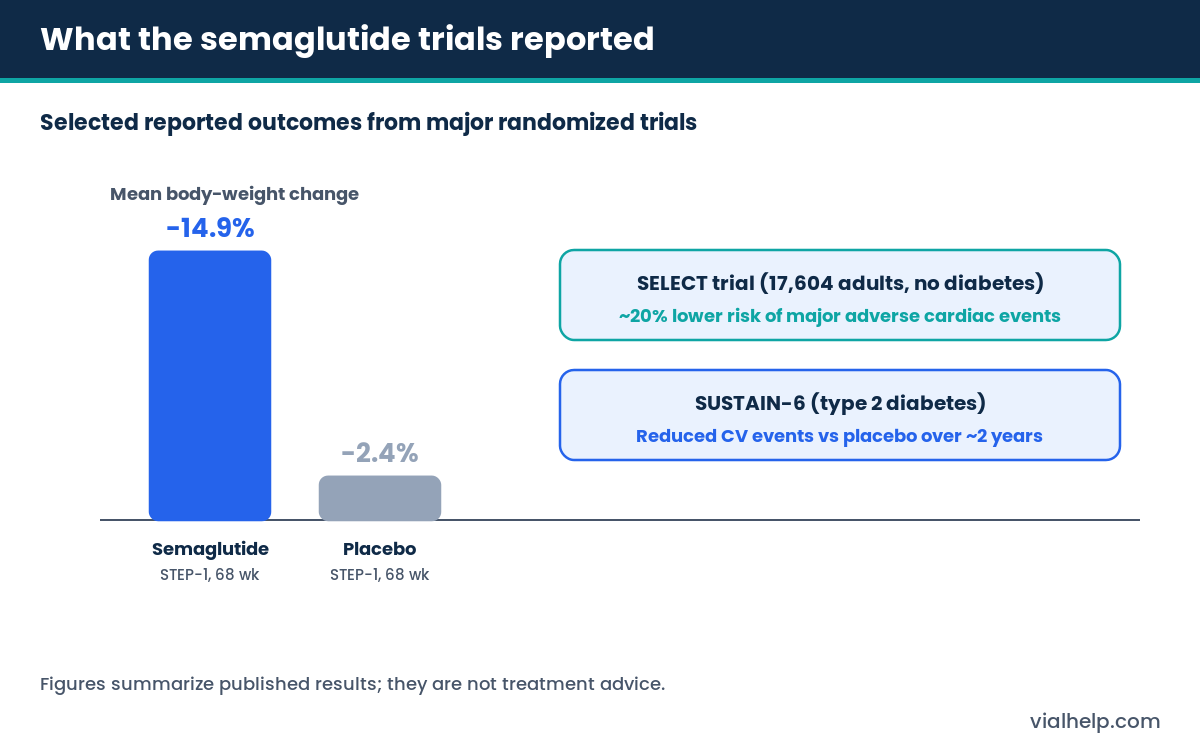
- Substantial weight loss — in the STEP-1 trial, mean body weight fell about 14.9% over 68 weeks versus 2.4% on placebo, with the majority of participants losing at least 5% of body weight.
- Improved glycemic control — large reductions in HbA1c and fasting glucose in the SUSTAIN program for type 2 diabetes.
- Cardiovascular risk reduction — the SELECT trial in 17,604 adults with established cardiovascular disease and overweight/obesity but without diabetes reported roughly a 20% lower risk of major adverse cardiovascular events.
- Favorable secondary effects — improvements in blood pressure, lipids and markers of inflammation reported in several studies.
What this does not mean: these are population-level findings from controlled trials in defined patient groups. They do not establish that semaglutide is appropriate, safe or effective for any particular individual, and gastrointestinal side effects (nausea, vomiting, diarrhea) are common, especially during dose escalation.
What the human evidence shows
Semaglutide is among the most thoroughly evaluated peptides in clinical medicine. It is FDA-approved in multiple formulations: Ozempic (subcutaneous, type 2 diabetes, 2017), Rybelsus (oral tablet, type 2 diabetes, 2019) and Wegovy (subcutaneous, chronic weight management, 2021). The SUSTAIN trials established glycemic and cardiovascular benefits in diabetes; the STEP trials established weight-management efficacy; and the SELECT trial extended cardiovascular benefit to people with obesity but without diabetes. In 2024 the FDA expanded Wegovy’s label to include reducing cardiovascular risk. Reported adverse effects include gastrointestinal symptoms, gallbladder events, and a boxed warning regarding thyroid C-cell tumors observed in rodents (human relevance unconfirmed). This is a prescription medicine with an extensive, ongoing safety record.
Handling, storage and reconstitution (research context)
- Lyophilized / powder form: keep cold and protected from light until use; follow the certificate of analysis and supplier handling notes.
- Reconstituted or solution form: refrigerate at 2–8°C, avoid freezing, and protect from light and agitation; discard if cloudy or discolored.
- When working out concentrations, remember that the syringe “units” marking is a volume scale, not a dose — see our IU vs mL explainer.
- Use the reconstitution calculator to convert vial mg and diluent volume into a clear mg/mL concentration.
Cautions and considerations
- Semaglutide sold as a “research” peptide is not the same as an FDA-approved finished drug product and is not quality-assured for human use.
- Approval status varies by formulation and country; counterfeit and compounded versions have raised quality concerns.
- Purity, identity and endotoxin levels should be confirmed against a current certificate of analysis — see our guide to reading a COA.
- This page is informational only and is not medical advice; decisions about any GLP-1 medication should involve a qualified healthcare professional.
Frequently asked questions
Is semaglutide a peptide?
Yes. Semaglutide is a 31-amino-acid acylated peptide analog of human GLP-1, chemically modified to resist enzymatic breakdown and bind albumin for a long half-life.
Why does semaglutide last about a week?
A fatty-diacid side chain lets it bind reversibly to albumin in the blood, and an Aib substitution blocks the DPP-4 enzyme that normally degrades GLP-1 within minutes — together extending the half-life to roughly seven days.
What is the difference between Ozempic and Wegovy?
Both contain semaglutide. Ozempic is approved for type 2 diabetes; Wegovy is approved for chronic weight management and uses a higher maximum dose. Rybelsus is an oral tablet form for diabetes.
How is semaglutide different from GH peptides like CJC-1295?
Semaglutide acts on the GLP-1 (metabolic/incretin) system, whereas peptides such as CJC-1295 and ipamorelin act on the growth-hormone axis. They target entirely different receptors and pathways.
Related compounds and further reading
- CJC-1295 (with DAC) — a growth-hormone-axis peptide, for contrast with semaglutide’s metabolic action.
- Ipamorelin — a selective growth hormone secretagogue.
- Browse the full peptide library and our research guides.
- IU vs mL: why units are not a dose — essential measurement background.
- How to reconstitute peptides — step-by-step reconstitution method and concentration math.
- Sterile technique — aseptic handling and contamination prevention for research vials.
Share this article
References
For informational use only. Not medical advice; consult a qualified healthcare professional. 21+.
Semaglutide reconstitution calculator
Use the calculator below to find the concentration (mg/mL), draw volume and U-100 syringe units for Semaglutide once it is reconstituted with bacteriostatic water. Semaglutide has molecular formula C187H291N45O59 and a molecular weight of ≈4113.6 g/mol. Enter your vial amount and the water volume to see the lab math — informational use only, not dosing advice.