
AOD-9604
Summary
AOD-9604 is a synthetic C-terminal fragment of human growth hormone (residues 176-191) studied as an anti-obesity peptide for its fat-metabolizing action, reportedly without raising IGF-1. Its obesity development was discontinued in 2007 after a failed pivotal trial; it is not FDA-approved.
Quick facts
| Also known as | AOD9604; AOD 9604; Tyr-hGH(177-191); hGH fragment 176-191 analog |
| Category | Growth hormone C-terminal fragment (investigational anti-obesity peptide) |
| Status | Not FDA-approved; obesity development discontinued 2007; later a supplement ingredient |
| CAS | 221231-10-3 |
| Formula | C78H123N23O23S2 |
| Molecular weight | 1815.1 g/mol |
| Sequence | YLRIVQCRSVEGSCGF (Tyr + hGH 177-191; disulfide Cys7-Cys14) |
| Half-life | Reported short (minutes); not well characterized in published PK |
| Storage | Lyophilized: -20C, sealed/desiccated, dark. Reconstituted: 2-8C, dark, avoid freeze-thaw (oxidation-prone disulfide). |
In Plain English
AOD-9604 is a small lab-made piece of human growth hormone, designed to focus on fat-burning without the other growth-hormone effects. A weight-loss drug trial failed years ago, so it is not an approved medicine. Researchers still study it for fat metabolism.
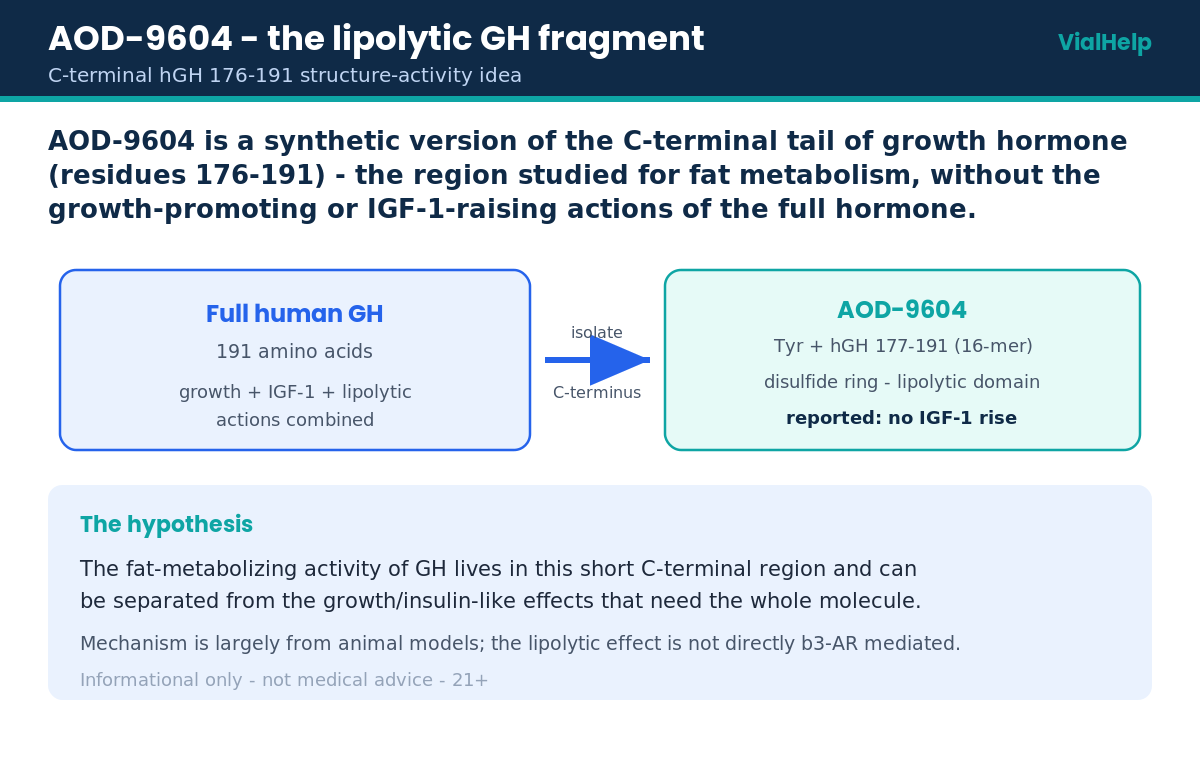
AOD-9604 is a synthetic fragment of human growth hormone, corresponding to the C-terminal region (residues 176-191) that researchers linked to fat metabolism. Developed by Metabolic Pharmaceuticals in Australia as a potential anti-obesity drug, it was designed to capture the fat-burning action of growth hormone without its growth-promoting or blood-sugar effects.
What is AOD-9604?
AOD-9604 is a 16-amino-acid peptide (sequence YLRIVQCRSVEGSCGF) made up of the last part of the human growth hormone molecule with an added N-terminal tyrosine and a small internal disulfide ring. The name is shorthand for “Anti-Obesity Drug 9604.” It is sometimes written AOD9604 or described as the hGH fragment 176-191 analog. AOD-9604 is not an approved drug; its obesity program was discontinued, and it later appeared as a supplement ingredient and research chemical.
How AOD-9604 is studied to work
The idea behind AOD-9604 is that the fat-metabolizing activity of growth hormone lives in this short C-terminal tail and can be separated from the growth and insulin-like effects that require the whole hormone. Note that the proposed mechanism is drawn largely from animal models.
- Lipolysis and reduced lipogenesis: the fragment is studied for stimulating fat breakdown and inhibiting fat storage, mimicking that action of full growth hormone.
- Beta-3 adrenergic receptor expression: in obese mice it raised repressed beta-3 receptor levels — though the primary study found the lipolytic effect is not directly mediated through that receptor.
- No IGF-1 rise reported: early human studies reported it did not raise serum IGF-1, supporting the idea that it does not act through the growth-hormone-to-IGF-1 axis.
- No reported effect on glucose handling like full growth hormone.
Reported effects and benefits in the research literature
Published findings on AOD-9604 are mixed, and the honest summary is one of early promise that did not hold up:
- Animal fat loss: growth hormone and AOD-9604 reduced body weight and fat in obese mice over two weeks (Heffernan 2001).
- Early human signal: a 12-week trial reported subjects lost on average about 1.8 kg more than placebo.
- Safety/tolerability: across early human trials it was reported as generally safe and well tolerated, with no IGF-1 elevation (Stier 2013).
- Cartilage research: after the obesity work stopped, it was explored for cartilage and osteoarthritis, though a clear positive human outcome is not established.
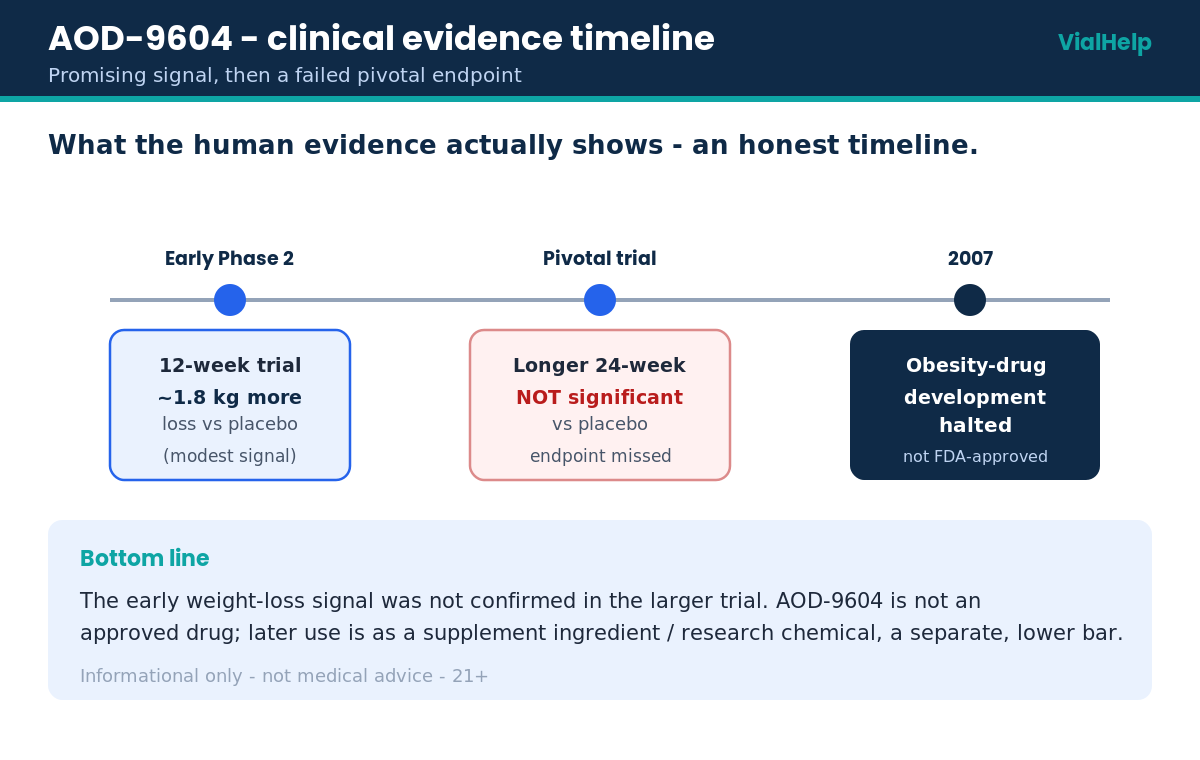
What this does not mean: the early weight-loss signal was modest and was not confirmed. A larger, longer 24-week trial did not show significant weight loss versus placebo, and obesity-drug development was halted in 2007. Animal receptor findings do not establish a meaningful fat-loss effect in people.
What the human evidence shows
AOD-9604 went through several human trials, including oral phase 2 obesity studies. An earlier study suggested a small weight-loss advantage over placebo, but the pivotal longer trial missed its primary endpoint and the obesity program was discontinued in 2007. AOD-9604 is not FDA-approved for any indication and was never marketed as a pharmaceutical. It was later positioned as a nutraceutical ingredient, and a self-affirmed GRAS (generally recognized as safe) determination has been claimed for food use — a separate and lower regulatory bar than drug approval. In the context of bulk substances for compounding, regulators have flagged AOD-9604 among peptides with limited human safety data. It is also banned in sport.
Handling, storage and reconstitution (research context)
- Lyophilized powder: store cold and dry, protected from light; -20°C for long-term, kept sealed and desiccated.
- Reconstituted solution: refrigerate at 2-8°C, use within a few weeks, avoid repeated freeze-thaw, and protect from light. The disulfide bond makes oxidation a plausible degradation route.
- Concentration math: calculate milligrams per millilitre before reconstituting with the reconstitution calculator; see IU vs mL on why a unit is a volume.
- Compound-specific stability figures are not published; the above are general peptide handling norms.
Cautions and considerations
- AOD-9604 is not an approved drug; its obesity development was discontinued after a failed pivotal trial.
- Supplement/GRAS status is separate from FDA drug approval and does not establish therapeutic efficacy.
- It is banned in competitive sport and tested for.
- Research material purity varies; a Certificate of Analysis should accompany it. This page is informational only and is not medical advice.
Frequently asked questions
Does AOD-9604 actually cause weight loss?
The evidence is weak. An early 12-week trial showed a small advantage over placebo, but the larger pivotal trial did not show significant weight loss, and the obesity program was stopped.
Is AOD-9604 a growth hormone?
No. It is a small fragment of the growth hormone molecule. Unlike full growth hormone, early studies reported it did not raise IGF-1.
Is AOD-9604 FDA-approved?
No. It is not an approved drug. A separate GRAS claim has been made for use as a food ingredient, which is not the same as drug approval.
How does it compare to GH secretagogues?
Secretagogues like ipamorelin or CJC-1295 raise the body’s own growth hormone (and IGF-1). AOD-9604 is instead a fragment studied only for the fat-metabolism action, with no reported IGF-1 rise.
Related compounds and further reading
- How to reconstitute peptides
- Sterile technique
- Tesamorelin
- CJC-1295 (with DAC)
- Ipamorelin
- Browse the full peptide library
- VialHelp guides
- Adipotide — a separate fat-loss research peptide with a vascular-targeting mechanism.
Share this article
References
- AOD9604 — Wikipedia (identity, development history, doping)
- Aod-9604, CID 71300630 — PubChem (formula C78H123N23O23S2, CAS 221231-10-3)
- Heffernan M, et al. Effects of hGH and its lipolytic fragment (AOD9604) on lipid metabolism. Endocrinology 2001 (PMID 11713213)
- Valentino MA, et al. Central and peripheral molecular targets for anti-obesity pharmacotherapy. Clin Pharmacol Ther 2010 (PMC3136748)
- Stier H, et al. Safety and tolerability of the hexadecapeptide AOD9604 in humans. J Endocrinol Metab 2013
- Thevis M, et al. Detecting peptidic drugs in sports doping. Expert Rev Proteomics 2014 (PMID 25382550)
For informational use only. Not medical advice; consult a qualified healthcare professional. 21+.
AOD-9604 reconstitution calculator
Use the calculator below to find the concentration (mg/mL), draw volume and U-100 syringe units for AOD-9604 once it is reconstituted with bacteriostatic water. AOD-9604 has molecular formula C78H123N23O23S2 and a molecular weight of 1815.1 g/mol. Enter your vial amount and the water volume to see the lab math — informational use only, not dosing advice.