
Kisspeptin-10
Summary
Kisspeptin-10 (KP-10) is the active decapeptide form of kisspeptin, the endogenous ligand of the KISS1R/GPR54 receptor. It sits at the top of the reproductive (HPG) axis, stimulating GnRH and downstream LH and FSH. It is an investigational research peptide, not an approved drug.
Quick facts
| Also known as | KP-10, Metastin (45-54), KISS1 (112-121), kisspeptin-10 (human) |
| Category | Reproductive / HPG-axis peptide (kisspeptin) |
| Status | Investigational research peptide — not approved |
| CAS | 374675-21-5 |
| Formula | C63H83N17O14 |
| Molecular weight | ~1302.5 g/mol |
| Sequence | Tyr-Asn-Trp-Asn-Ser-Phe-Gly-Leu-Arg-Phe-NH2 (YNWNSFGLRF-NH2) |
| Half-life | Very short — approximately 4 minutes (kisspeptin-10) |
| Storage | Lyophilized: store frozen, protect from light; reconstituted: refrigerate and use short-term |
In Plain English
Kisspeptin-10 is a short piece of a natural body signal called kisspeptin that helps control reproductive hormones. Researchers study it because it prompts the brain to start the hormone chain behind puberty and fertility, which makes it useful for understanding and testing reproductive health. The work is mainly in research and clinical studies; it is not an approved treatment.
Kisspeptin-10 (KP-10) is the short, active form of kisspeptin — a hypothalamic peptide that acts as the master “on-switch” for the body’s reproductive hormone axis. The peptide comes from the KISS1 gene, which was discovered in Hershey, Pennsylvania and originally named “metastin” for its role as a tumour-metastasis suppressor (the “KISS” name nods to Hershey’s Kisses). Only later did researchers find that its receptor controls puberty and fertility, revealing kisspeptin as a central regulator of reproduction.
What is Kisspeptin-10?
Kisspeptin-10 is the C-terminal decapeptide of kisspeptin — the ten amino acids that carry its biological activity. It is also written as KP-10 or metastin (45–54). The human sequence is Tyr-Asn-Trp-Asn-Ser-Phe-Gly-Leu-Arg-Phe-NH₂ (YNWNSFGLRF-NH₂), and the amidated C-terminal “RFamide” ending is required for the peptide to activate its receptor. The full kisspeptin protein is processed into several fragments — kisspeptin-54 (the main circulating form, also called metastin), -14, -13 and -10 — all sharing this same active C-terminus. Kisspeptin-10 is the endogenous ligand of the receptor KISS1R (GPR54). Note that the human and rodent versions of KP-10 differ slightly in sequence and molecular formula, so research material should specify the human peptide.
How kisspeptin-10 is studied to work
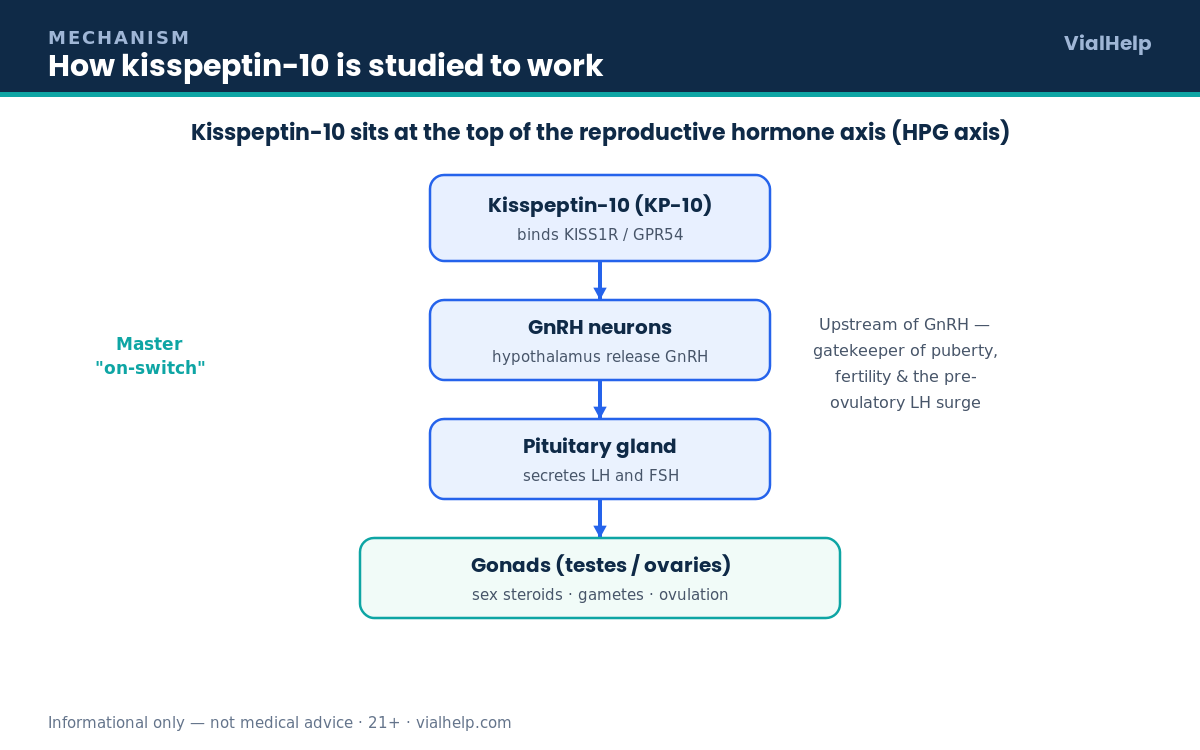
Kisspeptin-10 acts at the very top of the reproductive cascade known as the hypothalamic–pituitary–gonadal (HPG) axis:
- It binds KISS1R (GPR54), a Gq-coupled receptor found on GnRH neurons in the hypothalamus.
- This triggers release of GnRH (gonadotropin-releasing hormone) into the pituitary portal system.
- The pituitary responds by secreting luteinizing hormone (LH) and follicle-stimulating hormone (FSH).
- LH and FSH then drive the gonads to produce sex steroids (testosterone or estradiol) and gametes.
- Because it sits upstream of GnRH, kisspeptin is considered the gatekeeper of puberty and fertility and contributes to generating the pre-ovulatory LH surge.
Reported effects and benefits in the research literature
In human and laboratory studies, kisspeptin-10 has been examined mainly as a tool for switching on and probing the reproductive axis. Reported findings include:
- Potent, dose-dependent stimulation of LH (and, to a lesser degree, FSH); continuous infusion can raise testosterone and increase LH pulse frequency.
- Reproductive and fertility research, including ovulation and oocyte-maturation triggering (the IVF studies used the longer kisspeptin-54 form).
- Investigation of hypothalamic amenorrhea and other states of low GnRH drive.
- Puberty research and general probing of HPG-axis function.
- Notable sex differences in response between men and women and across the menstrual cycle.
What this does not mean: these are research observations about hormone signalling, not evidence that kisspeptin-10 is a safe or effective treatment for any condition. It is not an approved fertility drug, and nothing here is guidance for personal use.

What the human evidence shows
Much of the pivotal human work comes from Professor Waljit Dhillo’s group at Imperial College London. In 2005 they showed that infusing kisspeptin-54 significantly raised LH, FSH and testosterone in healthy men (Dhillo et al., JCEM). In 2011, George and colleagues demonstrated that kisspeptin-10 itself is a potent, rapid stimulator of LH in men, with continuous infusion increasing both testosterone and LH pulse frequency (JCEM). In 2014, Jayasena and colleagues reported that a single injection of kisspeptin-54 could trigger egg maturation in women undergoing IVF, with eggs fertilised in the large majority of patients (Journal of Clinical Investigation). Follow-up work highlighted kisspeptin-54’s potential advantage as an IVF trigger in women at high risk of ovarian hyperstimulation syndrome (OHSS).
Two cautions are important. First, the IVF-trigger studies used kisspeptin-54, which lasts longer in the circulation than kisspeptin-10 — the two are not interchangeable. Second, kisspeptin-10 and kisspeptin-54 remain investigational research peptides: neither is an approved drug, and their use is confined to clinical research and laboratory study.
Handling, storage and reconstitution (research context)
Kisspeptin-10 has a very short half-life — on the order of a few minutes — because it is rapidly broken down by plasma peptidases and cleared. General peptide-handling principles apply to the lyophilized material:
- Lyophilized powder: store frozen, protected from light and moisture.
- Reconstituted solution: refrigerate and use over a short period; minimize freeze–thaw cycles.
- Use the reconstitution calculator to convert vial mass and bacteriostatic-water volume into concentration (mg/mL), and review why syringe “units” are not a dose.
Cautions and considerations
- Kisspeptin-10 is a research peptide, not an approved medicine.
- It is not interchangeable with kisspeptin-54; the longer isoform behaves differently.
- Purity and identity matter — a certificate of analysis (COA) documents vial contents.
- This page is informational only and not medical advice, intended for an audience of 21+.
Frequently asked questions
What is the difference between kisspeptin-10 and kisspeptin-54?
Both share the same active C-terminal sequence, but kisspeptin-54 is the longer parent peptide (metastin) and lasts longer in the bloodstream. Kisspeptin-10 acts quickly and clears within minutes. The IVF-trigger research used kisspeptin-54.
What does kisspeptin-10 do to hormones?
In studies it stimulates the release of GnRH, which in turn raises LH and FSH from the pituitary. This is why it is described as an upstream regulator of the reproductive hormone axis.
Is kisspeptin-10 approved for fertility treatment?
No. Kisspeptin-10 is an investigational research peptide. While kisspeptin-54 has been studied as an IVF trigger, neither form is an approved fertility drug.
Why is it called “kisspeptin”?
The peptide comes from the KISS1 gene, discovered in Hershey, Pennsylvania — home of Hershey’s Kisses chocolates. It was first identified as a metastasis-suppressor and named “metastin” before its reproductive role was understood.
Related compounds and further reading
- Gonadorelin — synthetic GnRH, the hormone kisspeptin acts upstream of.
- Oxytocin — another hypothalamic peptide hormone.
- How to reconstitute peptides and sterile technique — core handling guides.
- Browse the full peptide library and all guides.
Share this article
References
- PubChem: Kisspeptin-10 (CID 25240297)
- Dhillo et al. 2005, JCEM — kisspeptin-54 stimulates the HPG axis in men (PMID 16174713)
- George et al. 2011, JCEM — kisspeptin-10 is a potent LH stimulator in men (PMID 21632807)
- Jayasena et al. 2014, J Clin Invest — kisspeptin-54 triggers egg maturation in IVF
- Abbara & Dhillo 2017 review — kisspeptin as an IVF maturation trigger (PMID 28393578)
- Wikipedia: Kisspeptin
For informational use only. Not medical advice; consult a qualified healthcare professional. 21+.
Kisspeptin-10 reconstitution calculator
Use the calculator below to find the concentration (mg/mL), draw volume and U-100 syringe units for Kisspeptin-10 once it is reconstituted with bacteriostatic water. Kisspeptin-10 has molecular formula C63H83N17O14 and a molecular weight of ~1302.5 g/mol. Enter your vial amount and the water volume to see the lab math — informational use only, not dosing advice.
Open the full calculator · Back to the Kisspeptin-10 profile