
Pharmacopeias move toward recombinant Factor C for endotoxin testing
USP and the European Pharmacopoeia now formally recognise recombinant Factor C for bacterial endotoxin testing, and why endotoxin is a separate result on a COA.

USP and the European Pharmacopoeia now formally recognise recombinant Factor C for bacterial endotoxin testing, and why endotoxin is a separate result on a COA.
Novo Nordisk filed CagriSema with the FDA in December 2025 and says a decision is anticipated by late 2026. What the REDEFINE trials showed, and what REDEFINE 4 did not.
The kallikrein-kinin system makes bradykinin — a short vasodilator. Why ACE (kininase II) links it to blood pressure, the ACE-inhibitor cough, and hereditary angioedema.
Neprilysin is the surface enzyme that degrades natriuretic peptides and bradykinin — why blocking it (sacubitril/ARNI) treats heart failure, and how it compares with DPP-4.
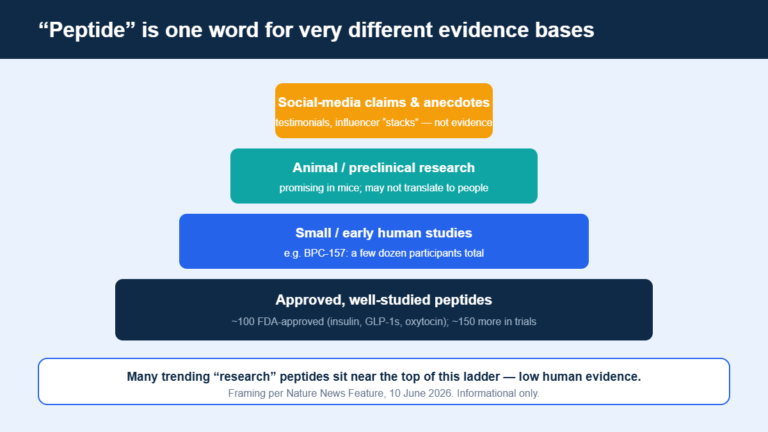
A June 2026 Nature feature weighs the science behind the peptide craze, contrasting roughly 100 approved peptide drugs with under-studied “research use only” compounds.
Vasopressin (ADH) is the body’s water-conservation hormone: what it is, its three receptors, and how it works with the RAAS and natriuretic peptides.
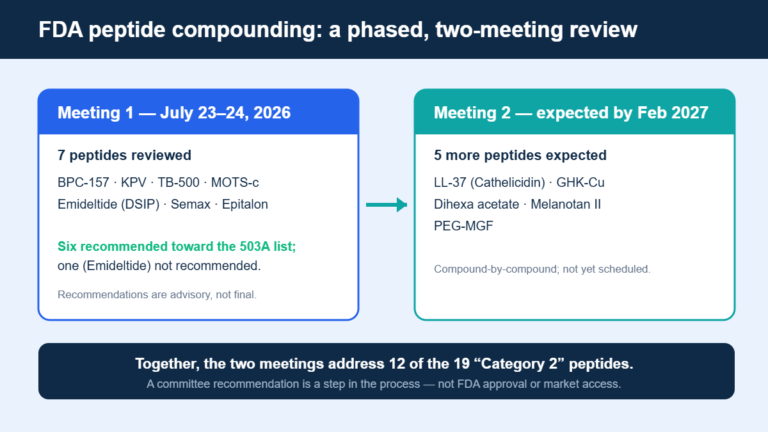
The FDA’s compounding advisory committee is expected to weigh five more peptides — LL-37, GHK-Cu, Dihexa, Melanotan II and PEG-MGF — for the 503A list by early 2027.

Lilly reported that investigational retatrutide met endpoints in the TRIUMPH-2 and TRIUMPH-3 Phase 3 trials, with a BLA submission planned for Q1 2027.
Natriuretic peptides — ANP, BNP and CNP — are the heart’s brake on blood pressure. How they oppose the RAAS, signal through guanylyl-cyclase receptors, and why neprilysin and sacubitril matter.
How the renin–angiotensin–aldosterone system (RAAS) defends blood pressure — the peptide cascade from renin to angiotensin II to aldosterone, its receptors, and the drugs that target it.