
Cerebrolysin
Summary
Cerebrolysin is a standardized peptide preparation made from purified porcine brain proteins (a mixture of low-molecular-weight peptides and free amino acids), studied as a neurotrophic/neuroprotective agent for stroke, dementia and traumatic brain injury. It has a substantial but mixed human clinical-trial record and is a prescription drug in many countries, but is not FDA-approved in the US.
Quick facts
| Also known as | FPF-1070; cerebroprotein hydrolysate; Renacenz (some markets) |
| Category | Neurotrophic peptide preparation (porcine brain-derived) |
| Status | Prescription drug in many countries; NOT FDA-approved in the US |
| CAS | 12656-61-0 (identifies the preparation, not a single molecule) |
| Formula | Not applicable – a peptide mixture, not a single molecule |
| Molecular weight | Not applicable – mixture of peptides under ~10 kDa plus free amino acids |
| Sequence | Not applicable – no single sequence (standardized mixture) |
| Half-life | Not applicable (mixture); some constituent neurotrophic peptides are very short-lived |
| Storage | Per product labeling: store below 25 C, protect from light; supplied as a solution in ampoules and used by injection – use an opened ampoule immediately. |
In Plain English
Cerebrolysin is a mixture of small protein fragments made from purified pig brain tissue, studied for possible effects on the brain and nervous system. Researchers investigate whether it can help protect or support brain cells after events like stroke or in conditions that affect memory and thinking. It is used as a medicine in some countries but is not approved by the U.S. FDA, and scientists are still studying how well it works and how it acts in the body.
Cerebrolysin is a standardized peptide preparation made from purified porcine (pig) brain proteins, studied for decades as a neurotrophic and neuroprotective treatment for stroke, dementia and traumatic brain injury. Developed under the code FPF-1070 and manufactured by EVER Neuro Pharma, Cerebrolysin is unusual among research peptides: it is not a single molecule but a mixture, and unlike most compounds in this library it has a substantial human clinical-trial record — though the results are decidedly mixed.
What is Cerebrolysin?
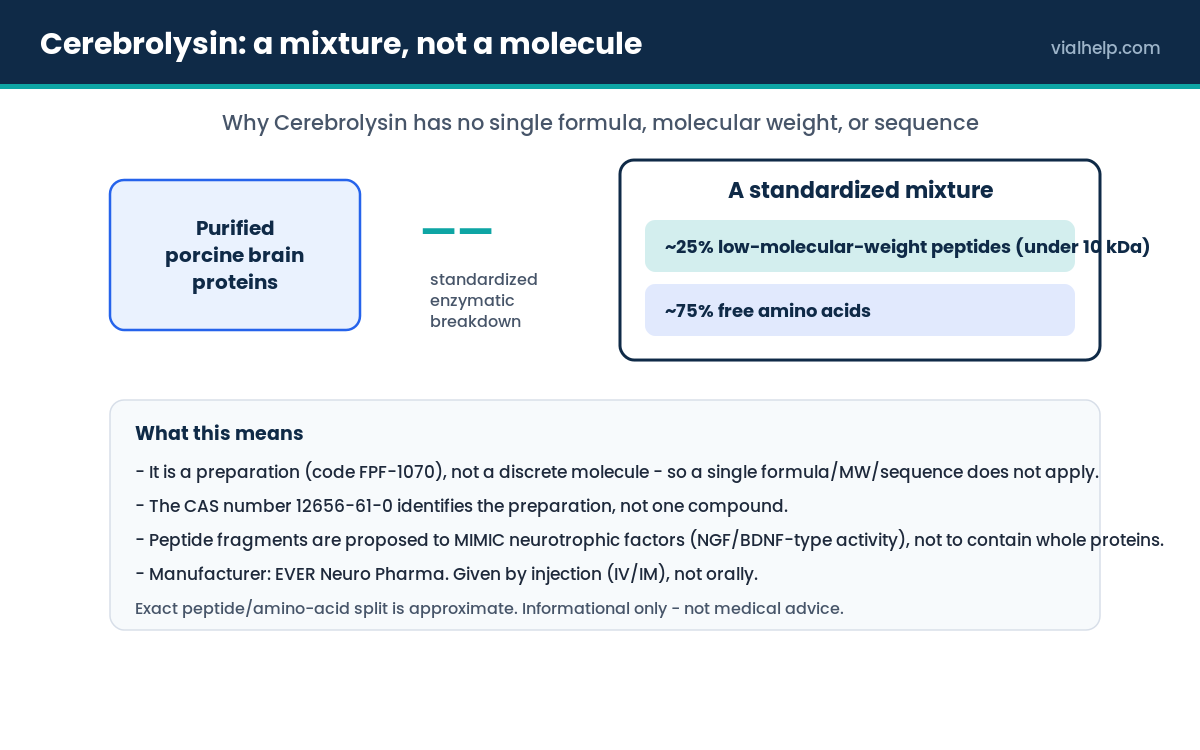
Cerebrolysin is produced by a standardized enzymatic breakdown of lipid-free, purified porcine brain proteins, yielding a mixture of low-molecular-weight peptides (broadly reported as under 10 kDa) together with free amino acids. Because it is a preparation rather than a discrete compound, it has no single molecular formula, molecular weight or amino-acid sequence; the CAS number 12656-61-0 identifies the preparation, not one molecule. It is given by injection — intravenous infusion or intramuscular — never orally, and is marketed in some regions under names such as Renacenz.
A common point of confusion is worth clearing up: some sources list BDNF, GDNF, NGF or CNTF as “constituents.” That is imprecise, because those are large intact proteins whereas Cerebrolysin is defined by peptide fragments under roughly 10 kDa. It is more accurate to say its fragments are proposed to mimic the activity of those neurotrophic factors, not that the product contains the whole proteins.
How Cerebrolysin is studied to work
The mechanism is described in the literature as proposed rather than fully established; the manufacturer states it “stimulates neurotrophic regulation in the central nervous system.” Effects are inferred largely from laboratory studies, and several proposed pathways are usually cited:
- Neurotrophic mimicry — peptide fragments proposed to act like endogenous neurotrophic factors (NGF / BDNF / GDNF / CNTF-type activity), supporting neuron survival and differentiation.
- Anti-apoptotic effects — proposed reduction of programmed neuronal cell death.
- Reduced excitotoxicity — proposed dampening of glutamate-driven neuronal injury.
- Amyloid modulation — proposed effects on amyloid processing, studied in Alzheimer’s models.
- Neuroplasticity and neurogenesis — proposed support of synaptic plasticity and new-neuron formation.
Reviewers caution that its “specific molecular effects are not clear,” and the very short blood half-life of some neurotrophic peptides raises pharmacokinetic questions about how the effects are produced.
Reported effects and benefits in the research literature
- Acute ischaemic stroke — the subject of numerous randomized trials and meta-analyses.
- Vascular dementia — randomized trials pooled in a Cochrane systematic review.
- Alzheimer’s disease — preliminary randomized-trial and review data suggesting possible cognitive effects.
- Traumatic brain injury (TBI) — a meta-analysis reported improved outcome scores, drawn mainly from cohort studies.
- Other, preliminary uses — schizophrenia (adjunct), multiple sclerosis and cerebral palsy, all explicitly early-stage.
What this does NOT mean: the positive signals come largely from heterogeneous, often industry-supported, and frequently low-quality or non-randomized studies. None of this establishes proven clinical benefit — and, as the next section shows, the strongest body of evidence (stroke) is actually negative for its primary outcome.
What the human evidence shows
This is where Cerebrolysin differs from most compounds in this library: it has a real, sizeable trial record, including independent Cochrane systematic reviews.
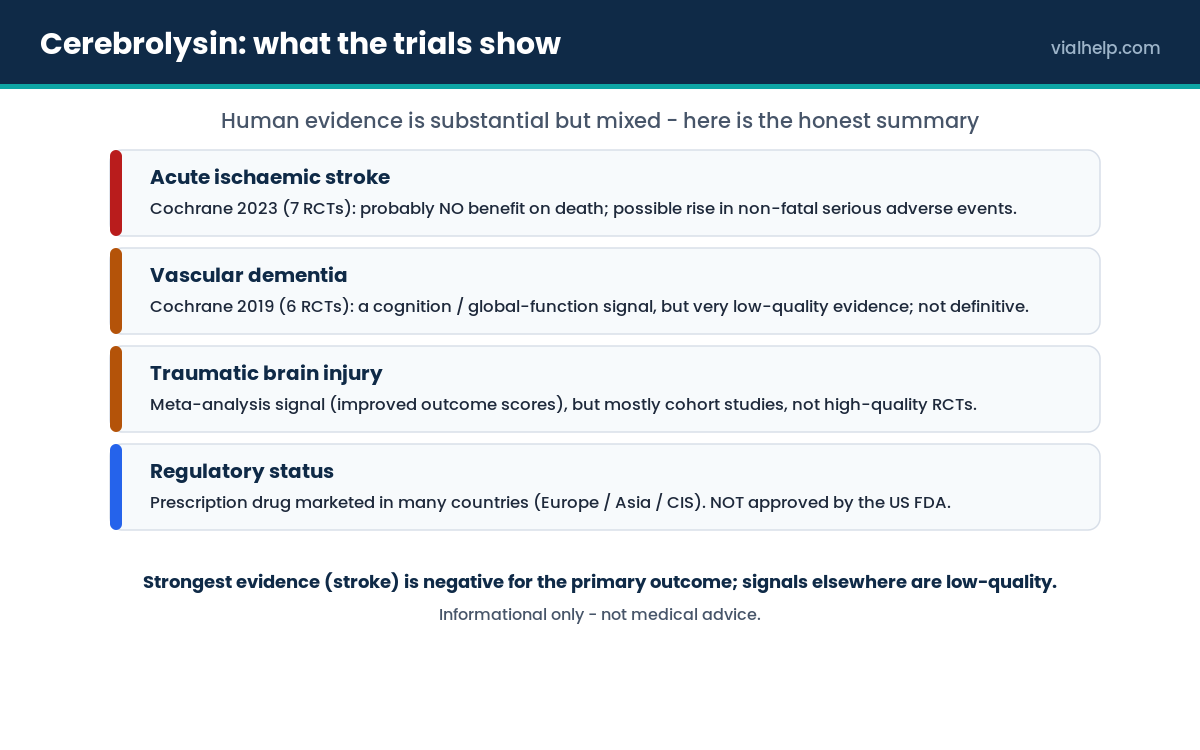
- Acute ischaemic stroke — the 2023 Cochrane review (7 RCTs, 1,773 participants) concluded it probably makes little to no difference to all-cause death, with a probable increase in non-fatal serious adverse events.
- Vascular dementia — the 2019 Cochrane review (6 RCTs, 597 participants) found a cognition and global-function signal, but rated the evidence very low quality and “not definitive.”
- Traumatic brain injury — a meta-analysis reported improved Glasgow Outcome and Rankin scores, but the authors note the data rest mainly on cohort studies, not high-quality RCTs.
- Regulatory status — Cerebrolysin is a prescription drug marketed across parts of Europe, Asia and the former Soviet states, but it is not FDA-approved in the United States. Many supportive trials were manufacturer-funded.
Handling, storage and reconstitution (research context)
- Supplied as a ready-to-use solution in ampoules (concentrate around 215.2 mg/mL), not a lyophilized powder — so it is not reconstituted the way a typical research peptide is.
- Per product labeling: store below 25 °C, protect from light, and use an opened ampoule immediately.
- These figures come from regional package inserts; verify against the local prescribing information before relying on them.
Even though Cerebrolysin ships as a solution, our reconstitution calculator and the IU vs mL explainer are useful references when you are working with powdered peptides that do require mixing.
Cautions and considerations
- Porcine-derived — a biological product that carries the usual considerations of animal-sourced material.
- Prescription medicine where approved; not FDA-approved in the US.
- Best evidence is negative — the stroke Cochrane review found no benefit on death and a possible rise in non-fatal serious adverse events.
- Informational only — not medical advice; decisions about any prescription therapy belong with a qualified clinician.
Frequently asked questions
Is Cerebrolysin a single peptide?
No. It is a standardized mixture of low-molecular-weight peptides and free amino acids derived from porcine brain, which is why it has no single formula, molecular weight or sequence.
Is Cerebrolysin FDA-approved?
No. It is not approved by the US FDA, although it is a marketed prescription drug in many countries across Europe, Asia and the former Soviet states.
Does Cerebrolysin work for stroke or dementia?
The honest answer is “the evidence is mixed and largely weak.” The Cochrane stroke review found no benefit on death; the vascular-dementia review found a cognition signal but rated it very low quality.
How is Cerebrolysin given?
By injection only — intravenous infusion or intramuscular injection. It is not taken orally.
Related compounds and further reading
- Semax — a nootropic research peptide
- Selank — an anxiolytic research peptide
- How to reconstitute peptides
- Sterile technique
- Browse the full peptide library
- All guides
- IU vs mL: why units are not a dose
Share this article
References
- Cochrane review – Cerebrolysin for acute ischaemic stroke (2023)
- Cochrane review – Cerebrolysin for vascular dementia (2019)
- Ghaffarpasand F et al. 2019 – Cerebrolysin in TBI (meta-analysis)
- Drugs.com International – Cerebrolysin (CAS, chemical name)
- EVER Neuro Pharma – Cerebrolysin product page
- Cerebrolysin overview (identifiers, regulatory)
For informational use only. Not medical advice; consult a qualified healthcare professional. 21+.
Cerebrolysin reconstitution calculator
Use the calculator below to find the concentration (mg/mL), draw volume and U-100 syringe units for Cerebrolysin once it is reconstituted with bacteriostatic water. Enter your vial amount and the water volume to see the lab math — informational use only, not dosing advice.