
Follistatin-344
Summary
Follistatin-344 (FS-344) is the 344-amino-acid isoform of follistatin, a myostatin- and activin-binding protein studied for muscle growth. Human data come from AAV follistatin gene therapy, not an injected peptide; it is not FDA-approved.
Quick facts
| Also known as | FS-344, follistatin 344, FST-344, activin-binding protein (344 isoform) |
| Category | Myostatin inhibitor / activin-binding protein |
| Status | Research protein – not FDA-approved; WADA-prohibited (S4 / gene doping) |
| CAS | Not applicable – protein |
| Formula | Not applicable – protein (glycoprotein) |
| Molecular weight | ~38 kDa (344-aa isoform) |
| Sequence | 344-amino-acid isoform (FS-344) of follistatin; gene FST, UniProt P19883 |
| Half-life | Not well established for an injected protein; circulating FST-315 persists longer than tissue-bound FST-288 |
| Storage | Recombinant protein: store lyophilized frozen (-20 C or colder); reconstituted, refrigerate short-term and aliquot/freeze to avoid freeze-thaw. |
In Plain English
Follistatin-344 is a lab-made version of follistatin, a protein your body already makes. Its job is to switch off some of the “stop growing” signals that keep muscles from getting bigger, so researchers study it mainly for muscle growth and muscle-wasting diseases. Importantly, the version actually tested in people was a gene therapy, not an injected peptide, and it is not an approved treatment.
Follistatin-344 (FS-344) is the 344-amino-acid form of follistatin, a naturally occurring protein that acts as a brake-release for muscle growth by binding and neutralizing myostatin and related signals. Originally discovered in the 1980s as a protein that suppresses follicle-stimulating hormone (FSH), follistatin later drew intense research interest because boosting its activity produces dramatic muscle growth in animals — and because it has been tested in humans as a gene therapy for muscular dystrophy.
What is Follistatin-344?
Follistatin is a secreted glycoprotein encoded by the FST gene (UniProt P19883). The gene produces two main precursors — a 344-amino-acid form (FS-344) and a 317-amino-acid form (FS-317). After processing, FS-344 gives rise to FST-315, the long, freely circulating isoform, while FS-317 yields the shorter, tissue-bound FST-288. “Follistatin-344” therefore refers to the precursor of the circulating isoform.
Because follistatin is a large multidomain protein of roughly 38 kilodaltons — not a small molecule — it does not have a simple drug-like molecular formula or a single meaningful CAS number. Any exact formula or CAS circulated for a “follistatin-344 peptide” product should be treated with caution.
How Follistatin-344 is studied to work
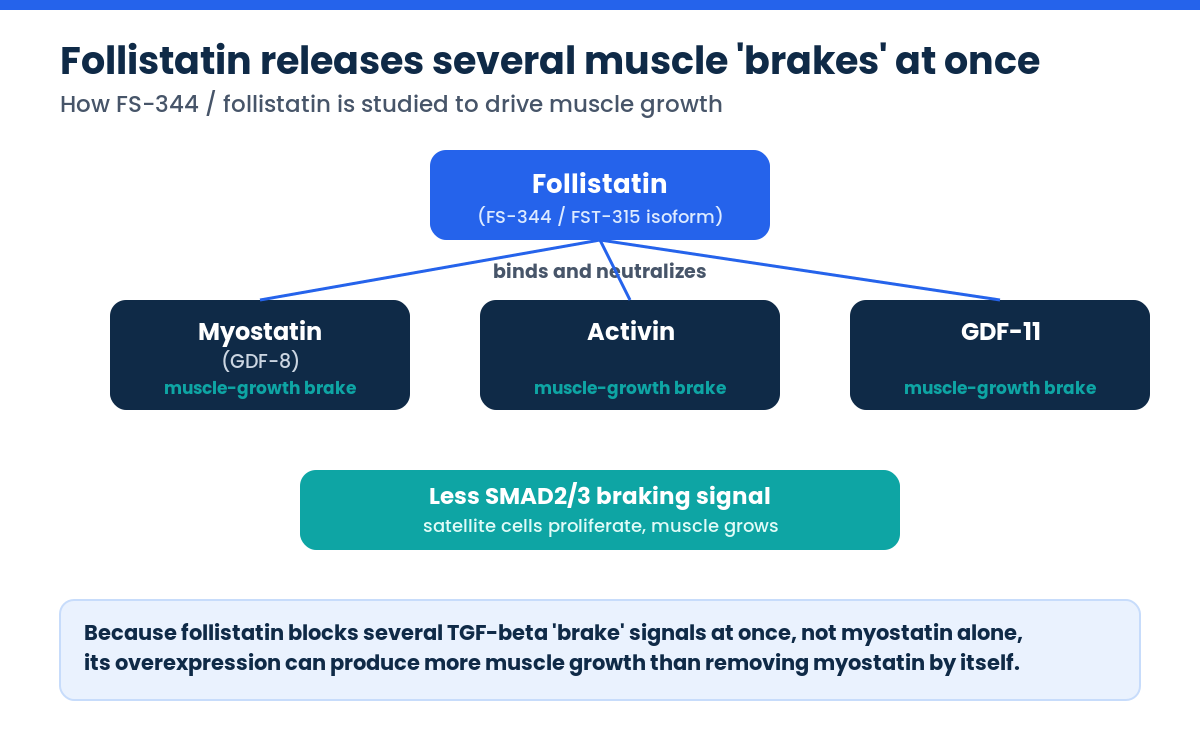
Follistatin works as a high-affinity trap for members of the TGF-beta family of signaling proteins. Several of these normally act as brakes on muscle growth; by binding them, follistatin releases those brakes.
- Binds and neutralizes myostatin (GDF-8), the main negative regulator of muscle mass.
- Also binds activin and GDF-11, related growth-limiting signals.
- Blocking these ligands reduces signaling through the activin type II receptors and the downstream SMAD2/3 pathway.
- Because it blocks several brakes at once, follistatin overexpression can drive more muscle growth than removing myostatin alone.
Reported effects and benefits in the research literature
- Transgenic follistatin overexpression produces striking skeletal-muscle hypertrophy in mice — larger gains than myostatin knockout alone.
- Follistatin drives muscle growth partly by promoting satellite-cell (muscle stem cell) proliferation.
- A single dose of AAV-delivered follistatin produced long-lasting muscle and strength gains in mice and primates.
- Consistent with its discovery, follistatin also regulates the activin-FSH axis in reproductive biology.
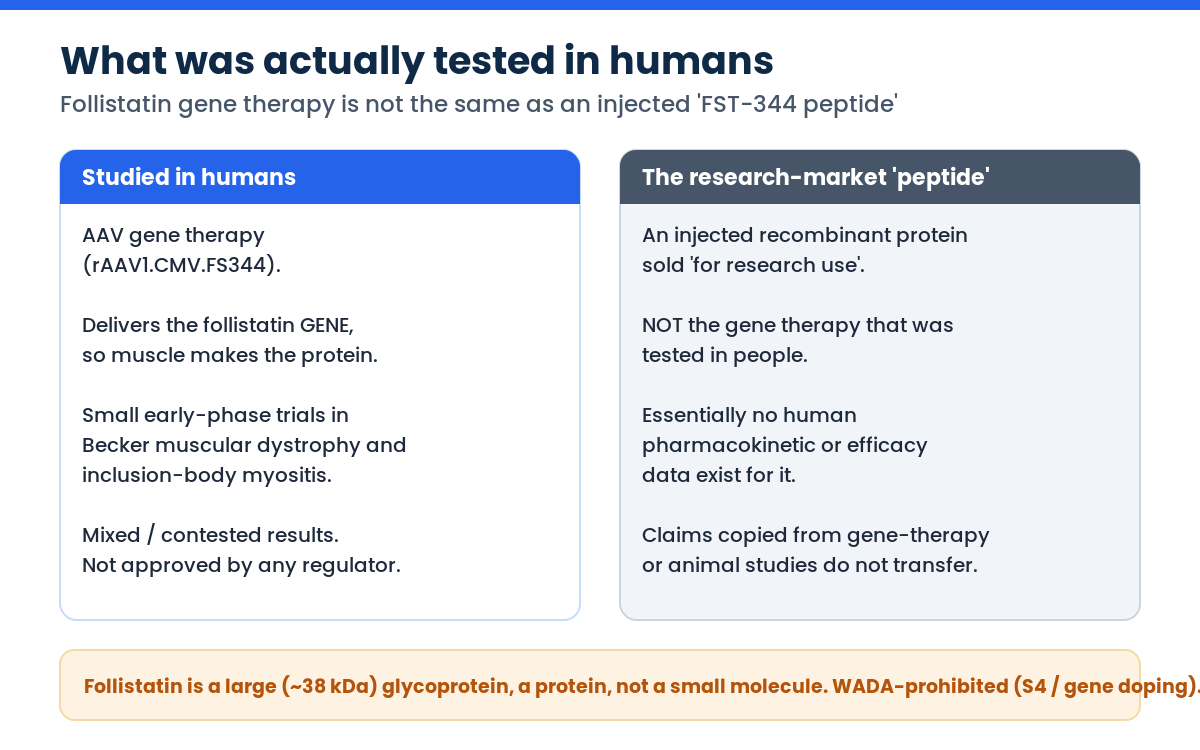
What this does not mean: these findings come from genetically engineered animals or from gene therapy that delivers the follistatin gene. They do not show that injecting a “follistatin-344 peptide” produces muscle growth in humans.
What the human evidence shows
The human research on follistatin has centered on gene therapy, not an injected peptide. In early-phase trials at Nationwide Children’s Hospital, an AAV vector carrying the follistatin gene (rAAV1.CMV.FS344) was injected into the thigh muscles of patients with Becker muscular dystrophy and inclusion-body myositis. Some participants showed improvements in six-minute walk distance along with better muscle-fiber regeneration and reduced fibrosis, and no serious adverse effects were reported in the Becker cohort. However, the inclusion-body-myositis results were later criticized in the peer-reviewed literature for reporting outcomes that differed from what was registered, so those efficacy claims remain contested.
No follistatin drug or peptide is approved by the FDA for any indication. Critically, the injectable “follistatin-344 peptide” sold on the research market is a recombinant protein — not the AAV gene therapy that was tested in people — and there is essentially no human pharmacokinetic or efficacy data for it. In sport, agents that modify myostatin, including follistatin, are prohibited under WADA Category S4, and AAV-follistatin can additionally fall under the gene-doping ban.
Handling, storage and reconstitution (research context)
- As a large protein, follistatin follows recombinant-protein handling rather than small-peptide conventions.
- Lyophilized protein is typically stored frozen (around -20 °C or colder).
- Once reconstituted, keep refrigerated short-term and aliquot/freeze for longer storage to minimize freeze-thaw damage.
To work out concentration and volume relationships after reconstitution, use the VialHelp reconstitution calculator, and see our explainer on why IU/units are a volume mark, not a dose.
Cautions and considerations
- Research protein only — not an approved medicine and no established human dosing.
- The studied human product is a gene therapy, not an injected peptide — do not equate the two.
- Not FDA-approved; WADA-prohibited (S4; gene doping under M3).
- Research-market material varies in purity and identity; a COA and endotoxin testing matter, and verifying a large protein is harder than a short peptide.
- Informational only — not medical advice.
Frequently asked questions
Is follistatin-344 the same as the follistatin gene therapy tested in humans?
No. The human trials used an AAV vector carrying the follistatin gene, which makes the protein inside muscle. A “follistatin-344 peptide” sold for research is an injected recombinant protein with essentially no human data.
Does follistatin build muscle?
Follistatin overexpression builds substantial muscle in animals by blocking myostatin and related brakes. Whether an injected follistatin protein does so in humans has not been established.
Is follistatin-344 a peptide or a protein?
It is a large glycoprotein of about 38 kilodaltons — a protein, not a short peptide — which is why it lacks a simple molecular formula or CAS number.
Is it banned in sport?
Yes. Myostatin-modifying agents including follistatin are on the WADA Prohibited List (S4), and gene-therapy delivery can fall under the gene-doping ban.
Related compounds and further reading
- IGF-1 LR3 — a growth-factor analog studied for muscle.
- MGF (mechano growth factor) — a local muscle-repair peptide.
- How to reconstitute peptides and sterile technique.
- Browse the full Peptide Library and Guides.
- IU vs mL: why units are not a dose.
Share this article
References
- UniProt P19883 (FST_HUMAN) – sequence, isoforms, function
- DrugBank – Follistatin (P19883)
- Mendell et al. – Phase 1/2a Follistatin Gene Therapy for Becker MD, Mol Ther (PMC4426808)
- ClinicalTrials.gov NCT01519349 – Follistatin gene transfer (BMD/sIBM)
- ClinicalTrials.gov NCT02354781 – rAAV1.CMV.huFollistatin344 in Duchenne MD
- Detection of black-market follistatin 344, Drug Test Anal (PMID 31758732)
For informational use only. Not medical advice; consult a qualified healthcare professional. 21+.
Follistatin-344 reconstitution calculator
Use the calculator below to find the concentration (mg/mL), draw volume and U-100 syringe units for Follistatin-344 once it is reconstituted with bacteriostatic water. Follistatin-344 has a molecular weight of ~38 kDa (344-aa isoform). Enter your vial amount and the water volume to see the lab math — informational use only, not dosing advice.
Open the full calculator · Back to the Follistatin-344 profile