
MGF
Summary
MGF (mechano growth factor) is the short C-terminal E-domain peptide derived from IGF-1Ec, a mechanically activated splice variant of the IGF-1 gene, studied for its role in muscle repair and satellite-cell activation. Almost all evidence is preclinical, there are no human clinical trials of the injected peptide, and it is sold for research use only.
Quick facts
| Also known as | Mechano growth factor; IGF-1Ec E-domain peptide; MGF C-terminal peptide; PEG-MGF (stabilized analog) |
| Category | Growth factor / IGF-1 splice variant |
| Status | Research compound – not FDA/EMA approved; prohibited in sport (WADA S2) |
| Formula | C121H199N41O40 (24-aa human E-peptide) |
| Molecular weight | 2868.17 g/mol (24-aa human E-peptide) |
| Sequence | YQPPSTNKNTKSQRRKGSTFEERK (24-aa human E-domain; R23H variant also sold) |
| Half-life | Native peptide degraded within minutes; PEGylated analogs designed to last longer (not well quantified) |
| Storage | Lyophilized: refrigerate short-term, freeze (-20 C or colder) long-term, protect from light/moisture. Reconstituted: 2-8 C, use within a few weeks; avoid freeze-thaw. |
In Plain English
MGF, short for mechano growth factor, is a research peptide — a natural variant of the growth factor IGF-1 that the body makes in muscle after exercise or injury. Scientists study it because it appears to signal muscle to repair and grow, which is why it draws interest in muscle-recovery research. Most of what is known comes from laboratory and animal studies, and it is not an approved drug.
MGF (mechano growth factor) is the short C-terminal peptide produced from IGF-1Ec, a mechanically activated splice variant of the insulin-like growth factor 1 (IGF-1) gene. First described in the late 1990s by Geoffrey Goldspink and colleagues studying how muscle responds to mechanical overload, MGF is studied as an early “kick-start” signal for muscle repair. It is sold only as a research chemical, and almost everything known about it comes from cell and animal work rather than human trials.
What is MGF?
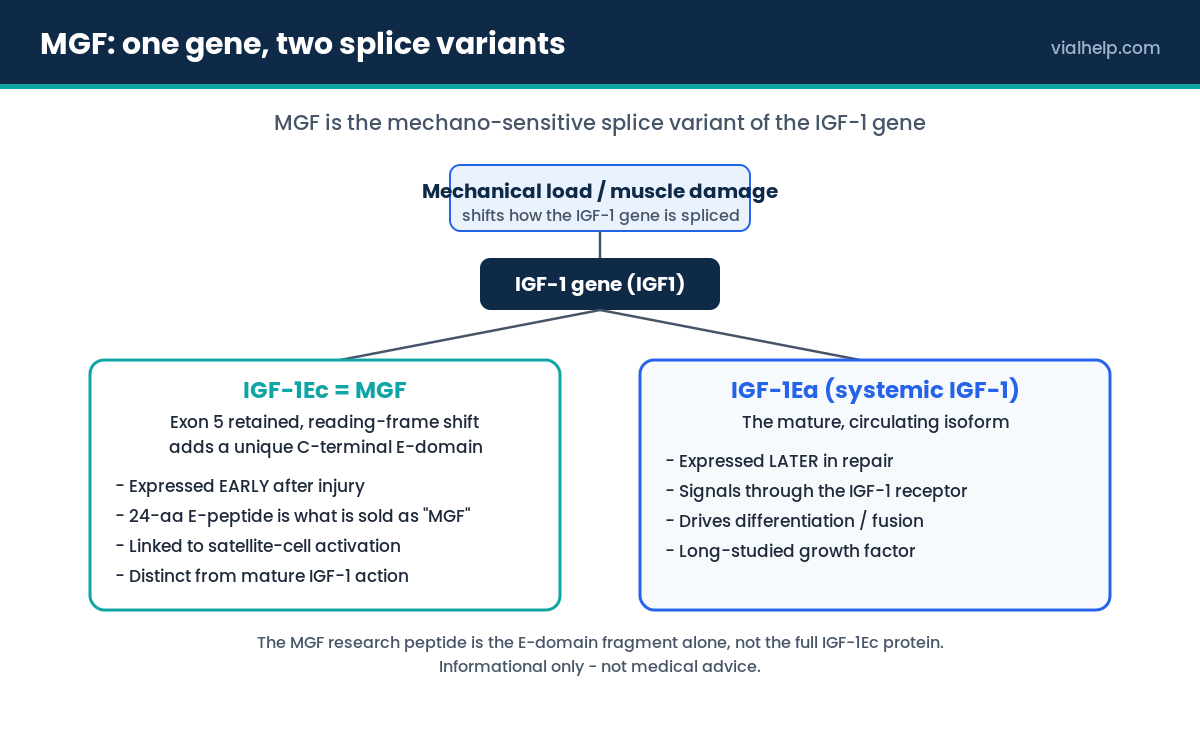
MGF is not a separate gene. When the IGF-1 gene is transcribed, alternative splicing can retain exon 5, which shifts the reading frame and produces a variant called IGF-1Ec with a unique C-terminal “E-domain.” The 24-amino-acid E-peptide cleaved from that domain is what laboratories synthesize and sell as “MGF” — it is the fragment alone, not the full IGF-1Ec protein. Its commonly cited human sequence is YQPPSTNKNTKSQRRKGSTFEERK; many vendors actually supply a rodent-consensus “R23H” variant (ending …FEEHK) while labelling it human, so the exact sequence on a certificate of analysis is worth checking.
Because the native peptide is broken down within minutes in the body, a PEGylated version known as PEG-MGF is also sold. Attaching polyethylene glycol (and sometimes substituting protease-resistant amino acids) is intended to slow degradation, so PEG-MGF has no single fixed molecular weight. MGF belongs to the IGF-1 / growth-factor family and is closely related to the systemic IGF-1 isoform that circulates in blood.
How MGF is studied to work
Mechanical load or muscle damage shifts IGF-1 splicing toward the Ec/MGF isoform. Its expression spikes early after injury, then cells later switch toward the systemic IGF-1Ea isoform that signals through the IGF-1 receptor. The leading hypothesis is that the cleaved E-peptide acts as a local (autocrine/paracrine) signal that activates muscle stem (“satellite”) cells before mature IGF-1 takes over the repair process.
- Satellite-cell activation and proliferation — the headline proposed action, expanding the muscle-progenitor pool rather than strongly forcing differentiation.
- Distinct from mature IGF-1 — which signals through IGF-1R to drive differentiation and cell fusion, whereas the E-peptide is reported to bias cells toward proliferation.
- An unresolved receptor question — the E-peptide’s effects appear independent of IGF-1R, but no dedicated “MGF receptor” has been definitively identified.
- Model-dependent downstream effects on apoptosis and possibly ERK/MAPK signalling.
Reported effects and benefits in the research literature
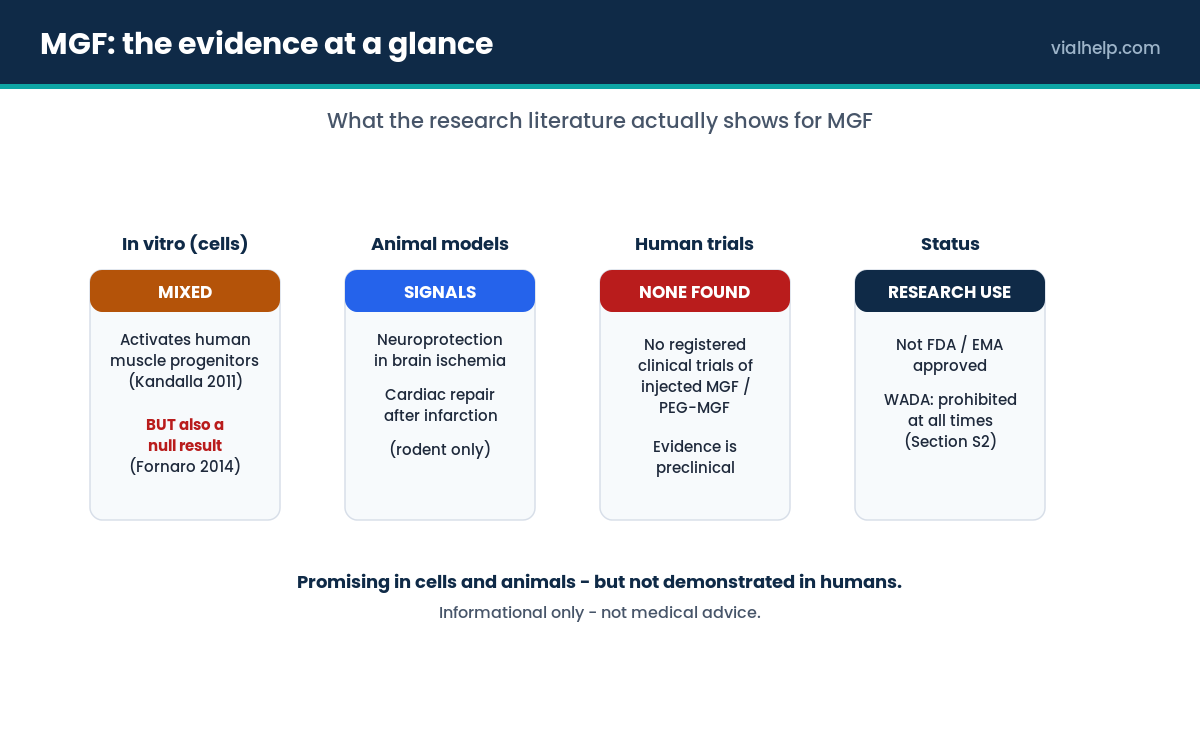
- Muscle repair / satellite-cell activation — the E-peptide activated human muscle progenitor cells in vitro (Kandalla 2011) and is broadly supported in rodent and cell reviews.
- Hypertrophy signalling — local IGF-1Ec/MGF expression is associated with muscle-growth signalling, largely in gene-transfer and animal models.
- Neuroprotection — a strong protective effect in rodent brain ischemia (Dluzniewska 2005) and promotion of neurogenesis in the aging mouse brain.
- Cardiac protection — reduced cardiomyocyte death and preserved function after myocardial infarction in rodents.
- A notable null result — Fornaro 2014 reported the MGF peptide had “no apparent effect” on myoblasts or primary muscle stem cells, so the literature is not unanimous.
What this does NOT mean: these are in-vitro and animal findings, and they include a significant negative study. They do not show that injecting MGF or PEG-MGF builds muscle, accelerates healing, or is safe in people.
What the human evidence shows
There are essentially no human data. A search of clinical-trial registries turns up no registered trials of injected MGF or PEG-MGF, and there are no published human efficacy or safety studies; the evidence base is overwhelmingly preclinical. MGF is not approved by the FDA, the EMA, or any major regulator, and it is sold only as a research chemical “not for human use.” It is also prohibited in sport: the World Anti-Doping Agency lists growth factors including MGF under Section S2 of its Prohibited List, banned at all times. Given how little human safety data exists, it is also worth noting that at least one review has raised theoretical cancer-related concerns about IGF-1 splice isoforms in tumour tissue.
Handling, storage and reconstitution (research context)
- Lyophilized powder: stable refrigerated short-term; commonly kept frozen at -20 °C or colder for long-term storage; protect from light and moisture.
- Reconstituted in bacteriostatic water: refrigerate at 2–8 °C and use within a short window (often cited as a few weeks); avoid repeated freeze-thaw cycles.
- These are general lyophilized-peptide handling norms rather than MGF-specific published standards.
Working out a concentration after reconstitution is just arithmetic once you know the vial mass and the water volume — our reconstitution calculator does the mg/mL math for you, and IU vs mL: why units are not a dose explains why a syringe “unit” is a volume mark, not an amount of peptide.
Cautions and considerations
- Research compound — not approved for human use by any major regulator.
- Evidence is preclinical — a key in-vitro study found no effect, and no human trials exist.
- Quality varies — confirm identity, purity (HPLC) and endotoxin on a certificate of analysis; vendors frequently mislabel the human versus R23H sequence.
- Prohibited in sport (WADA Section S2).
- Informational only — not medical advice.
Frequently asked questions
Is MGF the same as IGF-1?
No. MGF is a short peptide derived from a splice variant of the same gene. Mature IGF-1 is the circulating growth factor that signals through the IGF-1 receptor; the MGF E-peptide is studied as a distinct early-repair signal whose receptor has not been identified.
What is the difference between MGF and PEG-MGF?
MGF is the natural short peptide, which degrades within minutes. PEG-MGF is the same peptide with polyethylene glycol attached to slow that breakdown, so it is marketed as longer-acting. PEG-MGF has no single fixed molecular weight because PEG chain sizes vary.
Does MGF build muscle in humans?
There is no human evidence that it does. Muscle-related findings come from cell cultures and animals, and at least one in-vitro study found no effect at all.
Is MGF approved or legal to use?
It is not approved by the FDA or EMA and is sold only for laboratory research. It is also banned in sport at all times under WADA Section S2.
Related compounds and further reading
- IGF-1 LR3 — a long-acting IGF-1 analog
- IGF-1 DES — a truncated, more potent IGF-1 metabolite
- MK-677 (Ibutamoren) — an oral growth-hormone secretagogue
- How to reconstitute peptides
- Sterile technique
- Browse the full peptide library
- All guides
- IU vs mL: why units are not a dose
- Follistatin-344 — studied for binding myostatin and activin in muscle research.
Share this article
References
- Mechano growth factor (overview)
- PubChem CID 175675731 (formula, molecular weight)
- Matheny RW et al. 2010, Endocrinology (review)
- Zablocka B et al. 2012, Frontiers in Endocrinology
- Dluzniewska J et al. 2005, FASEB Journal (neuroprotection)
- Fornaro M et al. 2014, Am J Physiol Endocrinol Metab (null result)
For informational use only. Not medical advice; consult a qualified healthcare professional. 21+.
MGF reconstitution calculator
Use the calculator below to find the concentration (mg/mL), draw volume and U-100 syringe units for MGF once it is reconstituted with bacteriostatic water. MGF has molecular formula C121H199N41O40 (24-aa human E-peptide) and a molecular weight of 2868.17 g/mol (24-aa human E-peptide). Enter your vial amount and the water volume to see the lab math — informational use only, not dosing advice.