
MK-677 (Ibutamoren)
Summary
MK-677 (ibutamoren) is an orally active, non-peptide ghrelin-receptor agonist studied as a long-acting growth hormone secretagogue that raises GH and IGF-1.
Quick facts
| Also known as | Ibutamoren; Ibutamoren mesylate; MK-0677; L-163,191; Nutrobal |
| Category | Growth hormone secretagogue (ghrelin receptor agonist) |
| Status | Investigational / research compound (not FDA-approved) |
| CAS | 159752-10-0 (mesylate); 159634-47-6 (free base) |
| Formula | C27H36N4O5S (free base) |
| Molecular weight | 528.66 g/mol (free base) |
| Sequence | Non-peptide small molecule (no amino-acid sequence) |
| Half-life | ~24 hours |
| Storage | Solid: cool, dry, protect from light. In solution: refrigerate, protect from light. |
In Plain English
MK-677 is an oral compound (not actually a peptide) that signals the body to release more of its own growth hormone. Because it is taken as a pill and lasts about a day, it is convenient to study. It is an investigational compound, not an approved medicine.
MK-677 (ibutamoren) is an orally active growth hormone secretagogue first developed by Merck in the 1990s under the code name L-163,191. Unlike the injectable peptides it is usually grouped with, MK-677 is a non-peptide small molecule that mimics the hunger hormone ghrelin. Because it survives digestion, MK-677 can be taken by mouth to raise growth hormone (GH) and insulin-like growth factor 1 (IGF-1).
What is MK-677?
MK-677, also called ibutamoren (or, as a salt, ibutamoren mesylate) and known by the older code names MK-0677 and L-163,191, is an agonist of the ghrelin / growth-hormone-secretagogue receptor (GHS-R1a). Chemically it is a spiropiperidine small molecule with the formula C27H36N4O5S (about 528.7 g/mol) — not a peptide, which is exactly why it stays active after oral dosing. Merck investigated it for conditions involving low GH, including age-related frailty and muscle wasting, but it was never approved as a medicine. Today it is encountered mainly as a research and investigational compound.
How MK-677 is studied to work
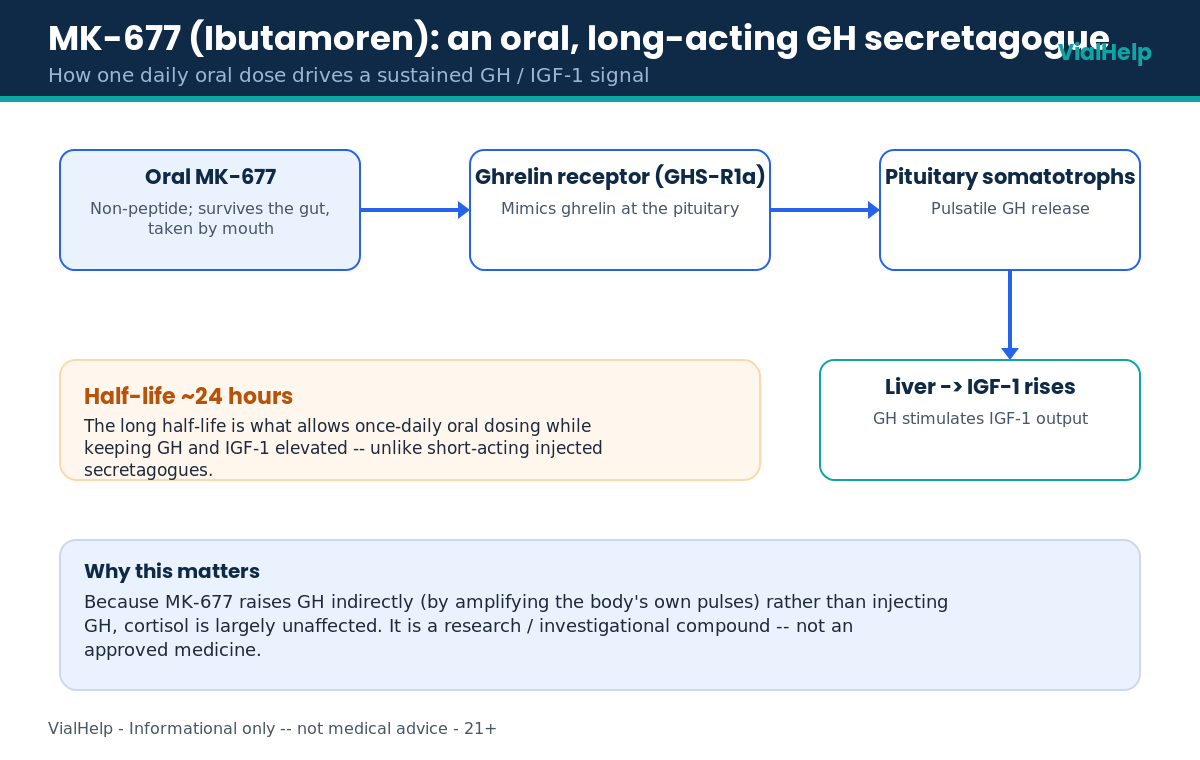
Growth hormone is normally released from the pituitary gland in bursts, or pulses. MK-677 increases those pulses indirectly: instead of injecting GH, it imitates ghrelin and switches on the same receptor that ghrelin uses, prompting the pituitary to release more of the body’s own GH. Studied pathways include:
- Binds the ghrelin / growth-hormone-secretagogue receptor (GHS-R1a) in the pituitary and hypothalamus
- Amplifies the natural, pulsatile release of growth hormone rather than replacing it
- Raises downstream IGF-1 produced by the liver
- Has little effect on cortisol or prolactin at the doses studied
- A long half-life of roughly 24 hours supports once-daily oral dosing
Reported effects and benefits in the research literature
Across published human and animal studies, the effects most often reported for MK-677 include:
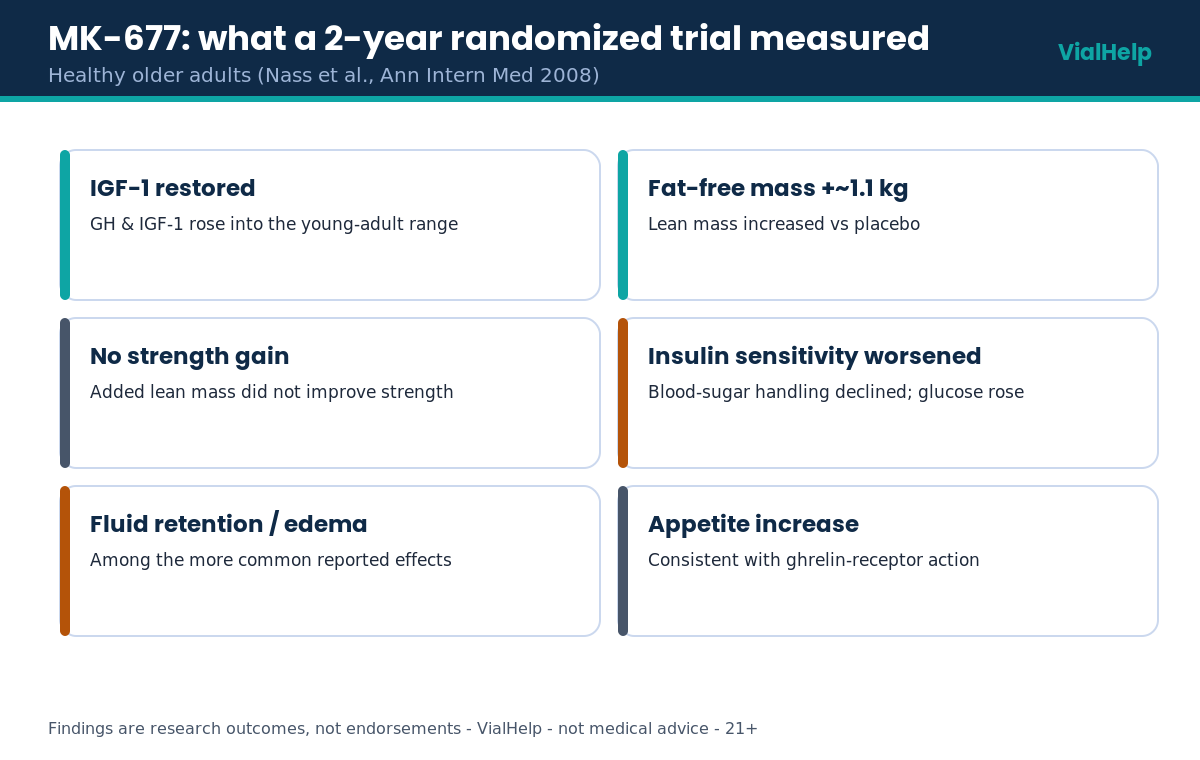
- Higher GH and IGF-1, restored toward young-adult ranges in older adults (Nass 2008; Chapman 1996)
- Increased fat-free (lean) body mass — about 1.1 kg over a year versus placebo in older adults
- Increased appetite, consistent with activation of the ghrelin receptor
- Increased markers of bone turnover (Murphy 1999)
- Improved self-reported sleep quality in some studies
What this does NOT mean: these are measured research outcomes, not proof of benefit or safety for any personal use. The same trials also reported no gain in muscle strength and a worsening of insulin sensitivity (see below). MK-677 is not an approved treatment for any condition.
What the human evidence shows
MK-677 has been examined in several controlled human trials. The most cited is a two-year, double-blind, randomized, placebo-controlled study in 65 healthy adults aged 60–81 (Nass et al., Annals of Internal Medicine, 2008): GH and IGF-1 rose into the young-adult range and fat-free mass increased by about 1.1 kg, but there was no improvement in strength, and insulin sensitivity worsened with higher fasting glucose. An earlier study (Chapman et al., 1996) likewise showed sustained increases in GH and IGF-1 in older subjects. A large trial in Alzheimer’s disease (2008) found no slowing of disease progression. On regulatory status, MK-677 is not approved by the FDA or EMA for any indication, and it is prohibited in sport by the World Anti-Doping Agency as a growth-hormone secretagogue.
Handling, storage and reconstitution (research context)
MK-677 is a small molecule rather than a lyophilized peptide, so it is usually supplied as a solid or a ready-made solution rather than something you mix yourself. General handling principles:
- Solid/powder: store cool and dry, protected from light and moisture
- Solutions: keep refrigerated and protected from light; label the date prepared
- For peptides that do require mixing, use the reconstitution calculator to work out concentration and volume
- If you are unsure how “units” relate to milligrams, read why units are not a dose
Cautions and considerations
- MK-677 is an investigational / research compound, not an approved medicine
- It can raise blood glucose and reduce insulin sensitivity — a meaningful consideration for anyone with blood-sugar concerns
- Fluid retention, increased appetite and lethargy are commonly reported
- Purity and identity vary by source; a Certificate of Analysis (COA) helps confirm what a product contains
- This page is informational only and is not medical advice
Frequently asked questions
Is MK-677 a peptide?
No. Despite often being sold alongside peptides, MK-677 is a non-peptide small molecule. That chemistry is why it is orally active, whereas most GH-releasing peptides must be injected.
Does MK-677 actually increase growth hormone?
Yes — indirectly. By activating the ghrelin receptor it amplifies the body’s own GH pulses, and controlled trials have measured increases in both GH and IGF-1.
Is MK-677 approved or legal?
It is not approved as a medicine by the FDA or EMA. It is used as a research compound and is banned in competitive sport by WADA.
What downsides are most commonly reported?
Increased appetite, water retention, higher blood sugar, and tiredness are the effects reported most often in studies.
Related compounds and further reading
- Ipamorelin — a selective injectable GH-releasing peptide
- CJC-1295 (with DAC) — a long-acting GHRH analog often discussed alongside secretagogues
- How to reconstitute peptides
- Sterile technique
- Peptide Library · Guides
- IU vs mL: why units are not a dose
Share this article
References
- Ibutamoren
- Ibutamoren, PubChem CID 151909
- Nass R et al. Effects of an oral ghrelin mimetic on body composition and clinical outcomes in healthy older adults: a randomized trial. Ann Intern Med 2008
- Chapman IM et al. Stimulation of the GH-IGF-I axis by daily oral MK-677 in healthy elderly. J Clin Endocrinol Metab 1996
- Murphy MG et al. Oral MK-677 increases markers of bone turnover in elderly. J Bone Miner Res 1999
- Sigalos JT, Pastuszak AW. The safety and efficacy of growth hormone secretagogues. Sex Med Rev 2018
For informational use only. Not medical advice; consult a qualified healthcare professional. 21+.
MK-677 (Ibutamoren) reconstitution calculator
Use the calculator below to find the concentration (mg/mL), draw volume and U-100 syringe units for MK-677 (Ibutamoren) once it is reconstituted with bacteriostatic water. MK-677 (Ibutamoren) has molecular formula C27H36N4O5S (free base) and a molecular weight of 528.66 g/mol (free base). Enter your vial amount and the water volume to see the lab math — informational use only, not dosing advice.
Open the full calculator · Back to the MK-677 (Ibutamoren) profile