
IGF-1 DES
Summary
IGF-1 DES (des(1-3)IGF-1) is a truncated, naturally occurring form of insulin-like growth factor 1 that lacks the N-terminal Gly-Pro-Glu tripeptide. The change weakens its binding to IGF-binding proteins, leaving more free peptide and making it more potent than IGF-1 in several animal models. It is a research compound, not an approved medicine.
Quick facts
| Also known as | des(1-3)IGF-1, DES(1-3)IGF-I, des-IGF-1, Insulin-like growth factor 1 des-(1-3) |
| Category | IGF / growth-factor analogue |
| Status | Research compound — not FDA-approved |
| CAS | 112603-35-7 |
| Formula | C319H501N91O96S7 |
| Molecular weight | ~7,371 g/mol (about 7.4 kDa) |
| Sequence | TLCGAELVDALQFVCGDRGFYFNKPTGYGSSSRRAPQTGIVDECCFRSCDLRRLEMYCAPLKPAKSA (67 aa) |
| Half-life | Short — minutes to tens of minutes in rodents (exact value uncertain); shorter than native IGF-1 |
| Storage | Lyophilized: store at -20 C (long-term -20 to -80 C). Reconstituted: 2-8 C, use within ~2-4 weeks; avoid freeze-thaw. |
In Plain English
IGF-1 DES is a research peptide, a shortened and more potent version of the natural growth factor IGF-1. Scientists study it for how it may signal muscle and other tissue to grow and repair, and it is of interest because it appears to act more strongly and briefly than regular IGF-1. Nearly all of this work is in the laboratory and in animals; it is not an approved medicine.
IGF-1 DES (short for des(1-3)IGF-1) is a naturally occurring, truncated form of insulin-like growth factor 1 that is studied in the laboratory as a more potent IGF-1 variant. It is identical to native IGF-1 except that it is missing the first three amino acids at one end of the chain — a small change with an outsized effect on how the molecule behaves.
What is IGF-1 DES?
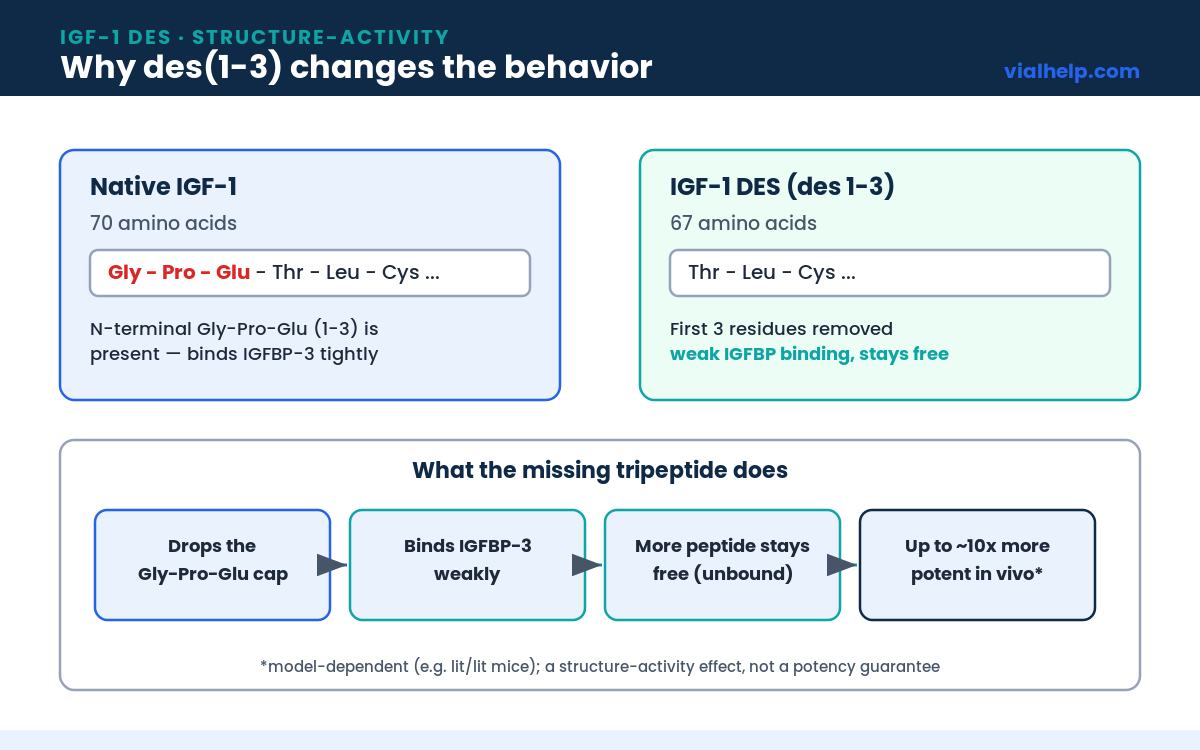
IGF-1 DES is a 67‑amino-acid peptide derived from insulin-like growth factor 1 (IGF-1) by removing the N-terminal tripeptide glycine-proline-glutamate (Gly-Pro-Glu, residues 1–3). That is the entire structural difference between the two molecules — hence the name “des(1-3).” It is not a wholly synthetic invention: des(1-3)IGF-1 occurs naturally in human brain tissue and bovine colostrum and is generated when enzymes clip the N-terminus off circulating IGF-1.
Removing those three residues sharply lowers the peptide’s affinity for the IGF-binding proteins (IGFBPs), especially IGFBP-3, which normally bind and sequester the great majority of IGF-1 in circulation. Because IGF-1 DES escapes that buffering, more of it remains free and able to engage its receptor — the basis for its higher apparent potency in several animal models.
How IGF-1 DES is studied to work
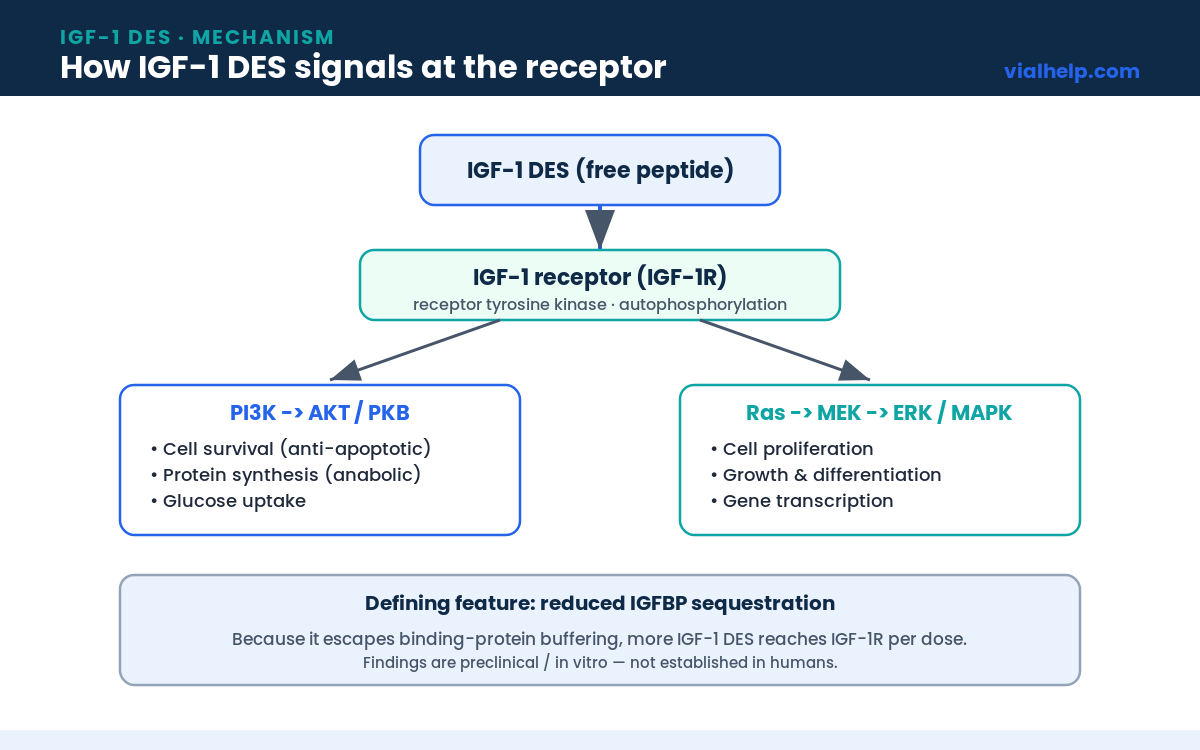
IGF-1 DES is thought to act through the same receptor system as IGF-1, but to reach it more efficiently. In circulation, roughly 95–98% of IGF-1 is bound to IGFBPs and is effectively held in reserve. With its binding-protein affinity reduced, IGF-1 DES stays largely free, binds the type‑1 IGF receptor (IGF-1R), and triggers the canonical IGF/insulin signaling cascade.
- IGF-1 receptor (IGF-1R): the primary target, a receptor tyrosine kinase that autophosphorylates on activation.
- Reduced IGFBP sequestration: the defining pharmacodynamic feature — weak IGFBP-3 binding leaves more free, receptor-available peptide.
- PI3K → AKT/PKB pathway: drives cell survival, protein synthesis (anabolic signaling) and glucose uptake.
- Ras → MEK → ERK/MAPK pathway: drives cell proliferation, growth and gene transcription.
- IRS-1/IRS-2 and Shc adaptors: recruited at the activated receptor to launch those downstream pathways.
Reported effects and benefits in the research literature
The findings below come from cell-culture and animal studies. They describe what researchers have measured in those models — not established outcomes in people.
- Greater potency than IGF-1 in vivo: in GH-deficient (lit/lit) mice, des(1-3)IGF-1 was reported up to roughly 10-fold more potent than IGF-1 (Gillespie 1990), though the differential is smaller in other assays.
- Anabolic effects in catabolic states: in dexamethasone-treated and diabetic rats, IGF-1 variants including des(1-3)IGF-1 increased weight gain, nitrogen retention and muscle protein synthesis; des(1-3)IGF-1 was about 2.5-fold more potent than IGF-1 in one catabolic-rat model (Tomas 1992).
- Tissue growth: enhanced gut growth after intestinal resection in rats.
- Cell proliferation: stimulated DNA synthesis in cultured myoblasts and fibroblasts at lower concentrations than full-length IGF-1.
What this does NOT mean: none of these results demonstrate muscle growth, recovery, anti-aging or performance benefits in humans. All efficacy data are preclinical, and as an IGF-1R agonist the peptide carries theoretical proliferative and blood-sugar considerations that are uncharacterized in people.
What the human evidence shows
There is essentially no human clinical evidence for IGF-1 DES as a therapeutic. It has no FDA approval for any use and is handled strictly as a laboratory research reagent; no clinical trials of the peptide itself as a drug were identified. (Note that full-length recombinant IGF-1, mecasermin/Increlex, is a separate, approved medicine — IGF-1 DES is not that molecule and is not approved.) IGF-1 and its analogues, including des(1-3)IGF-1, are also prohibited at all times in sport under Section S2 of the WADA Prohibited List.
Handling, storage and reconstitution (research context)
- Lyophilized powder: typically stored at −20 °C (long-term −20 °C to −80 °C), protected from light and moisture.
- Reconstituted solution: refrigerate at 2–8 °C and use within a short window (commonly cited as ~2–4 weeks); avoid repeated freeze–thaw cycles.
- Concentration math: work in mg/mL, not “units.” Our reconstitution calculator converts vial amount and diluent volume into concentration, and the explainer on why units are not a dose covers the common syringe-reading mistake.
- Always follow the specific product’s Certificate of Analysis (COA) and label.
Cautions and considerations
- Research compound only — not FDA-approved, not a medicine, and not for human or veterinary use.
- No established human dosing, safety or efficacy.
- Prohibited in sport (WADA Section S2) at all times.
- Purity and identity vary by source — a third-party COA (mass spec / HPLC) is essential, and net peptide content matters for accurate concentration.
- Informational and educational content only — not medical advice. Audience 21+.
Frequently asked questions
How is IGF-1 DES different from IGF-1 LR3?
Both are IGF-1 analogues engineered to evade binding proteins, but differently. IGF-1 DES is truncated — it removes the first three residues, giving a 67-amino-acid peptide. IGF-1 LR3 instead adds a 13-amino-acid N-terminal extension and swaps one residue, producing a longer peptide with a substantially longer half-life.
Is IGF-1 DES FDA-approved?
No. It has no FDA approval for any use and is treated as a research reagent. Native full-length IGF-1 (mecasermin/Increlex) is a separate, approved drug — IGF-1 DES is not that molecule.
Why is IGF-1 DES considered more potent than regular IGF-1?
Because it binds IGF-binding proteins (especially IGFBP-3) weakly, so more of it stays free and active; in some animal models that translated to roughly 10-fold greater potency than IGF-1.
Is IGF-1 DES banned in sports?
Yes. IGF-1 and its analogues, including des(1-3)IGF-1, are prohibited at all times under Section S2 of the WADA Prohibited List.
Related compounds and further reading
- How to reconstitute peptides — step-by-step research-handling guide.
- Sterile technique — clean handling and contamination prevention.
- IGF-1 LR3 — the long-acting, N-terminally extended IGF-1 analogue.
- MK-677 (Ibutamoren) — an oral growth-hormone secretagogue often discussed alongside IGF-1 compounds.
- Browse the full peptide library and the handling guides.
Share this article
References
- PubChem Substance: Insulin-like growth factor 1, des-(1-3)- (SID 135331146)
- Gillespie C, et al. Enhanced potency of truncated IGF-I (des(1-3)IGF-I) in lit/lit mice. J Endocrinol 1990 (PMID 2280209)
- Tomas FM, et al. IGF-I and especially IGF-I variants are anabolic in dexamethasone-treated rats. Biochem J 1992 (PMID 1371669)
- Yamamoto H, Murphy LJ. Enzymatic conversion of IGF-I to des(1-3)IGF-I in rat serum and tissues. J Endocrinol 1995 (PMID 7561610)
- UniProt P05019 – Insulin-like growth factor I (human), native sequence reference
- WADA Prohibited List – Section S2 (Peptide Hormones, Growth Factors)
For informational use only. Not medical advice; consult a qualified healthcare professional. 21+.
IGF-1 DES reconstitution calculator
Use the calculator below to find the concentration (mg/mL), draw volume and U-100 syringe units for IGF-1 DES once it is reconstituted with bacteriostatic water. IGF-1 DES has molecular formula C319H501N91O96S7 and a molecular weight of ~7,371 g/mol (about 7.4 kDa). Enter your vial amount and the water volume to see the lab math — informational use only, not dosing advice.