
GHRP-2 (Pralmorelin)
Summary
GHRP-2 (pralmorelin) is a synthetic ghrelin-mimetic hexapeptide that stimulates pulsatile growth hormone release; it underlies an approved GH-deficiency diagnostic test in Japan.
Quick facts
| Also known as | Pralmorelin; KP-102; GPA-748; Growth Hormone-Releasing Peptide-2 |
| Category | Growth hormone secretagogue / GHRP (ghrelin receptor agonist) |
| Status | Approved diagnostic agent (Japan); otherwise investigational |
| CAS | 158861-67-7 |
| Formula | C45H55N9O6 |
| Molecular weight | 817.98 g/mol |
| Sequence | D-Ala-D-2-Nal-Ala-Trp-D-Phe-Lys-NH2 |
| Half-life | ~30 minutes |
| Storage | Lyophilized: store frozen/refrigerated, protect from light. Reconstituted: refrigerate, use within weeks. |
In Plain English
GHRP-2 is a small lab-made peptide that triggers a strong release of the body’s own growth hormone. In Japan it is used as part of a test of the growth-hormone system. Researchers study it for growth-hormone release and appetite.
GHRP-2 (pralmorelin) is a synthetic growth hormone-releasing peptide developed from the pioneering work of endocrinologist Cyril Bowers in the 1980s and 1990s. A small six-amino-acid peptide, GHRP-2 mimics the hormone ghrelin to trigger sharp pulses of growth hormone (GH), and it forms the basis of an approved diagnostic test for GH deficiency in Japan.
What is GHRP-2?
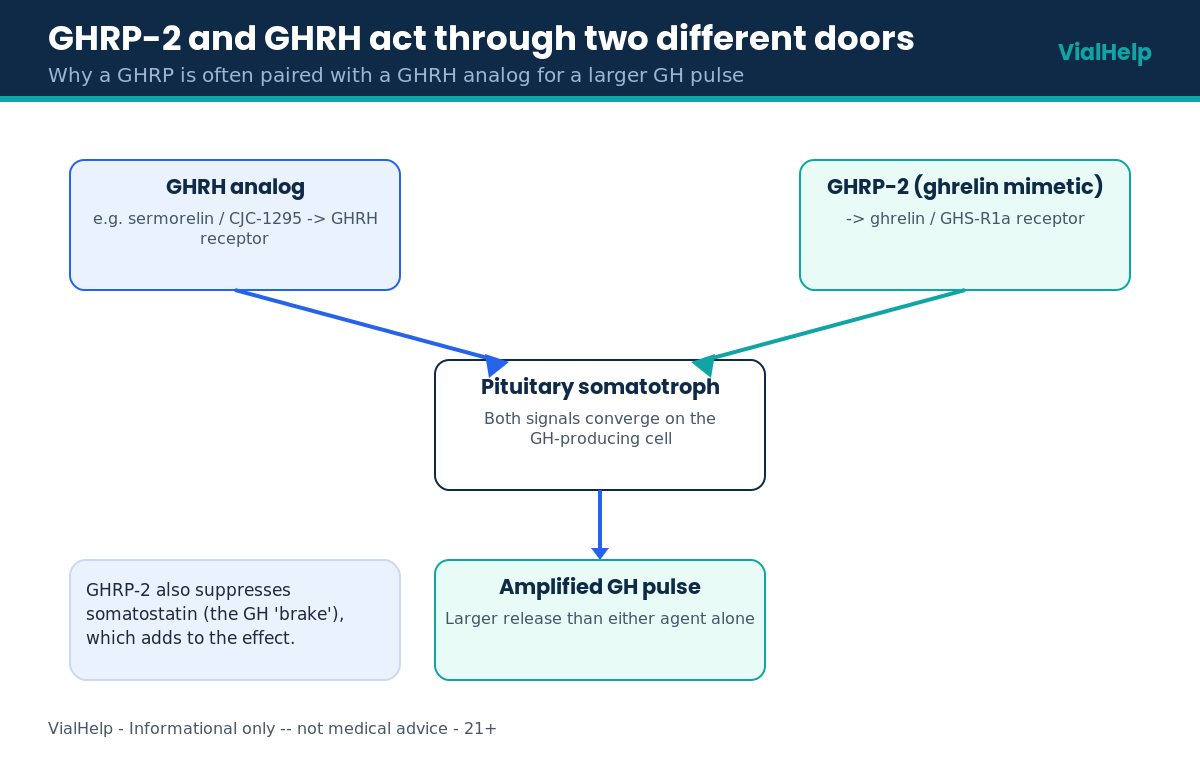
GHRP-2, also known as pralmorelin or KP-102, is a synthetic hexapeptide with the sequence D-Ala-D-2-Nal-Ala-Trp-D-Phe-Lys-NH2 (formula C45H55N9O6, about 818 g/mol). It is an agonist of the ghrelin / growth-hormone-secretagogue receptor (GHS-R1a) and belongs to the growth hormone-releasing peptide (GHRP) family alongside GHRP-6 and hexarelin. Importantly, GHRP-2 works through a different receptor than GH-releasing hormone analogs such as sermorelin or CJC-1295: those act on the GHRH receptor, while GHRP-2 acts on the ghrelin receptor.
How GHRP-2 is studied to work
GHRP-2 raises growth hormone by imitating ghrelin and pushing on several levers at once:
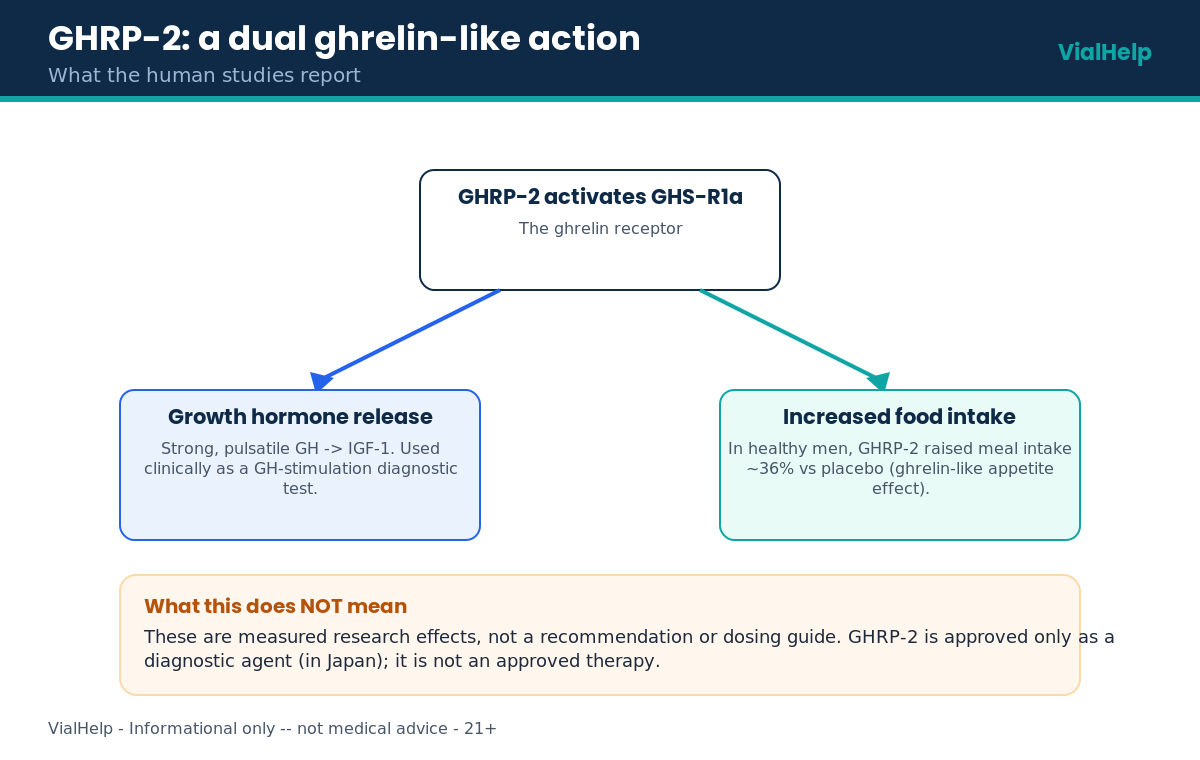
- Activates the ghrelin / GHS-R1a receptor on the pituitary and hypothalamus
- Stimulates a strong, pulsatile release of growth hormone
- Suppresses somatostatin, the body’s natural “brake” on GH
- Amplifies the action of the body’s own GH-releasing hormone
- Because it uses a separate pathway, it is often paired with a GHRH analog for a larger, synergistic GH pulse
Reported effects and benefits in the research literature
Effects reported for GHRP-2 in human and animal studies include:
- A robust rise in GH and IGF-1 — strong enough that GHRP-2 is used as a GH-stimulation diagnostic test
- Increased food intake: healthy men ate about 36% more after GHRP-2 versus placebo (Laferrère 2005)
- Studied for short stature and GH deficiency in children
- Investigated for effects on muscle, sleep quality and immune function
What this does NOT mean: these are measured research effects, not a recommendation or a dosing guide. Outside its diagnostic role, GHRP-2 remains investigational, and the appetite effect is a notable downside for some uses.
What the human evidence shows
GHRP-2 has its firmest footing as a diagnostic agent: it was approved in Japan in 2004 (as pralmorelin) for assessing growth hormone deficiency in adults and children, with phase II trials reporting high sensitivity for GH-stimulation testing. In healthy volunteers it reliably increases both GH secretion and food intake. Beyond diagnostics, its therapeutic use remains investigational — it is not FDA-approved as a treatment, and it is prohibited in sport by the World Anti-Doping Agency.
Handling, storage and reconstitution (research context)
GHRP-2 is supplied as a lyophilized (freeze-dried) powder and is reconstituted before use. General handling principles:
- Lyophilized powder: store frozen or refrigerated, protected from light
- Reconstitute with bacteriostatic water; once in solution, refrigerate and use within a few weeks
- Use the reconstitution calculator to convert vial strength and water volume into a concentration (mg/mL)
- See why units are not a dose before reading syringe markings
Cautions and considerations
- GHRP-2 is approved only as a diagnostic agent (Japan); other uses are investigational
- It reliably increases appetite, which may be undesirable depending on context
- Like other GH-raising compounds, it can affect fluid balance and blood sugar
- Confirm identity and purity with a Certificate of Analysis (COA)
- This page is informational only and is not medical advice
Frequently asked questions
What is the difference between GHRP-2 and GHRP-6?
Both are ghrelin-mimetic GHRPs. GHRP-2 is generally regarded as the more potent GH releaser for its size, while GHRP-6 tends to produce a stronger hunger response.
Does GHRP-2 increase appetite?
Yes. Because it acts on the ghrelin receptor, increased food intake is a well-documented and expected effect.
Is GHRP-2 approved or legal?
It is approved as a diagnostic agent in Japan but is not an approved therapy elsewhere, and it is banned in competitive sport by WADA.
Why is GHRP-2 combined with a GHRH analog?
Because the two act on different receptors, combining a GHRP with a GHRH analog produces a larger GH pulse than either alone — a synergy described in classic endocrine studies.
Related compounds and further reading
- Ipamorelin — a more selective GHRP with little appetite effect
- CJC-1295 (with DAC) — a GHRH analog commonly paired with GHRPs
- How to reconstitute peptides
- Sterile technique
- Peptide Library · Guides
- IU vs mL: why units are not a dose
Share this article
References
- Pralmorelin
- Pralmorelin, PubChem CID 6918245
- Laferrere B et al. Growth hormone releasing peptide-2 (GHRP-2), like ghrelin, increases food intake in healthy men. J Clin Endocrinol Metab 2005
- Garin MC et al. / GHRP-2 increases food intake (PMC)
- Sigalos JT, Pastuszak AW. The safety and efficacy of growth hormone secretagogues. Sex Med Rev 2018
- Obese subjects respond to the ghrelin agonist GHRP-2 on food intake. Obesity 2006
For informational use only. Not medical advice; consult a qualified healthcare professional. 21+.
GHRP-2 (Pralmorelin) reconstitution calculator
Use the calculator below to find the concentration (mg/mL), draw volume and U-100 syringe units for GHRP-2 (Pralmorelin) once it is reconstituted with bacteriostatic water. GHRP-2 (Pralmorelin) has molecular formula C45H55N9O6 and a molecular weight of 817.98 g/mol. Enter your vial amount and the water volume to see the lab math — informational use only, not dosing advice.
Open the full calculator · Back to the GHRP-2 (Pralmorelin) profile