
Humanin
Summary
Humanin is a 24-amino-acid mitochondrial-derived peptide (encoded by MT-RNR2) studied for cell-protective, anti-apoptotic signaling. Preclinical work links it to neuroprotection, metabolic and cardiovascular effects, and circulating levels decline with age. It is a research compound, not an approved medicine.
Quick facts
| Also known as | HN, MT-RNR2 peptide, S14G-Humanin / HNG (analogue) |
| Category | Mitochondrial-derived peptide (cytoprotective) |
| Status | Research compound — not FDA-approved |
| Formula | C119H204N34O32S2 |
| Molecular weight | ~2,687 g/mol |
| Sequence | MAPRGFSCLLLLTSEIDLPVKRRA (24 aa) |
| Half-life | Native Humanin short-lived; ~30 min in mice (rodent data); HNG analogue more stable. No human PK data. |
| Storage | Lyophilized: store frozen at -20 C (ideally -80 C long-term). Reconstituted: 2-8 C, use promptly; avoid freeze-thaw. |
In Plain English
Humanin is a very small peptide that the body’s cells make inside their mitochondria, the parts of a cell that produce energy. Researchers study it because it seems to help protect cells from stress and damage, and they are interested in possible links to aging, brain health, and metabolism. The research is early and mostly done in the lab and in animals, not in approved human treatments.
Humanin is a small mitochondrial-derived peptide studied in the laboratory for its cell-protective, anti-apoptotic signaling. First identified in 2001 in brain tissue that had survived Alzheimer’s disease, it was the earliest example of a now-recognized family of peptides encoded within mitochondrial DNA.
What is Humanin?
Humanin (HN) is a 24-amino-acid micropeptide encoded by a short open reading frame inside the MT-RNR2 gene — the mitochondrial 16S ribosomal RNA gene. It was the first mitochondrial-derived peptide (MDP) ever discovered, a class that also includes MOTS-c and the small humanin-like peptides (SHLPs). A 21-amino-acid form arises when the peptide is translated inside the mitochondrion, while the 24-amino-acid form is produced in the cytosol; both are reported to be active.
The most common analogue used in research is HNG (also called S14G-Humanin), a version with a single serine-to-glycine swap at position 14 that is more stable and reported to be far more potent than native Humanin in laboratory assays.
How Humanin is studied to work
In simple terms, Humanin behaves like a cell-survival signal released under stress. It acts both outside the cell — binding surface receptors that switch on pro-survival signaling — and inside the cell, where it binds and restrains pro-death proteins. Key receptors and pathways reported in the literature include:
- Trimeric receptor CNTFR / WSX-1 (IL27RA) / gp130: a cell-surface receptor complex that activates STAT3 survival signaling.
- Formyl peptide receptor 2 (FPR2/FPRL1): a G-protein-coupled receptor linked to ERK and Akt pro-survival pathways.
- STAT3, ERK/MAPK and PI3K–Akt downstream signaling.
- BAX, tBID and Bim binding: Humanin binds these pro-apoptotic proteins and helps keep them from acting on the mitochondria.
- IGFBP-3 binding: interaction with insulin-like growth factor binding protein-3 modulates the survival-versus-apoptosis balance and Humanin’s circulating behavior.

Reported effects and benefits in the research literature
These findings come overwhelmingly from cell-culture and animal studies (mice, rats, nematodes). They describe what has been measured in those models — not established outcomes in people.
- Neuroprotection: suppressed neuronal death from familial-Alzheimer genes and amyloid-beta toxicity; S14G-Humanin prevented amyloid-induced memory impairment in mice.
- Other neural models: protective effects reported in models of stroke, prion toxicity and polyglutamine disease.
- Metabolic effects: improved insulin sensitivity in rodents and promoted pancreatic beta-cell survival.
- Cardiovascular models: reduced myocardial ischemia–reperfusion injury and slowed atherosclerotic plaque progression in mice.
- Antioxidant and longevity signals: reduced oxidative stress; Humanin overexpression extended lifespan in C. elegans.
What this does NOT mean: these results do not show that Humanin treats, prevents or cures any disease in humans, nor that supplementing it is safe or effective. Animal findings frequently fail to translate to people, and no dosing or safety conclusions can be drawn from this literature.
What the human evidence shows
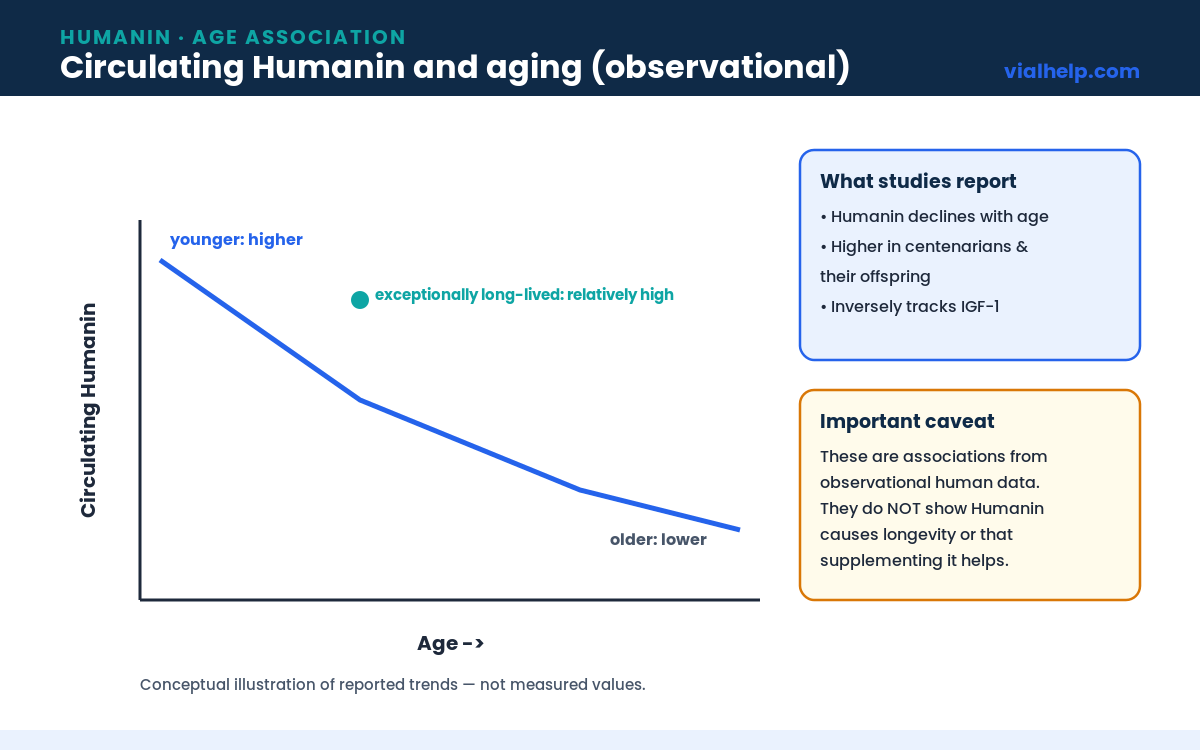
Direct human evidence is largely observational rather than interventional. A consistent finding is that circulating Humanin declines with age in humans and animals. Exceptionally long-lived people — centenarians and their offspring — tend to show relatively high Humanin levels, and Humanin levels tend to move inversely with IGF-1. There is no approved therapeutic use of Humanin, and no completed human trials establishing it as a treatment.
Handling, storage and reconstitution (research context)
- Lyophilized powder: typically stored frozen (−20 °C, ideally −80 °C for long term), protected from light and moisture.
- Reconstituted solution: refrigerate at 2–8 °C, use within a short window, and avoid repeated freeze–thaw; aliquoting helps.
- Concentration math: use the reconstitution calculator to convert vial amount and diluent volume into mg/mL, and see why units are not a dose for syringe reading.
- Always follow the specific product’s Certificate of Analysis (COA) and label.
Cautions and considerations
- Research compound only — not FDA-approved, not a medicine, and not for human use.
- No established human dose, indication or safety profile; human pharmacokinetics are unpublished.
- Purity and endotoxin status vary by supplier — a third-party COA is essential.
- Informational and educational content only — not medical advice. Audience 21+.
Frequently asked questions
What is Humanin?
Humanin is a 24-amino-acid mitochondrial-derived peptide encoded by the MT-RNR2 region of mitochondrial DNA, studied in the lab for cell-survival (cytoprotective) and anti-apoptotic signaling.
What is the difference between Humanin and HNG?
HNG (S14G-Humanin) is a synthetic analogue with a single serine-to-glycine swap at position 14; it is more stable and reported to be far more potent than native Humanin in research assays.
Is Humanin approved as a medicine?
No. Humanin is not FDA-approved for any use; the available evidence is overwhelmingly preclinical, and it is handled as a research-use-only compound.
Do Humanin levels really change with age?
In observational human and animal studies, circulating Humanin generally declines with age, while exceptionally long-lived individuals tend to show higher levels — an association, not proof of cause.
Related compounds and further reading
- How to reconstitute peptides — step-by-step research-handling guide.
- Sterile technique — clean handling and contamination prevention.
- MOTS-c — another mitochondrial-derived peptide studied in metabolism.
- Epitalon and SS-31 (Elamipretide) — longevity- and mitochondria-focused peptides.
- Browse the full peptide library and the handling guides.
Share this article
References
- Hashimoto Y, et al. A rescue factor abolishing neuronal cell death (Humanin discovery). PNAS 2001 (PMID 11371646)
- Muzumdar RH, et al. Humanin: a novel central regulator of peripheral insulin action. PLoS ONE 2009 (PMID 19623253)
- Ikonen M, et al. Interaction between humanin and IGFBP-3 regulates cell survival and apoptosis. PNAS 2003 (PMID 14561895)
- Yen K, Lee C, Mehta H, Cohen P. The emerging role of the mitochondrial-derived peptide humanin in stress resistance. J Mol Endocrinol 2013 (PMID 23239898)
- Zhu S, et al. The Molecular Structure and Role of Humanin in Neural and Skeletal Diseases and Tissue Regeneration. Front Cell Dev Biol 2022
- PubChem CID 16131438 – Humanin (C119H204N34O32S2; MW ~2687)
For informational use only. Not medical advice; consult a qualified healthcare professional. 21+.
Humanin reconstitution calculator
Use the calculator below to find the concentration (mg/mL), draw volume and U-100 syringe units for Humanin once it is reconstituted with bacteriostatic water. Humanin has molecular formula C119H204N34O32S2 and a molecular weight of ~2,687 g/mol. Enter your vial amount and the water volume to see the lab math — informational use only, not dosing advice.