
SS-31 (Elamipretide)
Summary
SS-31 (elamipretide) is a mitochondria-targeting tetrapeptide that binds cardiolipin to stabilize the inner mitochondrial membrane and improve energy production. In September 2025 it received accelerated FDA approval for Barth syndrome; it remains investigational for other uses.
Quick facts
| Also known as | Elamipretide, Bendavia, MTP-131, Forzinity |
| Category | Mitochondria-targeting (cardiolipin-binding) aromatic-cationic peptide |
| Status | Accelerated FDA approval for Barth syndrome (2025); investigational for other uses |
| CAS | 736992-21-5 (free base) |
| Formula | C32H49N9O5 (free base) |
| Molecular weight | 639.8 g/mol (free base) |
| Sequence | D-Arg-Dmt-Lys-Phe-NH2 (Dmt = 2′,6′-dimethyltyrosine) |
| Half-life | ~4 hours (subcutaneous; approximate) |
| Storage | Lyophilized: refrigerate 2-8°C short-term, freeze -20°C long-term, protect from light. Reconstituted: refrigerate, use within a limited window, avoid freeze-thaw. |
In Plain English
SS-31 is a small peptide that targets the cell’s energy factories (the mitochondria) and helps them work better. It recently gained approval for one rare genetic disease, but for other uses it is still experimental. Researchers study it for energy, heart, and muscle problems linked to the mitochondria.
SS-31, better known as elamipretide, is a mitochondria-targeting tetrapeptide that binds cardiolipin on the inner mitochondrial membrane to help the cell’s energy machinery run more efficiently. Part of the Szeto–Schiller family of aromatic-cationic peptides, it has been tested across heart failure, mitochondrial myopathy, eye disease and more — and in September 2025 received its first regulatory approval, a narrow accelerated approval for Barth syndrome.
What is SS-31 (elamipretide)?
SS-31 (aliases: elamipretide, Bendavia, MTP-131; brand name Forzinity) is a small four-amino-acid peptide with the sequence D-Arg-2',6'-dimethyltyrosine-Lys-Phe-NH₂. Its alternating aromatic and basic residues — the hallmark Szeto–Schiller motif — let it resist breakdown and cross membranes to concentrate inside mitochondria. The free base has a molecular formula of C₃₂H₄₉N₉O₅ and a molecular weight near 640 g/mol; it is administered by subcutaneous injection. It belongs to the mitochondria-targeting, cardiolipin-binding peptide class.
How SS-31 is studied to work
SS-31 acts at the inner mitochondrial membrane — the surface where most of the cell’s energy (ATP) is generated. Its mechanism centers on one molecule: cardiolipin.
- Binds cardiolipin: selectively concentrates in mitochondria and binds cardiolipin, a phospholipid unique to the inner membrane.
- Stabilizes cristae and the electron transport chain: helps maintain the folded membrane structure and the organization of the respiratory complexes.
- Improves bioenergetics: more efficient electron transport supports more efficient ATP production.
- Reduces reactive oxygen species (ROS): stabilizing the chain lowers electron “leak,” reducing oxidative stress.

Reported effects and benefits in the research literature
Because mitochondrial dysfunction appears in many diseases, SS-31 has been studied broadly:
- Mitochondrial function: improved respiratory efficiency, ATP production and reduced ROS in preclinical and some human-tissue studies.
- Heart failure: studied in heart failure with reduced ejection fraction on the rationale of cardiolipin dysfunction in failing hearts.
- Primary mitochondrial myopathy: tested for muscle weakness, fatigue and exercise capacity.
- Barth syndrome: improved knee-extensor muscle strength — the basis for its accelerated approval.
- Dry AMD / geographic atrophy: studied for slowing photoreceptor loss and improving low-light vision.
- Ischemia-reperfusion injury: tested for reducing cardiac injury after a heart attack.
What this does NOT mean: improving a mitochondrial marker is not the same as making patients better. Outside Barth syndrome, the controlled human trials repeatedly failed to translate biomarker improvements into clinical-endpoint benefit. SS-31 is not an approved or established treatment for heart failure, AMD, general mitochondrial myopathy, aging, or athletic performance.
What the human evidence shows
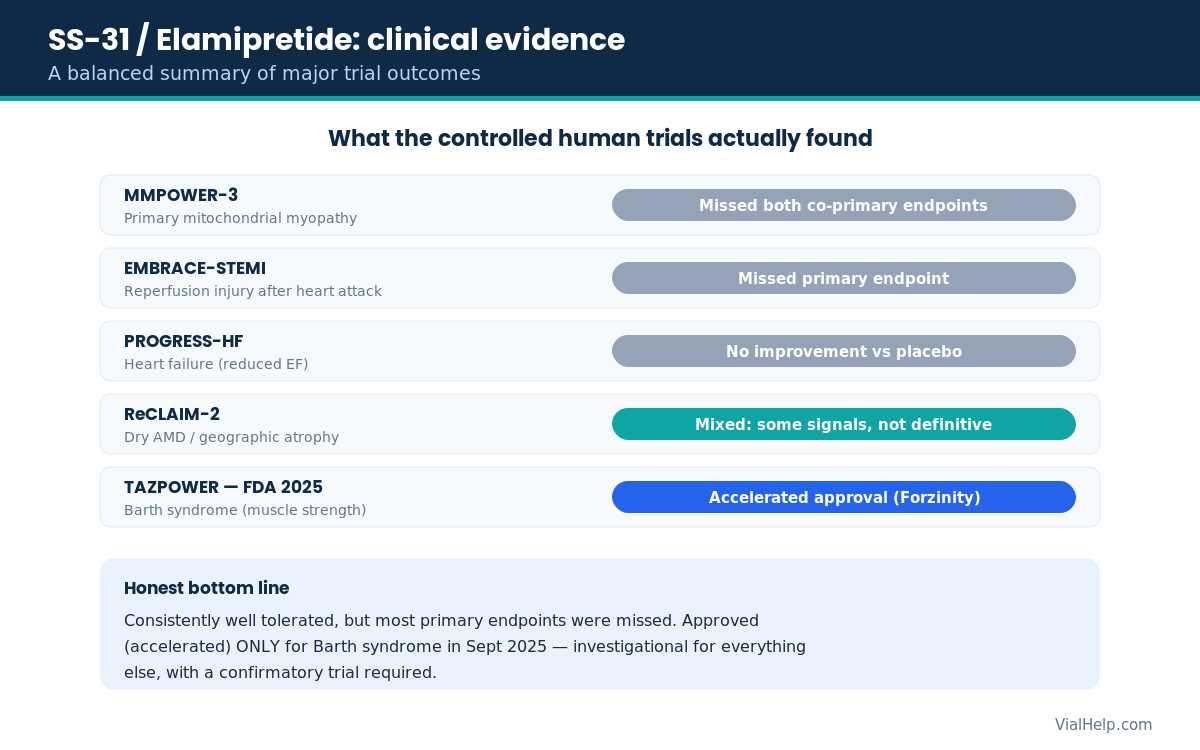
The clinical record is honest and instructive. In primary mitochondrial myopathy, the Phase 3 MMPOWER-3 trial missed both co-primary endpoints (six-minute walk distance and a fatigue score). The EMBRACE-STEMI trial in reperfusion injury missed its primary endpoint, and the PROGRESS-HF heart-failure trial showed no improvement in the primary measure. ReCLAIM-2 in dry AMD produced mixed signals rather than a definitive result. Across these studies the peptide was consistently well tolerated, with mild-to-moderate injection-site reactions the main adverse effect.
The exception is Barth syndrome. After a crossover trial that initially missed its endpoints, an open-label extension showed sustained muscle-strength gains, and on September 19, 2025 the FDA granted accelerated approval of elamipretide (Forzinity) to improve muscle strength in people with Barth syndrome weighing at least 30 kg. This is a narrow approval based on a surrogate strength endpoint and requires a confirmatory trial; elamipretide remains investigational for every other use.
Handling, storage and reconstitution (research context)
- Lyophilized powder: most stable — typically refrigerated (2–8 °C) short-term and frozen (−20 °C or lower) for longer storage, protected from light and moisture.
- Reconstituted solution: kept refrigerated, used within a limited window, away from light and heat, avoiding repeated freeze-thaw cycles.
- For concentration after adding bacteriostatic water, use the reconstitution calculator; the authoritative storage instructions for the approved product are in its FDA prescribing information.
Cautions and considerations
- Elamipretide is approved only for Barth syndrome (accelerated, 2025) and is otherwise an investigational research compound.
- Most large trials in other conditions missed their primary endpoints — promising mechanism, limited proven clinical benefit.
- Purity and identity vary by source; review a current COA — see how to read a COA.
- This page is informational only and not medical advice, for an audience 21 and older.
Frequently asked questions
Is SS-31 the same as elamipretide?
Yes. SS-31 is the research designation; elamipretide is the international nonproprietary name. It has also been called Bendavia and MTP-131, and is marketed for Barth syndrome as Forzinity.
Is SS-31 FDA-approved?
Only for one narrow use. In September 2025 the FDA granted accelerated approval of elamipretide for muscle strength in Barth syndrome. It is not approved for heart failure, eye disease, general mitochondrial myopathy, or any other indication.
How does SS-31 differ from other peptides?
Most research peptides act on cell-surface receptors. SS-31 works inside the cell, binding cardiolipin on the inner mitochondrial membrane to support energy production — a mitochondria-targeting mechanism rather than a receptor one.
Why did so many SS-31 trials fail?
SS-31 reliably improves mitochondrial biomarkers, but in MMPOWER-3, EMBRACE-STEMI and PROGRESS-HF those improvements did not translate into the clinical endpoints the trials measured — a common gap between mechanism and patient outcome.
Related compounds and further reading
- How to reconstitute peptides — step-by-step handling guide
- Sterile technique — clean handling basics
- MOTS-c and Epitalon — other compounds discussed in longevity and mitochondrial research
- Browse the full peptide library and the guides hub
- ARA-290 — an erythropoietin helix-B–derived peptide studied for tissue protection.
Share this article
References
- Elamipretide (PubChem CID 11764719)
- Elamipretide
- Szeto HH, first-in-class cardiolipin-protective compound (PMC3976620)
- MMPOWER-3 randomized clinical trial in primary mitochondrial myopathy (PMC10382259)
- Elamipretide: structure, mechanism and therapeutic potential (PMC11816484)
- FDA grants accelerated approval to first treatment for Barth syndrome (Sept 2025)
For informational use only. Not medical advice; consult a qualified healthcare professional. 21+.
SS-31 (Elamipretide) reconstitution calculator
Use the calculator below to find the concentration (mg/mL), draw volume and U-100 syringe units for SS-31 (Elamipretide) once it is reconstituted with bacteriostatic water. SS-31 (Elamipretide) has molecular formula C32H49N9O5 (free base) and a molecular weight of 639.8 g/mol (free base). Enter your vial amount and the water volume to see the lab math — informational use only, not dosing advice.
Open the full calculator · Back to the SS-31 (Elamipretide) profile