
Melanotan I
Summary
Melanotan I (afamelanotide) is a synthetic alpha-MSH analog and selective melanocortin-1 receptor (MC1R) agonist. It is the active ingredient in the approved drug SCENESSE, used to increase pain-free light exposure in adults with erythropoietic protoporphyria. It is chemically and pharmacologically distinct from the unapproved cosmetic-tanning peptide Melanotan II.
Quick facts
| Also known as | Afamelanotide, Scenesse, [Nle4-D-Phe7]-alpha-MSH, Melanotan-1, MT-1, NDP-MSH, EPT-1647, CUV1647 |
| Category | Melanocortin / MC1R agonist (alpha-MSH analog) |
| Status | Approved drug as SCENESSE (afamelanotide) for erythropoietic protoporphyria (EPP): EMA 2014, FDA Oct 2019. Not approved/sold for cosmetic tanning; reference/research use only otherwise. |
| CAS | 75921-69-6 |
| Formula | C78H111N21O19 |
| Molecular weight | 1646.9 g/mol (PubChem CID 16197727) |
| Sequence | Ac-Ser-Tyr-Ser-Nle-Glu-His-D-Phe-Arg-Trp-Gly-Lys-Pro-Val-NH2 (13-aa linear alpha-MSH analog; Met4->Nle, L-Phe7->D-Phe) |
| Half-life | ~15 h apparent half-life from the 16 mg controlled-release subcutaneous implant (median Tmax ~36 h; FDA SCENESSE label) |
| Storage | As reference material: lyophilized peptide stored cold and protected from light; reconstituted solution refrigerated and used within a short window. The approved drug is a clinician-placed implant, not a self-reconstituted product. |
In Plain English
Melanotan I is a lab-made peptide that tells the skin to make more of its own dark pigment. A closely related approved version is used to protect people with a rare condition that makes their skin very sensitive to light. Researchers study it for skin protection and tanning.
Melanotan I, also known by its International Nonproprietary Name afamelanotide and marketed as the prescription drug Scenesse, is a synthetic 13-amino-acid analog of the natural hormone alpha-melanocyte-stimulating hormone (alpha-MSH) that acts as a selective agonist of the melanocortin-1 receptor (MC1R). It is the only melanocortin peptide of its class to gain regulatory approval as a systemic medicine, and it should not be confused with Melanotan II, a different, unapproved compound widely sold for cosmetic tanning. This page is informational and educational only; it is not medical advice and does not endorse any non-approved use.
What is Melanotan I?
Melanotan I is a laboratory-modified version of alpha-MSH, the body’s own signal for triggering pigment production in the skin. Native alpha-MSH is broken down quickly in the body, which limits its usefulness as a drug. Researchers, originally at the University of Arizona, addressed this by making two changes to the peptide’s sequence: replacing methionine at position 4 with norleucine (Nle), and replacing L-phenylalanine at position 7 with its mirror-image form, D-phenylalanine. The resulting peptide, [Nle4-D-Phe7]-alpha-MSH (also historically called NDP-MSH), resists enzymatic breakdown and binds its target receptor far more potently than the natural hormone.
Chemically, Melanotan I has the sequence Ac-Ser-Tyr-Ser-Nle-Glu-His-D-Phe-Arg-Trp-Gly-Lys-Pro-Val-NH2, a molecular formula of C78H111N21O19, and a molecular weight of roughly 1,647 g/mol (PubChem CID 16197727; CAS 75921-69-6). The approved product, Scenesse, is not an injection that patients prepare themselves: it is a small, sterile, biodegradable implant containing 16 mg of afamelanotide that a healthcare professional places under the skin, where it releases the peptide slowly over several days.
How Melanotan I is studied to work
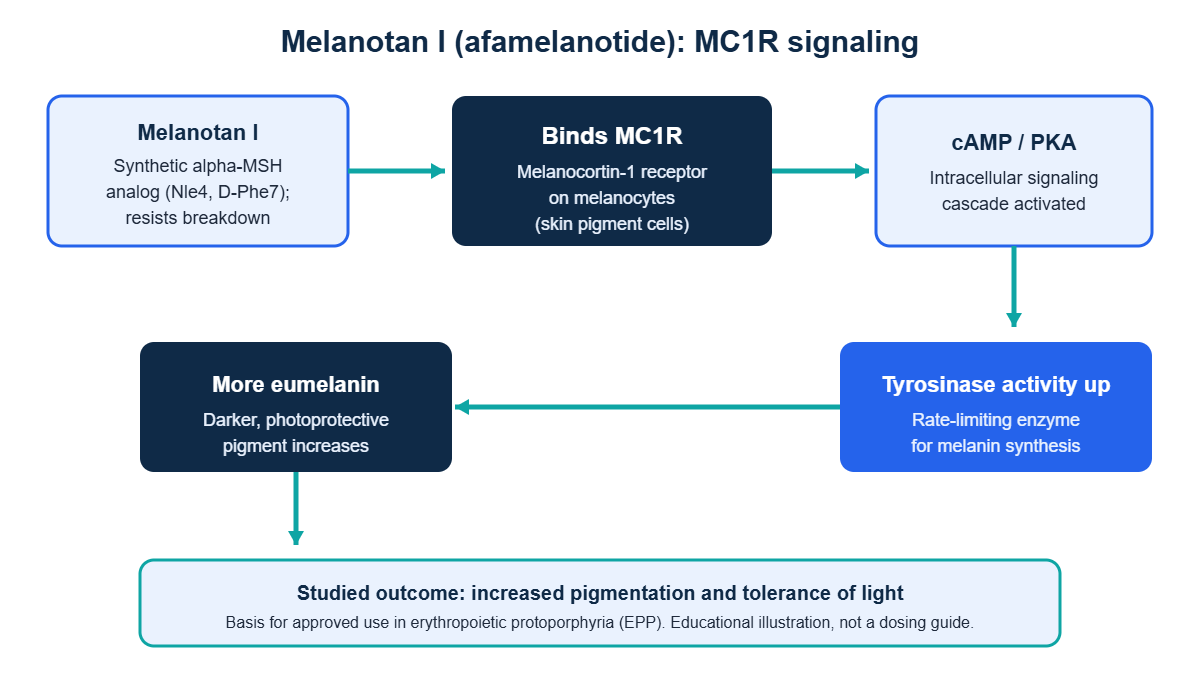
The melanocortin system is a family of five G-protein-coupled receptors (MC1R through MC5R) that respond to MSH-type signaling peptides. Melanotan I’s defining feature is that it is relatively selective for MC1R, the receptor found primarily on pigment-producing melanocytes in the skin. When Melanotan I binds MC1R, it activates the cAMP/PKA signaling pathway inside the melanocyte, which increases the activity of tyrosinase, the rate-limiting enzyme in melanin synthesis. The net effect studied in the literature is increased production of eumelanin, the darker, more photoprotective form of melanin, relative to the lighter phaeomelanin.
- MC1R – the main target; on melanocytes it drives melanin (pigment) production and is the basis of the drug’s intended effect.
- MC2R – the adrenal ACTH receptor; not a meaningful target for this peptide.
- MC3R and MC4R – central nervous system receptors involved in appetite, energy balance, and sexual function; Melanotan I has comparatively limited activity here, which distinguishes it from less-selective analogs.
- MC5R – involved in exocrine gland function; a minor consideration.
Reported effects in the research literature
The most consistently reported and clinically studied effect of Melanotan I is increased skin pigmentation independent of ultraviolet exposure, sometimes described as a “UV-free” tan. In the context of its approved indication, the relevant downstream effect is improved tolerance of light in people whose skin is abnormally sensitive to it.
- Dose-related increases in skin melanin density and darkening, measurable by skin reflectance.
- Increased eumelanin, which absorbs and scatters light and may reduce phototoxic skin reactions in susceptible individuals.
- In erythropoietic protoporphyria specifically, longer durations of pain-free time spent in light and fewer phototoxic episodes.
What this does not mean: photoprotection observed in a specific medical population does not establish that Melanotan I is a safe or effective sunscreen, tanning aid, or skin-cancer-prevention tool for the general public. It does not block all UV damage, and an MC1R-driven tan is not a substitute for sunscreen, protective clothing, or shade. These are research and regulatory findings, not personal recommendations.
What the human evidence shows
The strongest human evidence for Melanotan I comes from its development as a treatment for erythropoietic protoporphyria (EPP), a rare inherited disorder in which sunlight triggers severe burning pain in the skin. Two multicenter, randomized, double-blind, placebo-controlled trials of the 16 mg implant were published together in the New England Journal of Medicine in 2015 (Langendonk and colleagues). In the U.S. trial, patients receiving afamelanotide reported a longer median duration of pain-free sun exposure over six months than those on placebo (about 69 hours versus 41 hours), and the European trial likewise showed more pain-free time and fewer phototoxic reactions. Quality-of-life measures improved, and most adverse events were mild.
On the basis of this and supporting data, the European Medicines Agency granted conditional marketing authorization in December 2014, and the U.S. Food and Drug Administration approved Scenesse in October 2019 to increase pain-free light exposure in adults with a confirmed EPP diagnosis. Importantly, no health authority has approved Melanotan I (or any melanotan peptide) for cosmetic tanning.
Handling, storage and reconstitution (research context)
The approved medicine is a clinician-placed implant, so the reconstitution notes below apply only to the lyophilized reference peptide used in laboratory settings, not to any approved or self-administered product.
- Store lyophilized peptide cold and protected from light; many reference suppliers specify freezer storage for long-term holding.
- If reconstituted for laboratory use, bacteriostatic or sterile water is typically used, with the solution kept refrigerated and used within a short window.
- Minimize freeze-thaw cycles, which can degrade peptide integrity.
- Use sterile technique for any handling; see VialHelp’s reconstitution and sterile-technique guides for general background.
Cautions and considerations
- Outside its approved EPP indication, Melanotan I is not an approved consumer product; non-prescription “tanning” peptides sold online are unregulated and of unverified identity, purity, and sterility.
- Increased pigmentation can include new or darkening moles; dermatologic monitoring of pigmented lesions is part of the approved drug’s labeling.
- Reported side effects in trials included nausea, headache, fatigue, and reactions at the implant site.
- Melanotan compounds are not a substitute for sun protection and do not prevent skin cancer.
- This information is for adults 21+ and is educational only. Anyone considering treatment for a medical condition such as EPP should consult a qualified clinician.
Frequently asked questions
How is Melanotan I different from Melanotan II?
Melanotan I (afamelanotide) is a linear 13-amino-acid peptide that is relatively selective for MC1R and is an approved medicine (Scenesse) for EPP. Melanotan II is a smaller, cyclic peptide that activates multiple melanocortin receptors, including MC3R and MC4R, which is why it is associated with effects on libido and appetite. Melanotan II is not approved by any major regulator.
Is Melanotan I FDA approved?
Yes, but only as the prescription drug Scenesse for adults with erythropoietic protoporphyria. The FDA approved it in October 2019, and the EMA authorized it in 2014. It is not approved for cosmetic tanning or general use.
Does Melanotan I cause tanning without sun?
In studies, it can darken skin by stimulating melanin production through MC1R, independent of UV exposure. However, this is a pharmacological effect of an approved drug in a specific patient population, not an endorsed cosmetic use, and it does not replace sunscreen or other sun protection.
What is the half-life of Melanotan I?
From the 16 mg controlled-release implant, the FDA label reports an apparent half-life of roughly 15 hours, with peak peptide levels reached around 36 hours after placement. The implant is designed to release the peptide gradually rather than as a single bolus.
Related compounds and further reading
- Melanotan II
- PT-141
- How to reconstitute peptides
- Sterile technique
- Peptide library
- Reconstitution calculator

Share this article
References
- Afamelanotide. PubChem CID 16197727, NCBI 2026
- Afamelanotide. DrugBank Online (DB04931) 2026
- SCENESSE (afamelanotide) implant – Prescribing Information. U.S. FDA 2019
- Langendonk JG, et al. Afamelanotide for Erythropoietic Protoporphyria. N Engl J Med 2015
- Scenesse (afamelanotide) – European Public Assessment Report. EMA 2014
- Afamelanotide. Wikipedia 2026
For informational use only. Not medical advice; consult a qualified healthcare professional. 21+.
Melanotan I reconstitution calculator
Use the calculator below to find the concentration (mg/mL), draw volume and U-100 syringe units for Melanotan I once it is reconstituted with bacteriostatic water. Melanotan I has molecular formula C78H111N21O19 and a molecular weight of 1646.9 g/mol (PubChem CID 16197727). Enter your vial amount and the water volume to see the lab math — informational use only, not dosing advice.