
Melanotan II
Summary
Melanotan II (MT-II) is a synthetic cyclic alpha-MSH analog and non-selective melanocortin receptor agonist studied for skin pigmentation, appetite and sexual arousal. It is an unapproved research chemical with notable safety concerns.
Quick facts
| Also known as | MT-II, MT2, Melanotan 2 |
| Category | Melanocortin receptor agonist (alpha-MSH analog) |
| Status | Unapproved research chemical; not FDA-approved |
| CAS | 121062-08-6 |
| Formula | C50H69N15O9 |
| Molecular weight | 1024.2 g/mol |
| Sequence | Ac-Nle-c[Asp-His-D-Phe-Arg-Trp-Lys]-NH2 (cyclic heptapeptide) |
| Half-life | Reported short (~1 hour); not well characterized |
| Storage | Lyophilized: store at -20C, protect from light. Reconstituted: 2-8C, protect from light, avoid freeze-thaw. |
In Plain English
Melanotan II is a lab-made peptide that tells the skin to make more of its own dark pigment, which leads to tanning. It can also affect appetite and sexual arousal. It is an unapproved research chemical, not a medicine.
Melanotan II is a synthetic cyclic peptide that mimics alpha-melanocyte-stimulating hormone (alpha-MSH) and is best known in research for stimulating skin pigmentation. First studied at the University of Arizona in the 1990s, Melanotan II (often abbreviated MT-II or MT2) activates several melanocortin receptors at once. It is widely discussed but remains an unapproved research chemical, and several of its effects carry real safety concerns. This page is informational only and not medical advice.
What is Melanotan II?
Melanotan II is a cyclic heptapeptide – a ring-shaped chain of seven amino acids with the sequence Ac-Nle-c[Asp-His-D-Phe-Arg-Trp-Lys]-NH2. It was designed as a more potent, more stable analog of natural alpha-MSH. The cyclization, the D-phenylalanine substitution and the norleucine residue make it resistant to breakdown and far more potent than the natural hormone.
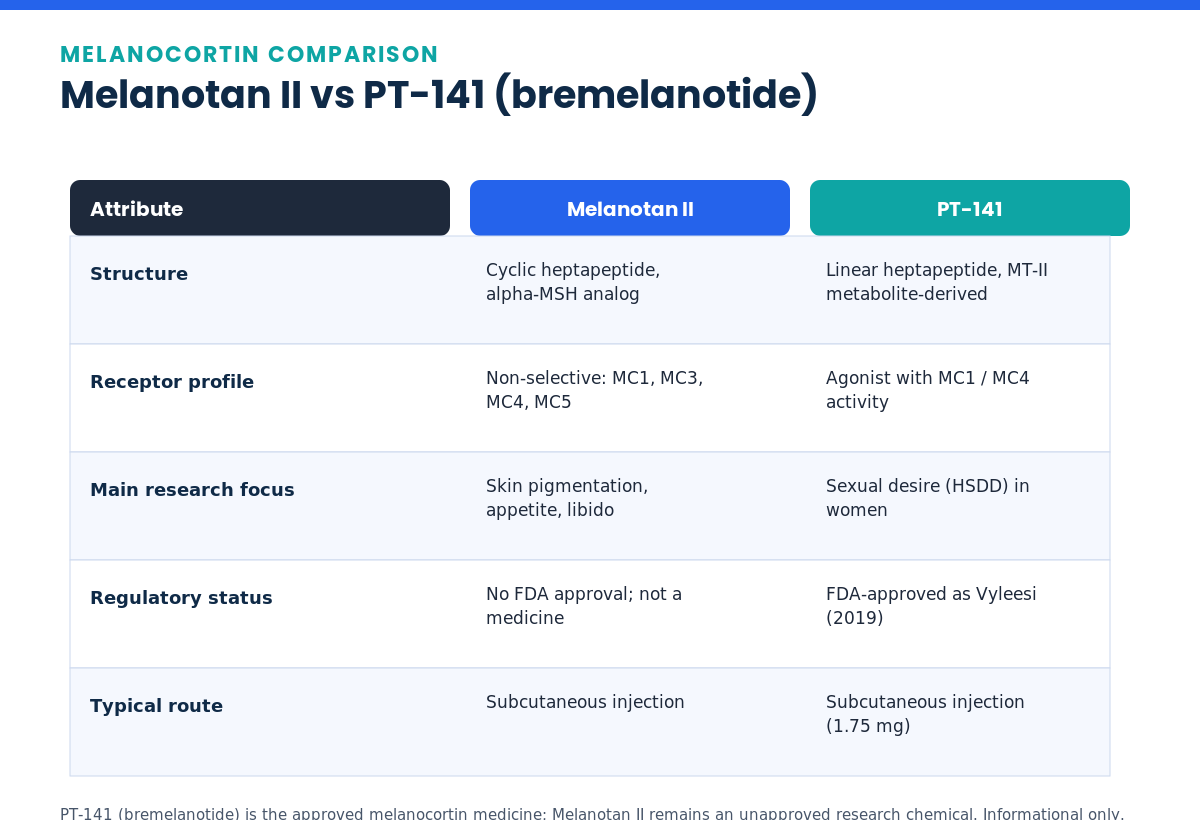
It belongs to the melanocortin class of peptides. A related, more receptor-focused analog, PT-141 (bremelanotide), was developed from Melanotan II research and later approved for a specific medical use – whereas Melanotan II itself has never been approved.
How Melanotan II is studied to work
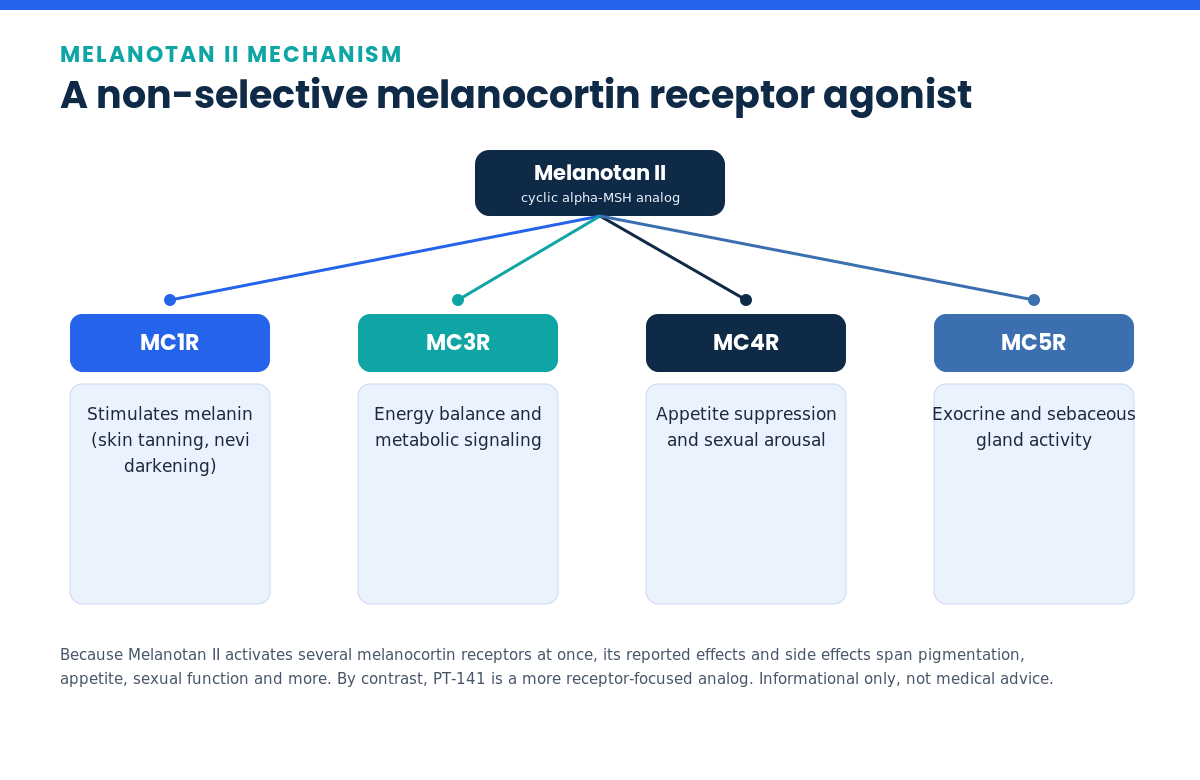
Melanotan II is a non-selective melanocortin receptor agonist. Rather than acting on a single pathway, it switches on multiple melanocortin receptors, which is why its reported effects are so broad and why its side-effect profile is wide-ranging.
- MC1R – stimulates melanin production in the skin (the basis of its tanning effect, and of darkening moles).
- MC3R – involved in energy balance and metabolic signaling.
- MC4R – influences appetite suppression and sexual arousal pathways in the brain.
- MC5R – linked to exocrine and sebaceous gland activity.
Reported effects and benefits in the research literature
Effects described in studies and case reports of Melanotan II include:
- Skin tanning – dose-dependent darkening of the skin via MC1R-driven melanin production, the most consistently reported effect.
- Appetite changes – reduced food intake in some reports, attributed to central MC4R activity.
- Sexual arousal effects – spontaneous erections were noted as a prominent effect in early human work, which led to the development of PT-141 for sexual dysfunction.
What this does not mean: these observations come largely from small early studies and scattered case reports, not from large, controlled safety trials. Melanotan II is not an approved product, its long-term safety is not established, and reported “benefits” are accompanied by significant risks (see below). Nothing here is a recommendation or a dosing protocol.
What the human evidence shows
Human data on Melanotan II are limited. The foundational human work was a small 1996 pilot study (Dorr and colleagues) in which a handful of volunteers received the peptide; it confirmed dose-dependent tanning but also documented dose-limiting nausea, flushing and spontaneous erections. There has been no large-scale clinical development of Melanotan II itself.
Regulators have repeatedly warned about it. There is no FDA-approved indication and no legal prescription pathway for Melanotan II in the United States; agencies in several countries have issued safety alerts about unlicensed melanotan products. Published case reports link Melanotan II use to new and changing moles (melanocytic nevi), darkening of existing lesions, and, in some reports, melanoma – a particular concern because the peptide stimulates the very cells involved in skin cancer. Other reported adverse effects include nausea, flushing, and rare systemic complications.
Handling, storage and reconstitution (research context)
- Lyophilized (freeze-dried): store cold and protected from light; long-term storage is typically around -20°C.
- Reconstituted: keep refrigerated at 2–8°C, protect from light, and avoid repeated freeze-thaw cycles.
- Reconstitution: add bacteriostatic water gently down the vial wall and swirl rather than shake; use the reconstitution calculator to find concentration in mg/mL.
- Measurement: syringe “units” are a volume mark, not a dose – see why units are not a dose.
Cautions and considerations
- Melanotan II is an unapproved research chemical, not a medicine; it has no FDA-approved use.
- It stimulates melanocytes, raising specific concerns about new or changing moles and skin cancer; any skin changes warrant professional evaluation.
- No standardized human dosing exists; this page provides no dosing guidance.
- Purity and identity of material sold outside regulated channels vary – review a current Certificate of Analysis.
- Informational only and not medical advice; consult a qualified healthcare professional. Intended for those 21 and over.
Frequently asked questions
Is Melanotan II FDA-approved?
No. Melanotan II has no FDA-approved indication and no legal prescription pathway. The related analog PT-141 (bremelanotide) is approved, but Melanotan II itself is not.
How is Melanotan II different from PT-141?
PT-141 (bremelanotide) was derived from Melanotan II but is more receptor-focused and is FDA-approved for a specific sexual-dysfunction indication. Melanotan II is non-selective and unapproved.
Why is Melanotan II associated with moles and skin cancer concerns?
It activates MC1R on melanocytes, the pigment-producing cells. Case reports describe new moles, darkening of existing moles, and melanoma in users, so skin changes should be evaluated by a professional.
What are the most common reported side effects?
Nausea, facial flushing and (in men) spontaneous erections were the most common short-term effects in early human work; pigment and mole changes are the most clinically significant longer-term concerns.
Related compounds and further reading
- How to reconstitute peptides
- Sterile technique guide
- PT-141 (bremelanotide) – the related, approved melanocortin analog
- Browse the full peptide library
- VialHelp guides and how-tos
- IU vs mL: why units are not a dose
Share this article
References
For informational use only. Not medical advice; consult a qualified healthcare professional. 21+.
Melanotan II reconstitution calculator
Use the calculator below to find the concentration (mg/mL), draw volume and U-100 syringe units for Melanotan II once it is reconstituted with bacteriostatic water. Melanotan II has molecular formula C50H69N15O9 and a molecular weight of 1024.2 g/mol. Enter your vial amount and the water volume to see the lab math — informational use only, not dosing advice.