
Melanocortin Peptide Side Effects: PT-141 and Melanotan
Peptide Safety Series
Melanocortin side effects are the trade-off behind a family of peptides best known for skin tanning and sexual-arousal research. Because melanocortin compounds such as PT-141 (bremelanotide) and Melanotan II switch on several receptors at once, their unwanted effects are fairly predictable once you understand which receptors are involved. This guide summarizes what controlled trials and regulatory labels report, alongside the safety signals seen with the unapproved research chemical Melanotan II.
What are melanocortin peptides?
Melanocortin peptides are analogs of alpha-melanocyte-stimulating hormone (alpha-MSH). They act on the melanocortin receptors MC1R through MC5R, which influence pigmentation, appetite, energy balance, sexual function and gland activity. Two are widely discussed: PT-141 (bremelanotide), which is FDA-approved as Vyleesi for a specific sexual-desire condition, and Melanotan II, an unapproved research chemical studied for tanning.
Why melanocortin side effects happen
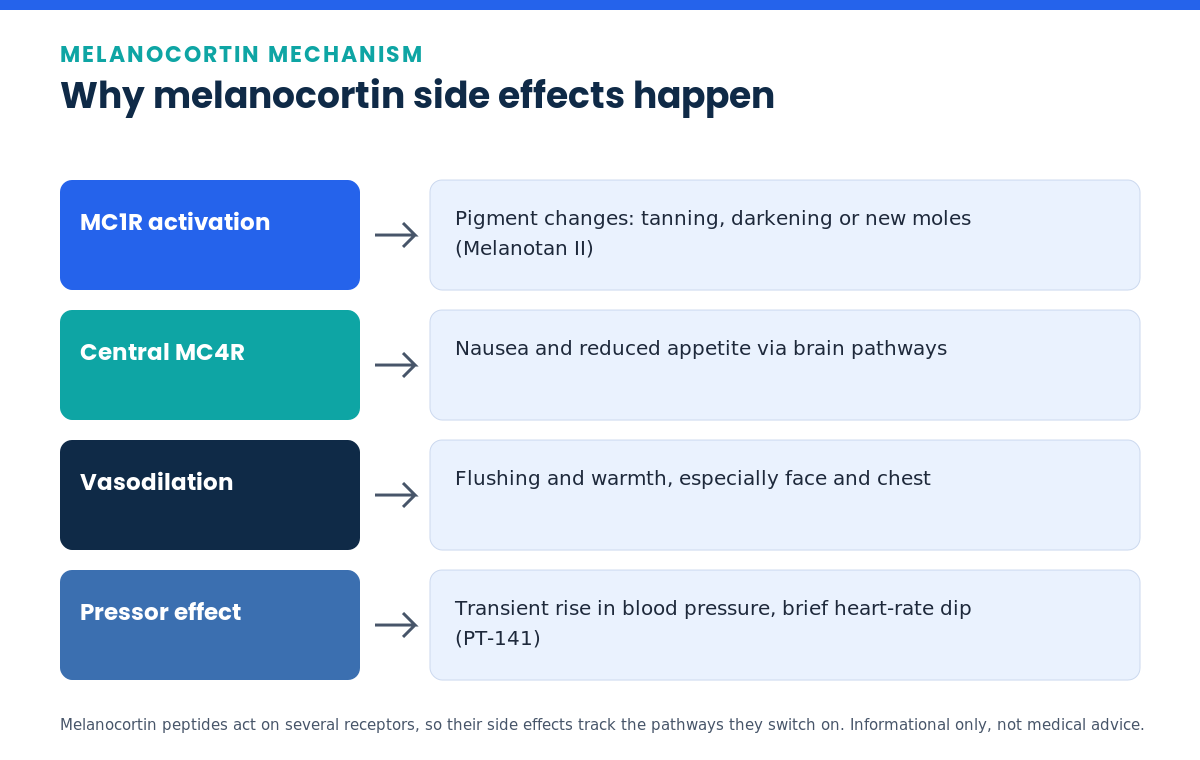
Most melanocortin side effects map directly onto the receptors these peptides activate. Nausea and appetite changes come largely from central MC4R activity; flushing reflects vasodilation; pigment and mole changes come from MC1R stimulation of melanocytes; and a brief pressor (blood-pressure) effect is seen with PT-141.
PT-141 (bremelanotide) side effects
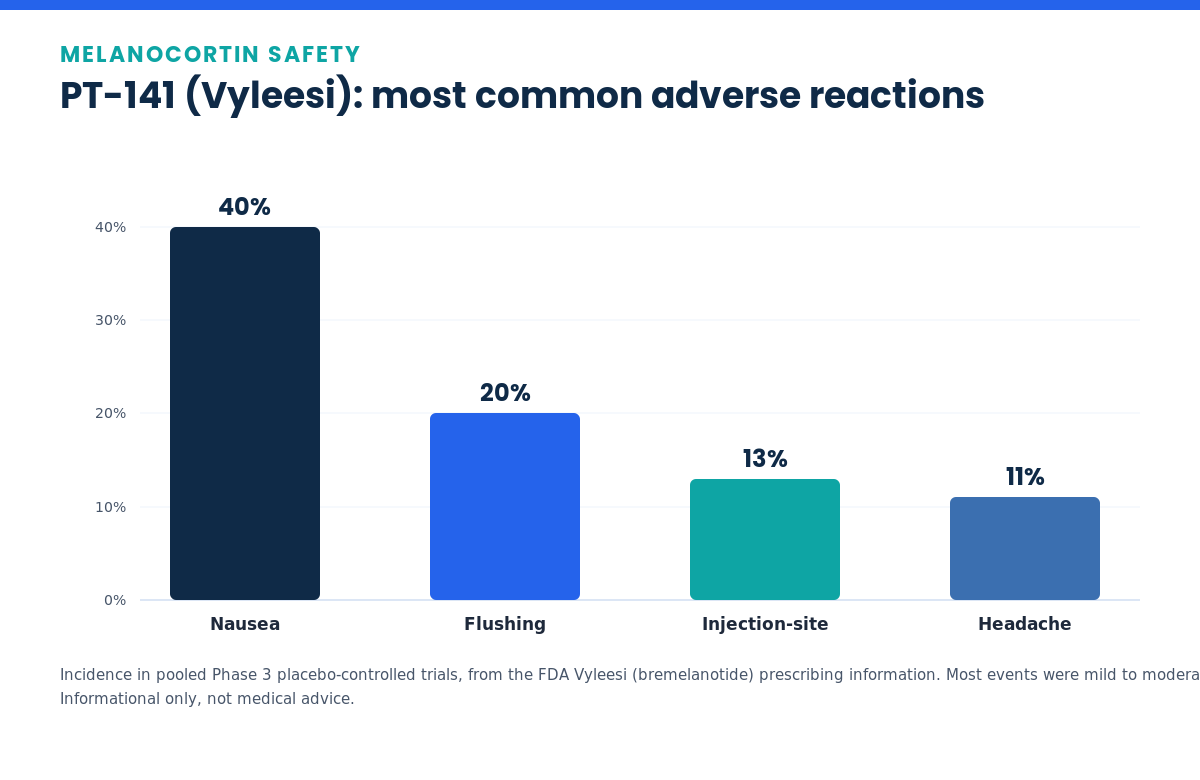
Because PT-141 is an approved medicine, its side-effect profile is well documented in the FDA prescribing information for Vyleesi. In pooled Phase 3 placebo-controlled trials, the most common adverse reactions were:
- Nausea – about 40% of treated patients (vs 1% placebo), most often with the first dose and usually transient.
- Flushing – roughly 20%, typically mild warmth and redness of the face and upper body.
- Injection-site reactions – about 13%.
- Headache – about 11%; vomiting was also common.
The label notes a transient rise in blood pressure and a small drop in heart rate after each dose. For that reason, Vyleesi is contraindicated in people with uncontrolled hypertension or known cardiovascular disease. Nausea was the most common reason participants stopped treatment (about 8%).
Melanotan II side effects and safety concerns
Melanotan II is not approved by the FDA and has not undergone large safety trials, so its risk picture comes from small early studies and published case reports. Reported effects include:
- Nausea and flushing – prominent in early human work, often dose-limiting.
- Spontaneous erections – noted in early male volunteers, which is what led to PT-141 being developed.
- Pigment and mole changes – new moles (melanocytic nevi), darkening or growth of existing moles, and case reports of melanoma. This is the most clinically significant concern, since the peptide stimulates the very cells involved in skin cancer.
Shared cautions across melanocortin peptides
- Gastrointestinal upset (especially nausea) is the most common short-term complaint across this class.
- Blood-pressure effects matter most for PT-141 and for anyone with cardiovascular risk.
- Material sold outside regulated channels varies in purity and identity – review a current Certificate of Analysis.
- Only PT-141 is an approved medicine; Melanotan II is an unapproved research chemical.
Frequently asked questions
What is the most common melanocortin side effect?
Nausea. It affects roughly 40% of PT-141 (Vyleesi) users in trials and was also prominent in early Melanotan II studies; it is usually mild and transient.
Why is Melanotan II linked to moles and melanoma?
It activates MC1R on melanocytes, the pigment-producing cells. Case reports describe new and changing moles and, in some instances, melanoma, so skin changes should be checked by a professional.
Does PT-141 affect blood pressure?
Yes. The FDA label describes a transient increase in blood pressure and a small heart-rate decrease after each dose; it is contraindicated in uncontrolled hypertension or known cardiovascular disease.
Are these side effects the same for everyone?
No. Responses vary by individual and by compound. This article is informational only and not a substitute for advice from a qualified healthcare professional.
References
- VYLEESI (bremelanotide) FDA prescribing information – DailyMed. dailymed.nlm.nih.gov
- VYLEESI label (2019), FDA Drugs@FDA. accessdata.fda.gov
- Bremelanotide – LiverTox, NIH/NCBI Bookshelf. ncbi.nlm.nih.gov
- Melanotan II – Wikipedia (overview and history). en.wikipedia.org
- Changes in oral mucosa associated with Melanotan II injections: a case report (PMC). pmc.ncbi.nlm.nih.gov
- Vyleesi side effects overview – Drugs.com. drugs.com
Informational only — not medical advice. Consult a qualified healthcare professional. Intended for those 21 and over.