
Peptide Solubility and Diluents: Getting Peptides to Dissolve
Peptide solubility — whether a compound dissolves cleanly and which diluent it needs — is one of the most practical questions in handling research material. Most common peptides dissolve readily in bacteriostatic water, but a meaningful minority resist it, turning cloudy or leaving particles. Understanding why that happens, and what to reach for instead, prevents wasted material and confusing results. This guide covers the chemistry in plain terms and the standard diluent choices.
Start with bacteriostatic water
For the majority of research peptides, the default diluent is bacteriostatic water (BAC water) — sterile water containing about 0.9% benzyl alcohol as a preservative, which allows a vial to be used over several days. Add it slowly down the inside wall of the vial and swirl gently rather than shaking. If you want the full comparison of water types, see bacteriostatic water vs sterile water.
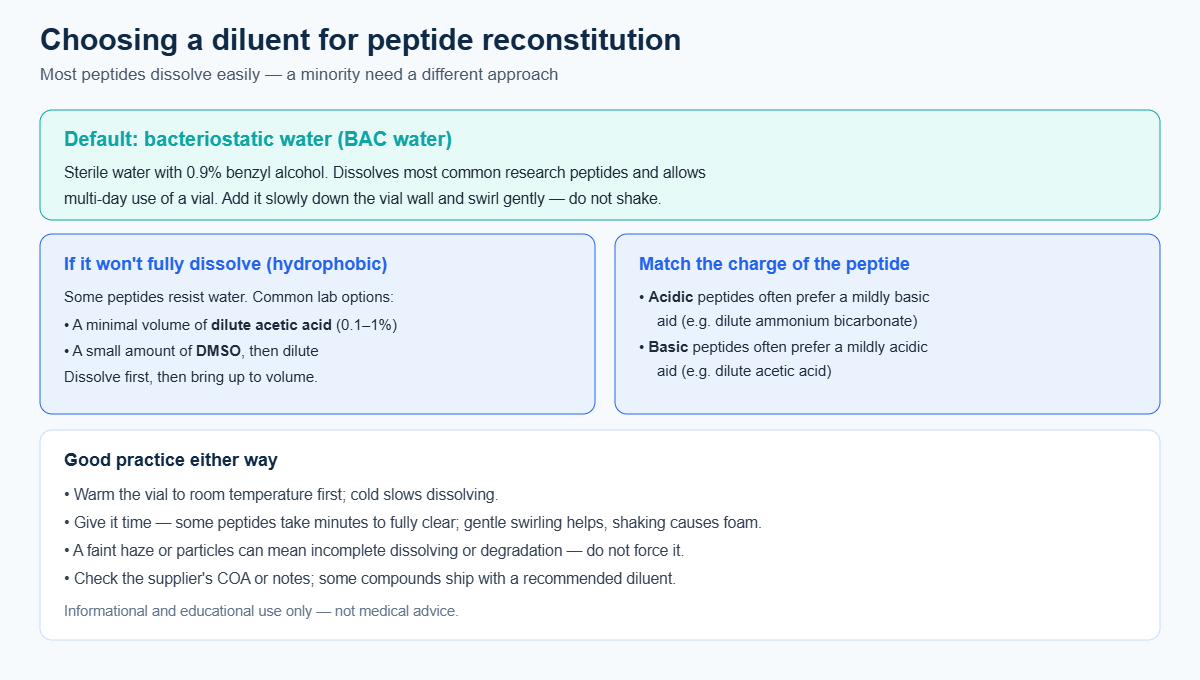
If the powder dissolves to a clear, colourless solution, you are done — no exotic diluent is needed. The extra steps below only apply when a peptide will not fully go into solution.
Why some peptides will not dissolve in water
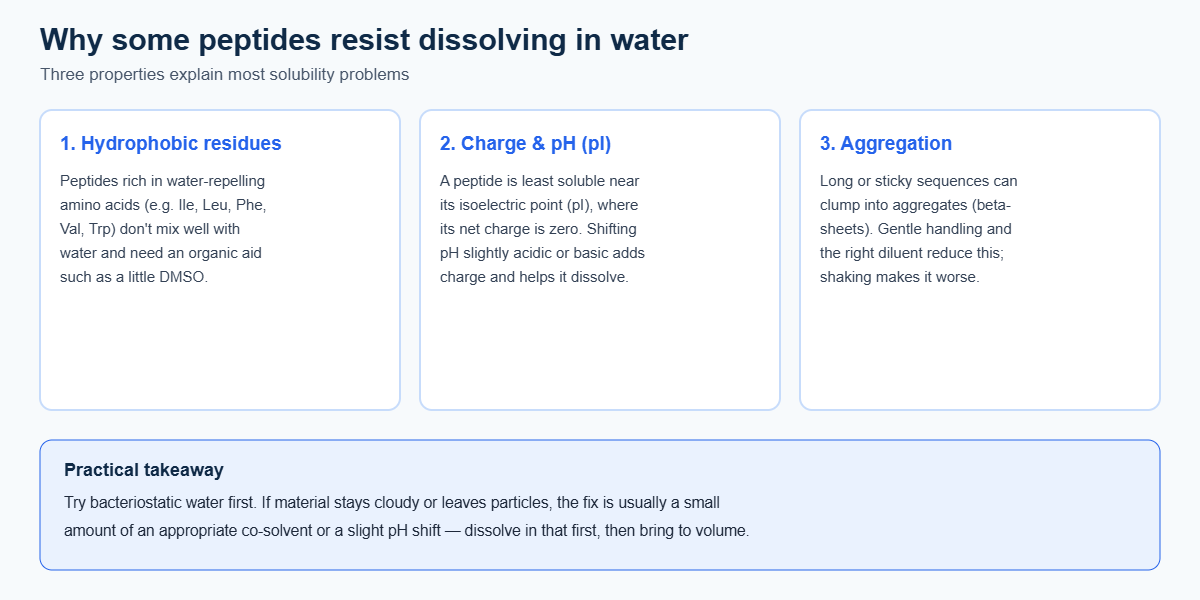
Three properties explain most solubility trouble:
- Hydrophobic residues. Peptides rich in water-repelling amino acids (isoleucine, leucine, phenylalanine, valine, tryptophan) simply do not mix well with water and often need a small amount of an organic co-solvent.
- Charge and pH (the isoelectric point). A peptide is least soluble near its isoelectric point (pI) — the pH at which its net charge is zero. Nudging the pH slightly acidic or basic gives the molecule charge and helps it dissolve.
- Aggregation. Longer or “sticky” sequences can clump together into aggregates. Gentle handling and the right diluent reduce this; vigorous shaking makes it worse.
Diluent options for stubborn peptides
When BAC water alone is not enough, the standard laboratory approach is to dissolve the peptide in a minimal volume of a stronger aid first, then bring it up to the final volume with water. Common choices:
- Dilute acetic acid (about 0.1–1%) — a mild acid that helps many basic and neutral peptides dissolve.
- A small amount of DMSO — an organic solvent useful for highly hydrophobic peptides; use the smallest volume that works, then dilute.
- Dilute ammonium bicarbonate or a mild base — can help acidic peptides that resist water.
The guiding principle is to match the aid to the peptide: acidic peptides often prefer a mildly basic helper, and basic peptides a mildly acidic one. Dissolve in the minimal volume of that aid, confirm a clear solution, then top up with your main diluent.
Good practice regardless of diluent
- Bring the vial to room temperature before reconstituting — cold slows dissolving.
- Be patient: some peptides take several minutes to clear. Gentle swirling helps; shaking causes foam and can damage fragile sequences.
- A persistent haze or visible particles can indicate incomplete dissolving or degradation — do not force it or filter away material you paid for without understanding why.
- Check the supplier’s notes or COA; some compounds ship with a recommended diluent for exactly this reason. See common reconstitution mistakes to avoid the usual pitfalls.
Frequently asked questions
Can I just use more bacteriostatic water to dissolve a stubborn peptide?
Not usually. If a peptide is limited by hydrophobicity or charge, adding more water rarely helps — the fix is a different diluent or a slight pH shift, not more of the same.
Is DMSO safe to use as a diluent?
In a research setting DMSO is a common co-solvent, used in the smallest effective amount. This article is informational only and not guidance for human use.
Why does my peptide look cloudy?
Cloudiness usually means incomplete dissolving (wrong or insufficient diluent) or aggregation/degradation. Warming to room temperature and gentle swirling help; if it persists, the diluent choice is the likely issue.
Does the diluent change my concentration math?
The total final volume is what sets concentration, so measure carefully when you dissolve-then-dilute. Run the numbers with the reconstitution calculator.
Related reading
- Bacteriostatic water vs sterile water.
- How to reconstitute peptides · Sterile technique.
- Common peptide reconstitution mistakes.
- Reconstitution calculator · Peptide library.