
Peptide Half-Life Explained: How Compounds Clear Over Time
Peptide half-life is one of the most quoted — and most misunderstood — numbers in the research literature. Half-life is the time it takes for the amount of a compound in circulation to fall by half. It is a measure of how quickly the body clears a molecule, and it quietly determines how a peptide behaves in a study: how sharp its peak is, how long it lingers, and how often researchers administer it. This guide explains what half-life means, how to read it, and why two peptides with the same target can behave completely differently because of it.
What “half-life” actually measures
Half-life (often written t½) is the time for the concentration of a substance to drop to 50% of its current value. The key feature is that the process is exponential: each half-life removes half of whatever is left, not half of the original amount. After one half-life, 50% remains; after two, 25%; after three, 12.5%, and so on. By four to five half-lives, only a few percent is left and the compound is generally considered largely cleared.
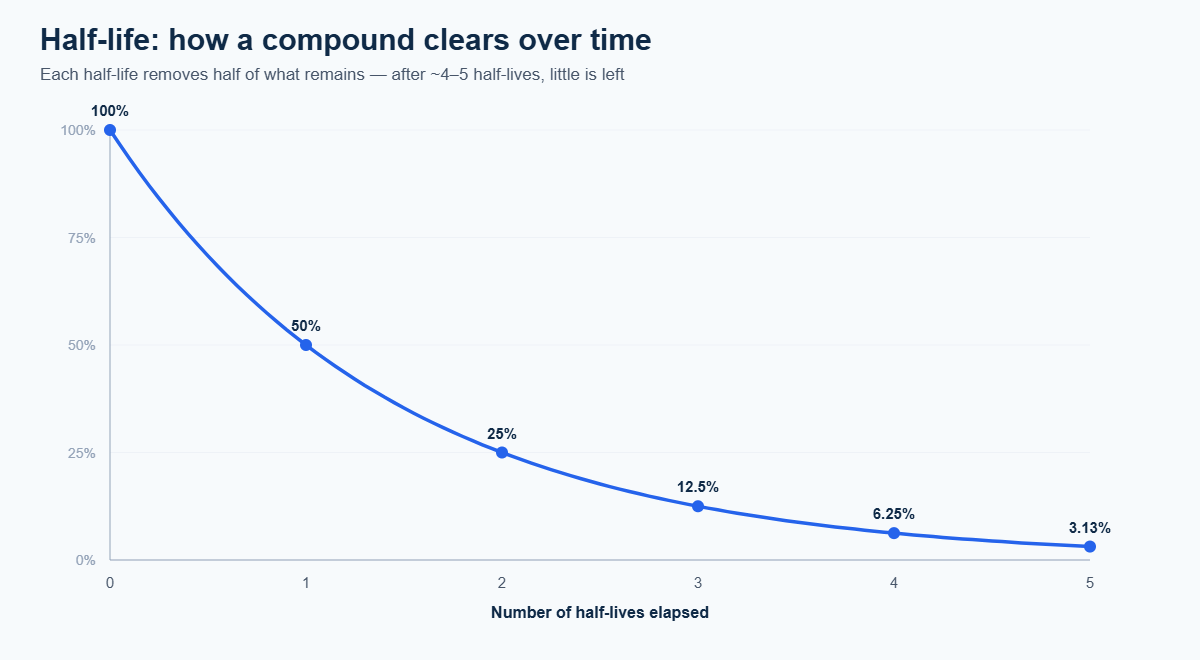
Because the decline is proportional rather than linear, half-life is a stable, useful descriptor: it does not depend on the starting amount. A compound with a 30-minute half-life is at roughly 6% of its peak after two hours regardless of how much was present to begin with.
Why half-life matters more than the peak
Two peptides can reach the same peak concentration and still produce very different exposure profiles. A short half-life produces a tall, narrow spike that clears fast; a longer half-life produces a broader, flatter curve that persists. In the research literature this is why administration frequency varies so widely between compounds — it is largely a function of how fast each one clears.
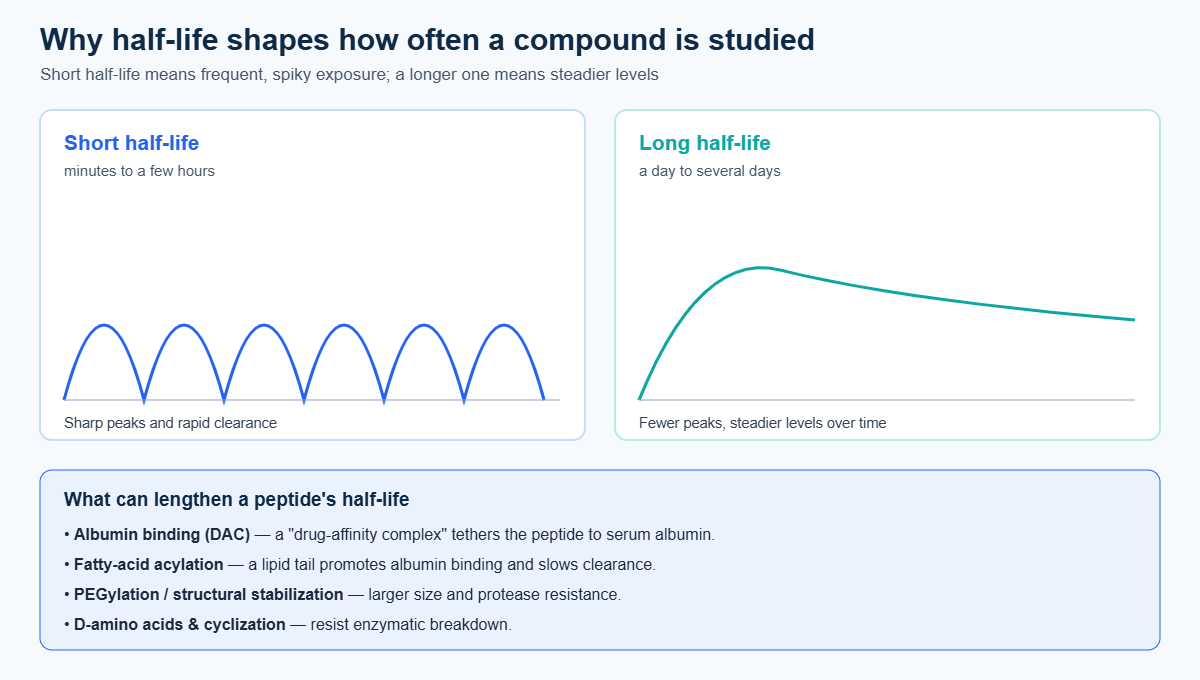
This is also why “how often” a compound appears in study protocols tracks its half-life. Short-lived peptides are typically administered more frequently to maintain measurable levels, while longer-lived analogs can be given less often. The reconstitution calculator reflects the practical side of this: its frequency and “vial lasts about” outputs depend on how often material is used, which in turn is shaped by half-life.
How peptides are engineered to last longer
Native peptides are often cleared within minutes because circulating enzymes (peptidases) break them down quickly and the kidneys filter small molecules efficiently. A large part of peptide chemistry is aimed at slowing this down. Common strategies include:
- Albumin binding via a DAC — a “drug-affinity complex” chemically tethers the peptide to serum albumin, a long-lived blood protein, so it circulates far longer. This is the mechanism behind the long-acting form of CJC-1295; see what “DAC” means on a peptide.
- Fatty-acid acylation — attaching a lipid chain promotes reversible albumin binding and slows clearance, a strategy used in several long-acting metabolic peptides.
- PEGylation and structural stabilization — increasing effective size and shielding the molecule from enzymes.
- D-amino acids and cyclization — structural tweaks that make a sequence harder for peptidases to cleave.
The practical result is that “half-life” is not a fixed property of a peptide family — it is something chemists deliberately tune. That is why an analog can share a parent compound’s target yet be administered on a completely different schedule.
How to read a half-life figure critically
- Check the context. An in vitro (test-tube) half-life can differ greatly from an in vivo (living system) one. Many research figures are approximate or come from animal models.
- Watch for wide ranges. Reported half-lives for the same compound can vary between studies and species — treat a single number as an estimate, not a constant.
- Distinguish plasma half-life from duration of effect. A molecule can be cleared from the blood but still have produced longer-lasting downstream changes, so “half-life” is not the same as “how long it works.”
Frequently asked questions
How many half-lives until a compound is “gone”?
As a rule of thumb, after about four to five half-lives roughly 94–97% has been cleared, and the remainder is usually considered negligible for most purposes.
Does a longer half-life mean a compound is stronger?
No. Half-life describes duration in circulation, not potency. A very potent compound can have a short half-life, and a weak one can last a long time.
Is plasma half-life the same as shelf life?
No — they are unrelated. Plasma half-life is how fast the body clears a compound; shelf life is how long the material stays stable in the vial. For the latter, see storage and stability guidance in the library.
Why do sources disagree on a peptide’s half-life?
Different assays, species, and measurement conditions produce different figures. This is why reputable references give ranges and note whether the value is from an animal model or human data.
Related reading
- What “DAC” means on a peptide — how albumin binding extends half-life.
- Reconstitution calculator — concentration, doses per vial and duration.
- Peptide reference library — half-life is listed in each compound’s quick facts.