
Storing Lyophilized vs Reconstituted Peptides
Storing peptides correctly starts with one fact: a dry, lyophilized peptide and the same peptide dissolved in solution are two very different stability problems, and they call for different handling. In the freeze-dried (lyophilized) state, a peptide is a low-moisture solid in which the chemical reactions that break peptide bonds and modify side chains are slowed to a crawl. The moment it is reconstituted, water becomes both the solvent and a reactant, degradation pathways accelerate, and the practical shelf life drops from years to weeks. This article is a laboratory-handling reference that explains why the two states differ and how researchers typically store each. It is informational only and is not dosing guidance.
Why lyophilized peptides are far more stable than reconstituted ones
Lyophilization removes nearly all the water from a peptide, leaving an amorphous solid. Because water is required for hydrolysis and participates in deamidation and other degradation reactions, removing it dramatically lowers the rate at which the molecule changes. In solution, the same peptide is constantly exposed to water, dissolved oxygen, and a defined pH, all of which drive chemical change. A peer-reviewed review of therapeutic peptide stability notes that aqueous solutions are where deamidation, oxidation, hydrolysis, and aggregation proceed most readily, and that pH and temperature strongly influence those rates.
The residues most vulnerable in solution are well documented across manufacturer and academic sources. Sequences containing asparagine (Asn), glutamine (Gln), methionine (Met), cysteine (Cys), and tryptophan (Trp) tend to have shorter solution shelf lives because of deamidation and oxidation. That is why a peptide that is perfectly stable as a powder for years may need to be used within weeks once dissolved.
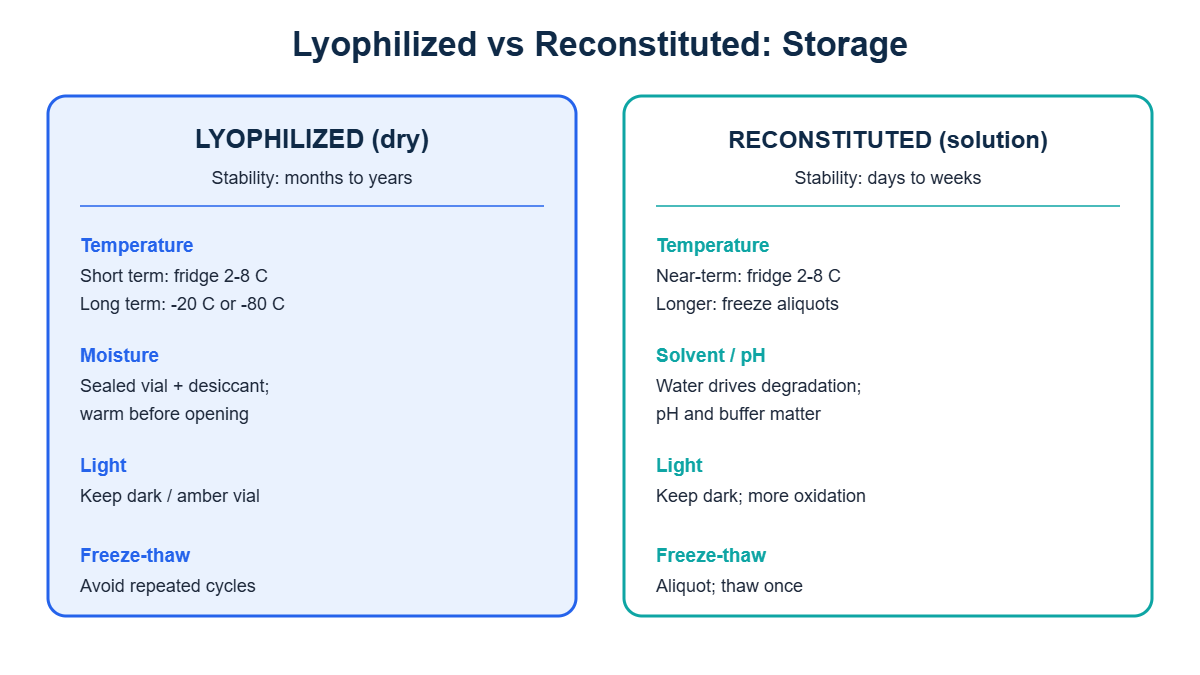
Storing lyophilized peptides: fridge for short term, freezer for long term
For the dry state, lower temperature, lower moisture, and darkness are the priorities. Manufacturer handling guides converge on the same hierarchy:
- Short term: A refrigerator at 2 to 8 C (the USP definition of refrigerated storage) is acceptable for near-term holding of a sealed, dry vial.
- Long term: Store below about -15 C; -20 C is standard and -80 C is preferred for extended storage. Many lyophilized peptides remain stable for months to years under these conditions.
- Keep it dry: Peptides are often hygroscopic. Store in a tightly sealed vial, ideally with desiccant, to keep atmospheric moisture out.
- Keep it dark: Protect from bright light, which can drive photo-oxidation of sensitive residues.
- Warm before opening: Let a cold vial equilibrate to room temperature in a desiccator before breaking the seal, so condensation does not pull moisture into the powder.
Storing reconstituted peptides: cold, dark, and on a short clock
Once a peptide is in solution, the goal shifts from “years” to “minimize the time and stress before use.” General lab handling practice is:
- Near-term use: Keep the solution sealed, light-protected, and refrigerated at 2 to 8 C. A refrigerated solution is often used within a window measured in days to a few weeks, but that window is highly sequence-dependent.
- Longer holding: Where the solvent allows it, freezing aliquots at -20 C or colder extends solution life compared with refrigeration.
- Buffer and pH matter: Solution stability depends heavily on solvent and pH; near-neutral, mildly acidic conditions are commonly cited as more favorable for limiting deamidation and oxidation.
- Watch for microbes: Solutions are also vulnerable to bacterial degradation, another reason the usable window is short.
The contrast with the dry state is the whole point: reconstitution trades long-term stability for usability, so a reconstituted vial is best treated as a perishable working stock.
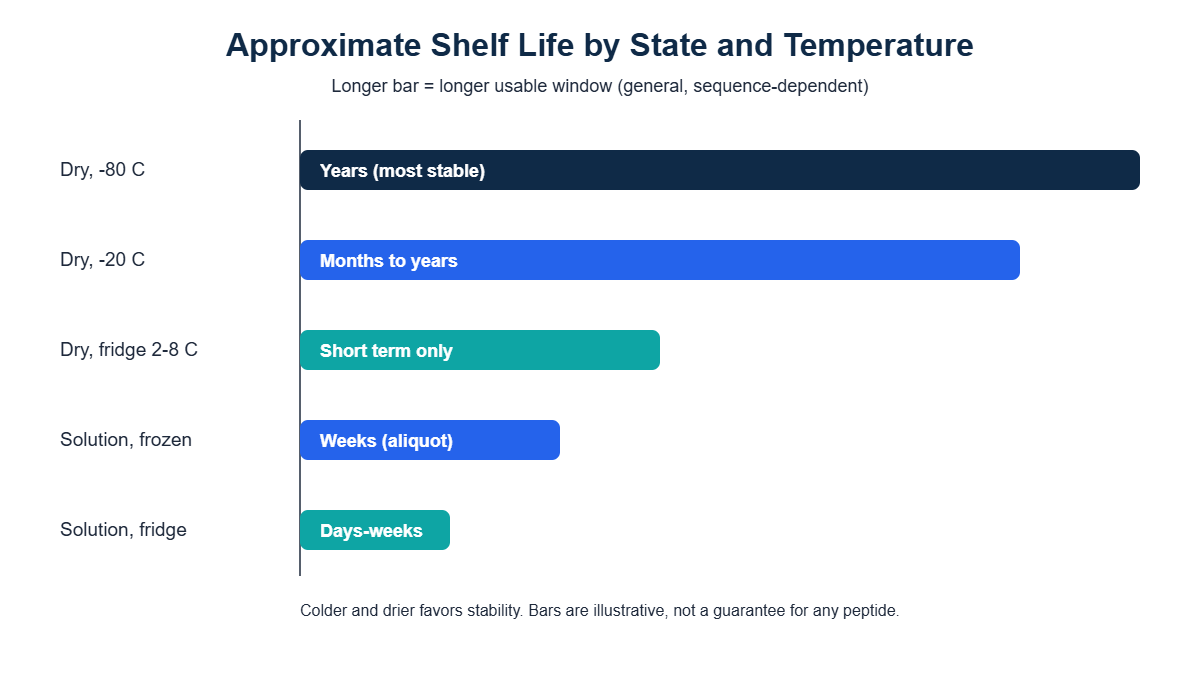
Light, temperature, and freeze-thaw
Three variables act on both states, though they bite harder in solution. Temperature governs reaction rate: every step colder slows chemical degradation. Light drives oxidation of residues such as Met, Cys, and Trp, which is why amber vials and dark storage are standard. Freeze-thaw cycling is a distinct, mechanical stress. A vial that is frozen, partially used, refrozen, and pulled again experiences repeated cycles that can progressively damage peptide structure and promote aggregation. Manufacturer guidance is explicit that repeated freeze-thaw should be avoided for both lyophilized material and solutions.
Aliquoting and container choice
The standard defense against freeze-thaw damage is aliquoting. Rather than repeatedly freezing and thawing one stock, researchers divide a solution into single-use aliquots before freezing, so each portion is thawed only once.
- Make a series of working aliquots sized to a single use.
- Use tightly sealed, low-permeability vials to limit moisture ingress (dry state) and evaporation or contamination (solution).
- Favor amber or otherwise light-protected containers, or store in the dark.
- Label aliquots with contents and date so freeze-thaw history is traceable.
Is the fridge ever enough for long-term storage?
For dry, lyophilized peptides the refrigerator is generally a short-term option; long-term holding is done at -20 C or -80 C. For solutions, even the freezer only extends a window that remains far shorter than the dry state.
Why does a reconstituted peptide degrade so much faster?
Water is a reactant in hydrolysis and deamidation, and solution also exposes the peptide to dissolved oxygen, pH effects, and potential microbial growth. Lyophilization removes the water and slows these pathways dramatically.
Does every peptide degrade at the same rate?
No. Stability is sequence-dependent. Peptides rich in Asn, Gln, Met, Cys, or Trp are typically the least stable in solution because of deamidation and oxidation at those residues.
Related tools and reading
Informational only – not medical advice. 21+.