
Reading a Peptide Sequence: Amino-Acid Codes Explained
Every research peptide is described by a sequence — a string like His-D-Trp-Ala-Trp-D-Phe-Lys-NH₂ or a run of single letters like HWAWFK. Reading a peptide sequence is a core literacy skill: it tells you the identity of the molecule, lets you check a certificate of analysis, and underpins the molecular weight you use for every concentration calculation.
What a peptide sequence is
A peptide is a chain of amino acids joined by peptide (amide) bonds. Because every amino acid has an amino end and a carboxyl end, a finished chain has two distinct ends that are never interchangeable:
- The N-terminus (free amino group) is written on the left and is residue 1 — the start.
- The C-terminus (free carboxyl group) is written on the right — the end.
Sequences are always read N-terminus to C-terminus, left to right. That is not arbitrary: it mirrors biology, since a ribosome builds a chain N-terminus first. Order is identity — His-Gly-Lys is a different molecule from Lys-Gly-His even though they share the same three residues. (Same order and composition means the same molecular weight, which is why weight alone cannot distinguish two sequences with the same residues in a different order.)
The 20 amino acids: one-letter and three-letter codes
Each standard amino acid has a three-letter code (Ala, Arg, Lys…) and a one-letter code (A, R, K…). Eleven of the one-letter codes are just the first letter of the name; the other nine are the ones worth memorising, because the obvious letters were already taken:
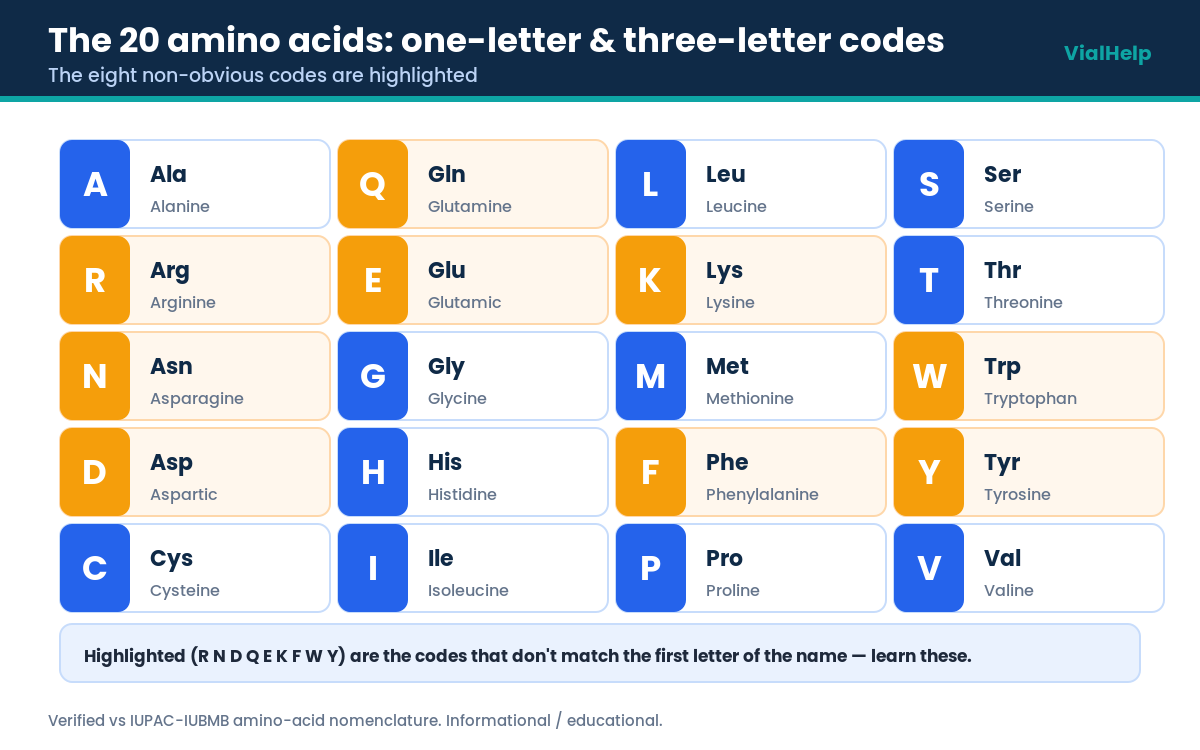
The codes that trip people up are R = arginine, N = asparagine, D = aspartic acid, Q = glutamine, E = glutamic acid, K = lysine, F = phenylalanine, W = tryptophan and Y = tyrosine. (You may also see ambiguity codes in databases: B = Asx, Z = Glx, X = any residue, U = selenocysteine, O = pyrrolysine — these are not among the standard 20.)
The modifications you will see on research peptides
Research peptides rarely stop at the plain 20. A few notations appear constantly, and reading them is part of reading the sequence:
- Ac- (N-terminal acetylation): an acetyl cap on the N-terminus that blocks aminopeptidases and adds about 42 Da. Written as a prefix, e.g. Ac-Ser…
- -NH₂ (C-terminal amidation): the C-terminal acid is replaced by an amide, removing the negative charge and resisting carboxypeptidases. Written as a suffix, e.g. …-Lys-NH₂
- D-amino acids (e.g. D-Phe, D-Trp): the mirror-image form of an amino acid. Ribosomes use only L-forms, so a D- prefix marks the non-natural isomer, which resists enzymes and changes binding. Unprefixed residues are assumed L.
- Nle (norleucine) and other non-standard residues: stable substitutes used to avoid, for example, methionine oxidation.
- Disulfide / cyclic notation: two cysteines can form an S–S bridge, or the chain can close into a ring, written as cyclo[…].
- pGlu (pyroglutamate): a cyclised N-terminal glutamine/glutamate that caps the terminus (as in GnRH).
Reading a real sequence, step by step
Take GHRP-6: His-D-Trp-Ala-Trp-D-Phe-Lys-NH₂. Reading left to right, N to C: histidine, then tryptophan in the D configuration, alanine, a normal (L) tryptophan, phenylalanine in the D configuration, and lysine — whose C-terminus is amidated (-NH₂). So it is six residues, two of them D-isomers, with an amidated end.
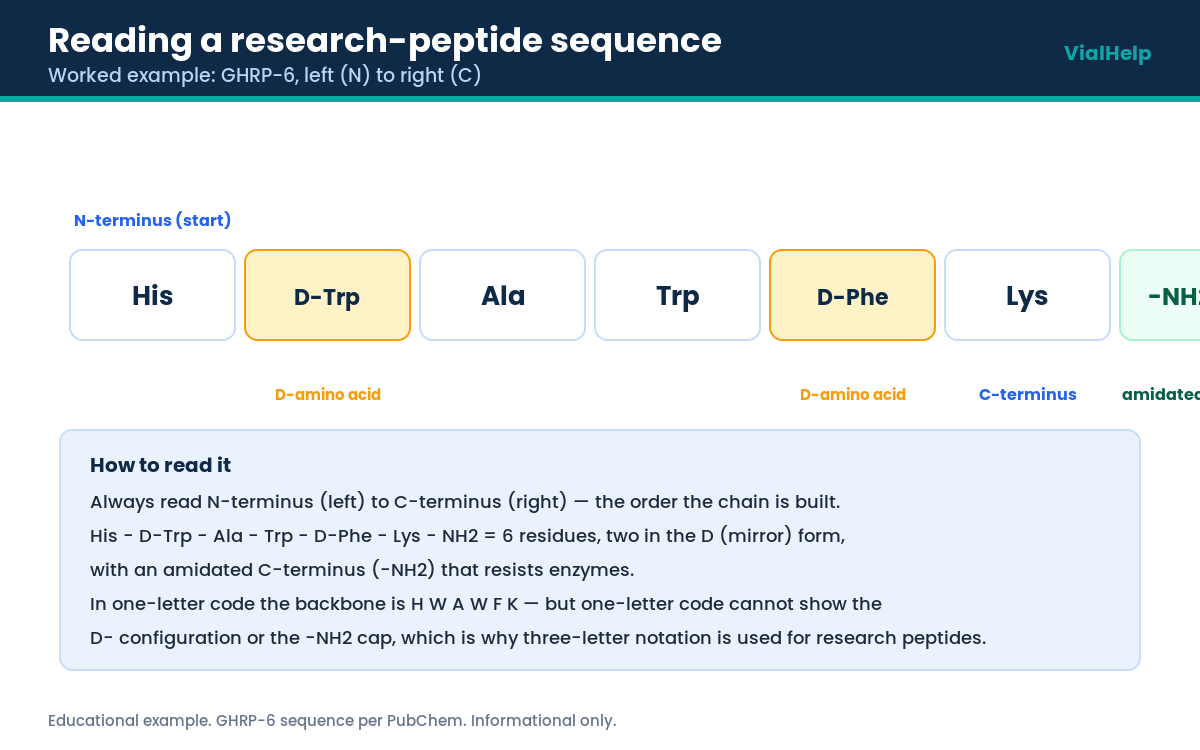
In one-letter code the backbone reads HWAWFK — but notice the one-letter form cannot show the D-configuration or the -NH₂ cap. That is exactly why three-letter notation is the norm for research peptides: it carries the modifications the one-letter code drops.
Why sequence matters for identity and the COA
The ordered residue list, plus any modifications, sums to one specific, calculable molecular weight. A certificate of analysis states the expected (theoretical) weight for the claimed sequence and then reports the measured mass by mass spectrometry; a match supports the claimed identity. One caveat worth knowing: matching mass confirms the molecular weight, not the exact residue order, because sequence isomers share a mass — full sequence proof needs tandem MS or Edman sequencing. Practically, the notation on the label is the identity claim, and the COA’s mass is the physical check. That verified molecular weight is also the number you feed into any reconstitution calculation.
Frequently asked questions
Why is arginine “R” and not “A”?
Because A was assigned to alanine. When the obvious first letter is taken, a nearby or phonetic letter is used — hence R for arginine, K for lysine, W for tryptophan, and F for phenylalanine.
What does -NH₂ at the end of a sequence mean?
It marks C-terminal amidation: the terminal carboxyl group is replaced by an amide, which removes a charge and makes the peptide more resistant to enzymes.
Does a one-letter sequence tell me everything?
No. It gives the backbone residues but cannot show D-amino acids, terminal caps (Ac-, -NH₂), cyclization or non-standard residues. For research peptides, rely on the three-letter notation.
References
- IUPAC-IUBMB — Nomenclature and Symbolism for Amino Acids and Peptides
- UniProt — Nomenclature and symbols for amino acids
- Chemistry LibreTexts — Peptides (N- to C-terminus, peptide bond)
- PubChem — Melanotan II (cyclic Ac-/-NH2 example)
- NIST Chemistry WebBook (amino-acid reference data)
Informational / educational only — not medical advice · 21+. Covers peptide notation and identity, not personal use.