
Vial Labeling Best Practices
Vial labeling is the single cheapest insurance policy in a reconstitution workflow: a clear, durable label turns an anonymous cloudy vial into a self-documenting record of exactly what is inside, how strong it is, and when it was made. Once a lyophilized powder goes into solution it looks identical to every other reconstituted vial in the fridge. Without a label, the only way to recover that information is memory or guesswork, and neither belongs in a record-keeping system. This article covers what to record, why each field matters, and how to make labels that survive cold storage and handling. It is written from a lab-handling and record-keeping perspective, not as dosing guidance.
Why vial labeling matters
The case for disciplined labeling comes down to three failure modes that show up repeatedly when vials are stored without complete labels:
- Mix-ups. Two reconstituted vials of similar volume and clarity are easy to confuse. A label that names the compound removes the ambiguity at the moment of selection rather than relying on tray position or memory.
- Freeze-thaw and concentration guessing. If the concentration was never written down, anyone using the vial later has to reverse-engineer it from the original powder mass and the diluent volume added. A label that states mg/mL ends the guessing.
- Unusable records. A logbook entry is only useful if it can be tied back to a physical vial. A lot or COA reference on the label is the link between the object in your hand and the paperwork that describes it.
Authoritative handling standards reinforce the same principle. USP guidance on compounded preparations calls for the container to be labeled with the active ingredient identity and amount, the preparer, and a beyond-use date after which the preparation should not be used. CDC injection-safety guidance is built on the assumption that a vial’s labeling tells the user what it is and how it may be handled. The lab-chemistry world reaches the same conclusion: secondary-container guidance states that any container holding a prepared solution should carry the substance name, its concentration, the date of preparation, and the initials of the person who made it.
The fields to record on every reconstituted vial
A complete label is short but specific. Each field answers a question a future user will otherwise have to guess at:
- Compound name. Write the full name, not an abbreviation or a nickname, so the contents are unambiguous to anyone.
- Concentration (mg/mL). The most useful single number on the label. It is computed from the powder mass and the diluent volume, and recording it removes any need to re-derive it later.
- Reconstitution date. The date the powder was put into solution. It anchors the beyond-use note and lets anyone gauge how long the vial has been in storage.
- Diluent used. Note what the vial was reconstituted with (for example, bacteriostatic water or sterile water). The diluent affects storage expectations.
- Lot / COA reference. A short code linking the vial to its source lot and certificate of analysis. This is what makes the record traceable.
- Beyond-use / expiry note. A short note for when the vial should no longer be considered usable, based on storage conditions and the source documentation.
- Initials. Who prepared it, so the record has an owner.
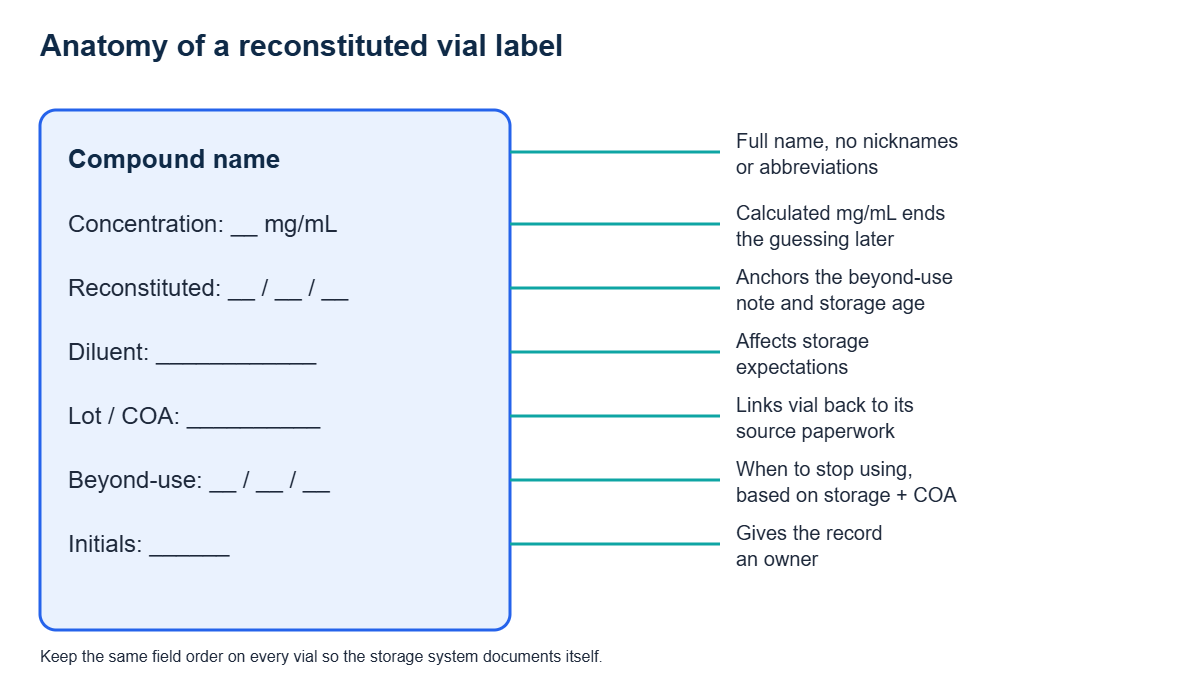
How concentration ties to the calculator’s label maker
Concentration is the field most prone to error because it is calculated, not observed. If you reconstitute a 10 mg vial with 2 mL of diluent, the concentration is 5 mg/mL. Get the arithmetic wrong and every downstream record inherits the mistake. This is exactly the step a reconstitution calculator is built to handle: enter the powder mass and the diluent volume, and the tool returns the mg/mL figure. The VialHelp reconstitution calculator includes a label maker that takes that same computed concentration and arranges it alongside the other fields, so the number on the printed label matches the number the calculator produced.
Durable labels and legibility
A label that smears in the fridge or peels off in the freezer is worse than no label, because it implies a record that no longer exists. Lab labeling guidance recommends label stock that is waterproof, chemical-resistant, and adhesive enough to withstand cold and condensation. A few practical habits keep labels readable:
- Use a waterproof, freezer-rated label and a smear-proof or permanent marker rather than ballpoint ink.
- Print rather than handwrite where possible; printed text resists rubbing and is legible to everyone.
- Apply the label to the body of the vial, not the cap, so it stays with the contents.
- Keep field order consistent across every vial so a glance lands on the same information each time.
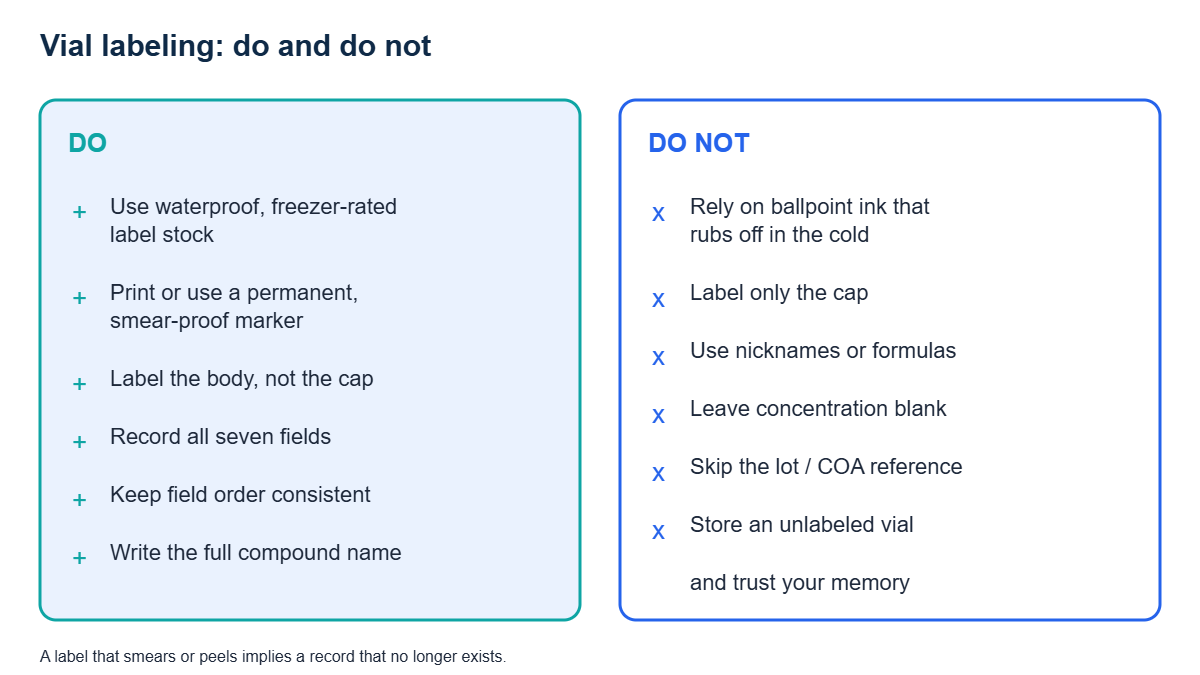
Example label layout
A workable layout fits on a standard vial label and reads top to bottom in the order a user scans it: compound name on the first line; concentration in mg/mL on the second; reconstitution date and diluent on the third; lot or COA reference on the fourth; a beyond-use note and preparer initials on the last. The exact arrangement matters less than consistency and completeness. If every vial in the fridge carries the same seven fields in the same order, the storage system documents itself.
What is the most important field if space is tight?
Compound name and concentration together, because they answer what the vial is and how strong it is. The remaining fields support traceability, but a vial that lacks a name or a concentration cannot be used confidently at all.
Should the diluent really go on the label?
Yes. The diluent influences storage expectations and the beyond-use note, so recording it on the label keeps that context attached to the physical vial instead of only in a separate log.
What does a lot or COA reference add?
It is the link between the vial and its source documentation. With it, you can trace a stored vial back to the certificate of analysis that describes the original material; without it, the vial is an orphan record.
Related tools and reading
Informational only – not medical advice. 21+.