
Concentration Math Basics: mg, mL, and mg/mL
Concentration math is the small piece of arithmetic that connects three lab quantities: mass (in milligrams, mg), volume (in milliliters, mL), and concentration (in milligrams per milliliter, mg/mL). Once you can move between those three numbers, the rest of reconstitution work stops feeling like guesswork. This page explains what mg/mL actually means, the single relationship that ties everything together, and several worked examples framed strictly as laboratory math – not as dosing instructions.
What mg/mL means
A concentration of mg/mL is just a ratio: it tells you how many milligrams of solid are dissolved in each milliliter of liquid. A milligram is one-thousandth of a gram, a submultiple of the SI base unit of mass, the kilogram. A milliliter is one-thousandth of a liter, equal to one cubic centimeter. Putting mass over volume gives a density-like figure that describes the solution rather than either ingredient alone.
So “5 mg/mL” means every single milliliter of that liquid carries 5 mg of the dissolved substance. Pull out 1 mL and you have 5 mg of solid; pull out half a milliliter and you have 2.5 mg. The ratio stays constant no matter how much you draw, which is exactly why it is so useful.
The core concentration math relationship
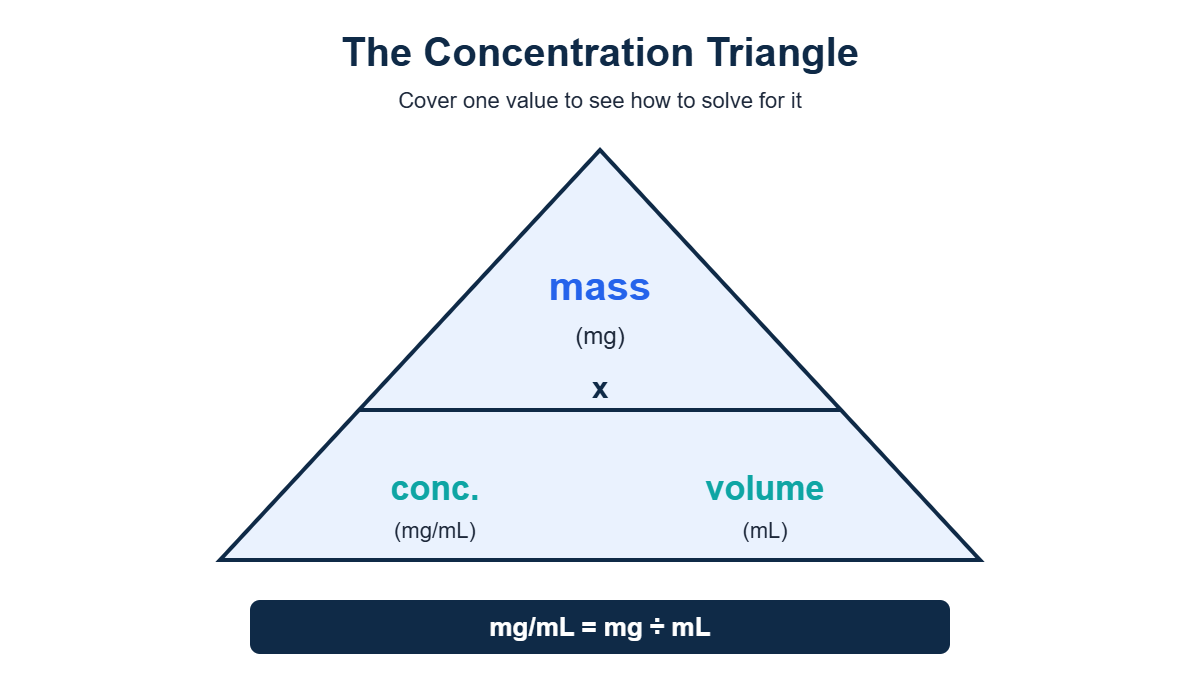
Every problem here comes from one equation:
- concentration = mass ÷ volume (mg/mL = mg ÷ mL)
- mass = concentration × volume (mg = mg/mL × mL)
- volume = mass ÷ concentration (mL = mg ÷ mg/mL)
These are the same relationship rearranged three ways, much like the speed/distance/time triangle. If you know any two of the three values, you can always solve for the third. The triangle below is a quick way to remember which operation to use: cover the quantity you want, and the position of the other two tells you whether to multiply or divide.
Worked examples (lab math only)
These examples treat the vial as a math object. They are not recommendations about how much of anything a person should use.
- Find the concentration. A 10 mg vial reconstituted in 2 mL of liquid gives 10 mg ÷ 2 mL = 5 mg/mL.
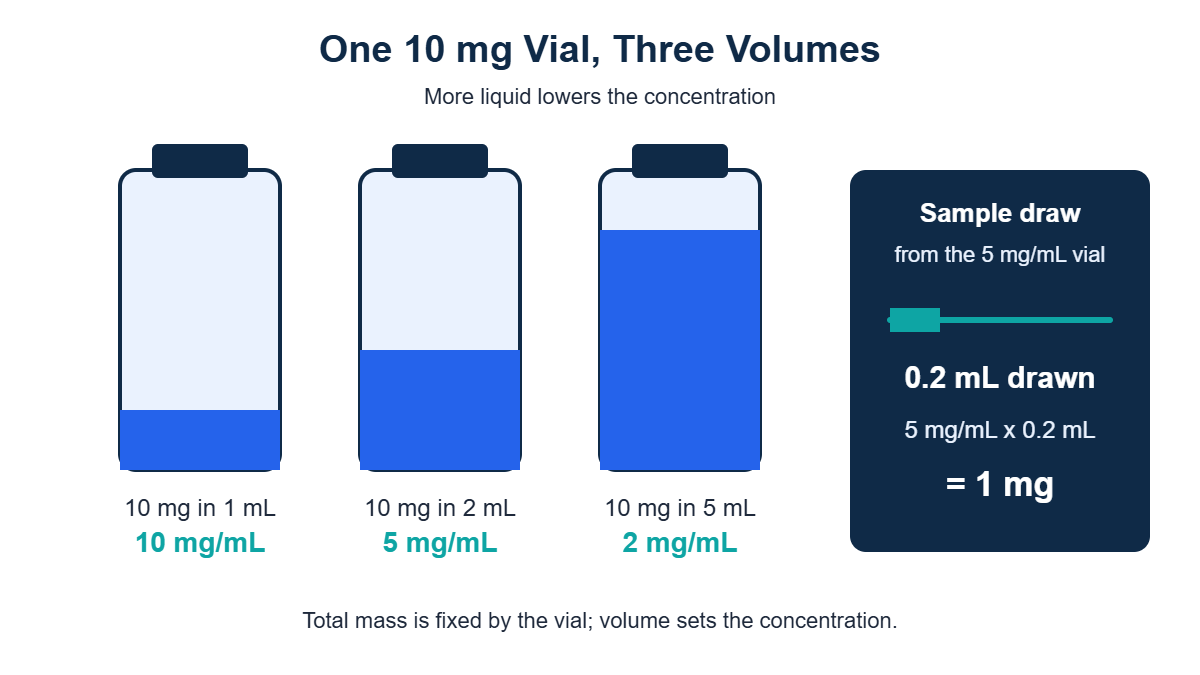
- Find the mass in a draw. From that 5 mg/mL solution, drawing 0.2 mL gives 5 mg/mL × 0.2 mL = 1 mg.
- Find the volume for a target mass. If you wanted 2.5 mg from the same 5 mg/mL solution, you need 2.5 mg ÷ 5 mg/mL = 0.5 mL.
- A second vial. A 5 mg vial in 1 mL is also 5 mg/mL, so it behaves identically per milliliter even though it holds half the total mass.
Notice that the third example is just the second one run backwards. Whenever a problem gives you a number and asks for the matching volume or mass, you are applying one of the two division or multiplication forms above.
How reconstitution volume changes concentration
The amount of solid in a sealed vial is fixed by the manufacturer. The concentration is decided entirely by how much liquid you add during reconstitution. Because concentration = mass ÷ volume, adding more liquid spreads the same mass across more milliliters and drives the concentration down; adding less liquid concentrates it.
- A 10 mg vial in 1 mL → 10 mg/mL
- A 10 mg vial in 2 mL → 5 mg/mL
- A 10 mg vial in 5 mL → 2 mg/mL
Same vial, three different concentrations – and therefore three different draw volumes for the same target mass. This is the single most common source of confusion: people compare draw volumes across vials without realizing the underlying concentrations differ. Always solve from the concentration, never by copying a volume from a different setup.
Reading a draw volume on the syringe
Insulin-style syringes are marked in units (U-100 means 100 units = 1 mL), while standard syringes are marked in milliliters. To translate a target mass into a mark on the barrel, divide the mass by the concentration to get the volume, then locate that volume on the scale.
- On a 1 mL (100-unit) syringe, 0.2 mL lines up with the 20-unit mark.
- On the same syringe, 0.5 mL lines up with the 50-unit mark (half the barrel).
Keeping units and milliliters straight is the difference between a correct reading and a tenfold error.
Common mistakes in concentration math
- Mixing up mg and mL. Mass and volume are different dimensions; you can only divide one by the other, never treat them as interchangeable.
- Confusing total vial mass with concentration. A bigger vial is not automatically “stronger” – concentration depends on the reconstitution volume.
- Reusing a draw volume across vials. A volume that gave 1 mg in a 5 mg/mL solution gives 2 mg in a 10 mg/mL solution.
- Unit-scale slips. Reading milliliters as if they were insulin units (or vice versa) shifts the result by a factor of ten or more.
Concentration math FAQ
Is mg/mL the same as a percentage solution?
They are related but not identical. A 1% solution means 1 gram per 100 mL, which equals 10 mg/mL. To convert, multiply the percentage by 10 to get mg/mL.
Does the type of liquid change the concentration math?
No. The arithmetic of mass ÷ volume is the same regardless of which reconstitution liquid is used. The liquid choice affects solubility and handling, not the ratio itself.
Why does adding more liquid lower the number?
Because the mass stays fixed while the volume in the denominator grows. Dividing the same mass by a larger volume always yields a smaller concentration.
Related tools and reading
- Reconstitution calculator – enter vial mass and liquid volume to get mg/mL.
- Concentration & volume converter – move between mg, mL, and mg/mL.
- BAC water calculator – plan reconstitution volumes.
- Guides – more lab-math explainers.
Informational only – not medical advice. 21+.