
Net Peptide Content: What “mg” on a Vial Really Means
Peptide measurement · COA basics
The milligram number printed on a research peptide vial tells you the net peptide content of the powder only if you read the Certificate of Analysis — because that labeled “mg” is usually the gross mass of the freeze-dried material, not the mass of pure peptide.
That distinction matters the moment you reconstitute and start calculating concentration. A vial labeled “5 mg” can contain noticeably less than 5 mg of actual peptide, which means the real mg/mL after you add diluent is lower than the label implies. Here is what makes up that gap, and how to read it correctly.
What “net peptide content” actually means
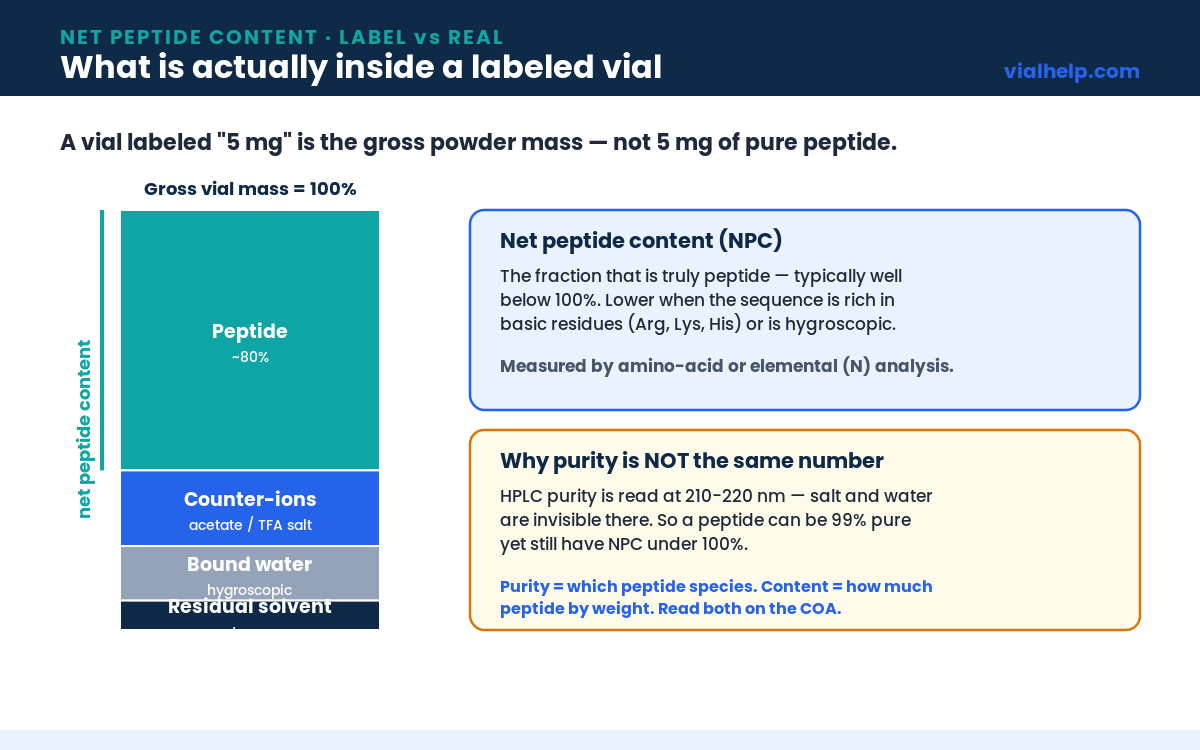
A lyophilized peptide powder is a mixture. Alongside the peptide itself it contains salt counter-ions, non-covalently bound water, and trace residual solvents. Net peptide content (NPC) is the fraction of the total powder mass that is genuinely peptide. It is commonly well below 100%.
Manufacturers measure NPC by methods that count the peptide specifically — typically amino-acid analysis (hydrolyzing the peptide and quantifying the released amino acids) or elemental nitrogen analysis (counter-ions and water contain no peptide nitrogen, so total nitrogen tracks the peptide). UV quantitation against a sequence’s extinction coefficient is also used.
Why net peptide content is not the same as HPLC purity
This is the most common confusion. HPLC purity is measured by running the sample on reversed-phase HPLC with UV detection at 210–220 nm (the wavelength where the peptide bond absorbs) and comparing the main peak to all the peptide-related peaks. It tells you how much of the peptide material is your target sequence versus deletion sequences, truncations, or oxidized by-products.
But salt and water are invisible at that wavelength. So a peptide can read 99% pure by HPLC and still have an NPC well under 100%, because purity says nothing about the counter-ions and moisture riding along in the powder. In short: purity tells you which peptide species are present; net content tells you how much peptide there is by weight. A good COA reports both.
Salt forms: why acetate and TFA add mass
Peptides are purified by reversed-phase HPLC using trifluoroacetic acid (TFA), so they are most often delivered as the TFA (trifluoroacetate) salt. TFA pairs with the positively charged groups on the peptide — the N-terminus and the basic side chains of arginine, lysine and histidine. For biological work, the TFA is often exchanged for a gentler counter-ion such as acetate.
Those counter-ions are not weightless. Acetate is roughly 59 Da and trifluoroacetate roughly 113 Da, and a peptide with several basic residues carries several counter-ions. That is why peptides rich in Arg, Lys and His tend to have lower NPC — more of the powder mass is salt.
Why this changes your concentration math
Net peptide content does not change the reconstitution volume — it changes the true milligrams of peptide in the numerator. Work an example: a vial labeled 5 mg with an NPC of 80% holds about 4 mg of actual peptide. Reconstituted in 2 mL, the label implies 2.5 mg/mL, but the true peptide concentration is about 2.0 mg/mL — a 20% overshoot if you ignore NPC.
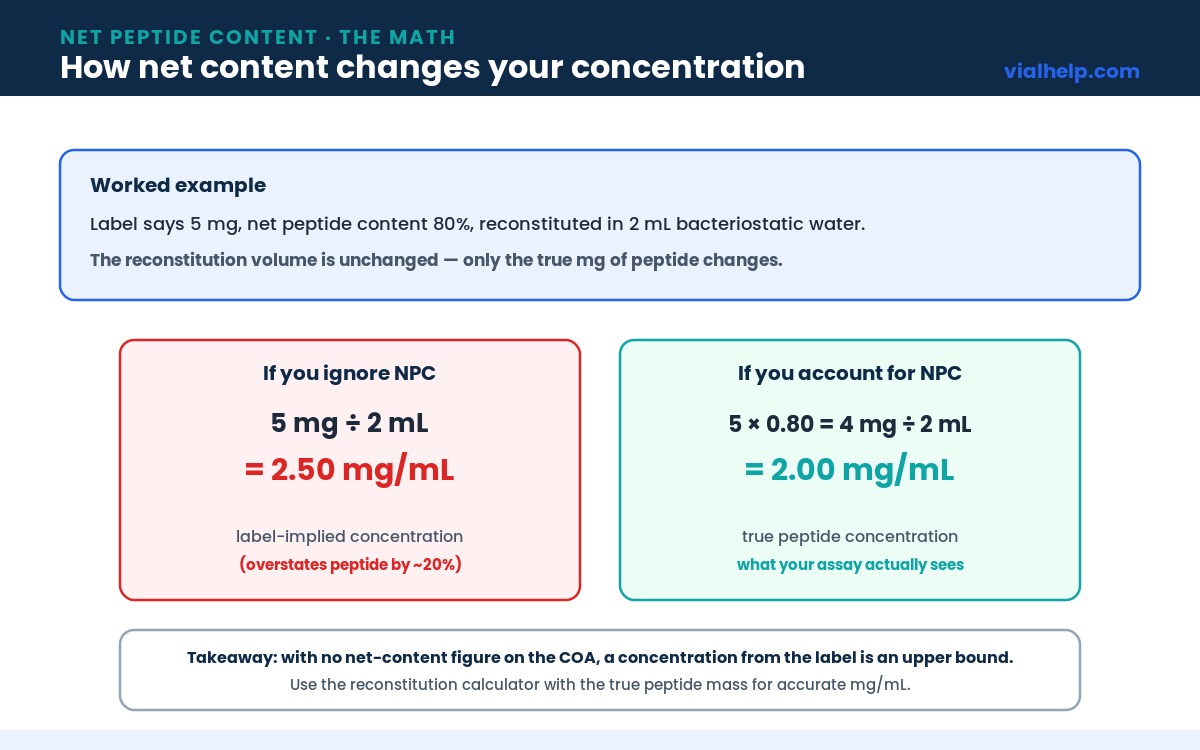
If your COA gives no net-content figure, any concentration calculated from the label is an upper bound. When you do know the true peptide mass, our reconstitution calculator and concentration converter turn it into an accurate mg/mL, and the units-are-not-a-dose explainer covers reading the syringe correctly.
Practical takeaways
- The label “mg” is the gross powder mass — expect the actual peptide to be lower.
- On the COA, look for two separate numbers: HPLC purity (%) and net/peptide content (%), plus the salt form and water content.
- Purity is not content. A high purity figure alone does not tell you how much peptide is in the vial.
- Peptides rich in basic residues (Arg, Lys, His) and hygroscopic peptides tend to have lower NPC.
- No net-content figure on the COA means the true peptide mass — and your concentration — is uncertain.
Frequently asked questions
Is a 5 mg vial really 5 mg of peptide?
Usually not exactly. The 5 mg is the gross lyophilized mass, which includes salt counter-ions and bound water; the net peptide content is typically somewhat lower.
Where do I find net peptide content?
On the product’s Certificate of Analysis, listed separately from HPLC purity. If only purity is shown, the absolute peptide amount is not specified.
Does the salt form change how much peptide I have?
Yes. Heavier counter-ions like TFA add more mass than acetate, so for the same labeled weight a TFA salt can contain slightly less peptide than an acetate salt.
Related reading
- Bachem. Quality Control of Amino Acids & Peptides: A Guide. bachem.com
- Iris Biotech GmbH. Net content and purity, two key parameters in peptide synthesis. iris-biotech.de
- Roux S, et al. Elimination and exchange of trifluoroacetate counter-ion from cationic peptides. J Pept Sci 2008;14(3):354-359 (PMID 18035848). pubmed.ncbi.nlm.nih.gov
- AmbioPharm. What is Net Peptide Content? ambiopharm.com