
Growth Hormone Peptide Side Effects: What the Research Shows
The peptides that raise growth hormone — the GHRPs, the GHRH analogs, and oral secretagogues such as MK-677 — share a recognizable set of reported effects. That is because most growth hormone peptide side effects trace back to a single thing: elevated growth hormone (GH) and IGF-1. Here is a balanced, sourced look at what the research literature describes.
The most commonly reported growth hormone peptide side effects
Across clinical trials and product data for GH-raising compounds, the effects reported most often are:
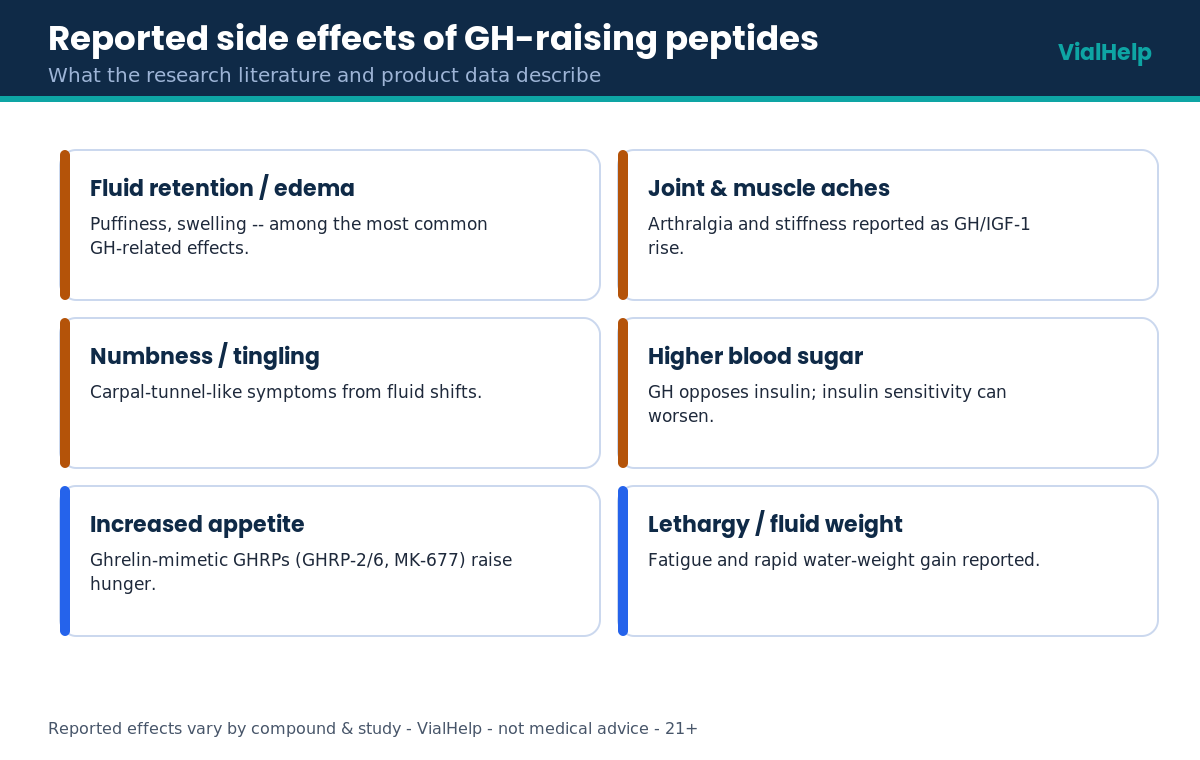
- Fluid retention and edema — puffiness and swelling are among the most common GH-related effects
- Joint and muscle aches (arthralgia) and stiffness as GH/IGF-1 rise
- Numbness or tingling — carpal-tunnel-like symptoms driven by fluid shifts
- Higher blood sugar / reduced insulin sensitivity — GH opposes insulin
- Increased appetite — specific to the ghrelin-mimicking GHRPs (GHRP-2, GHRP-6) and MK-677
- Lethargy and rapid water-weight gain reported by some users
Why GH-raising peptides cause these effects
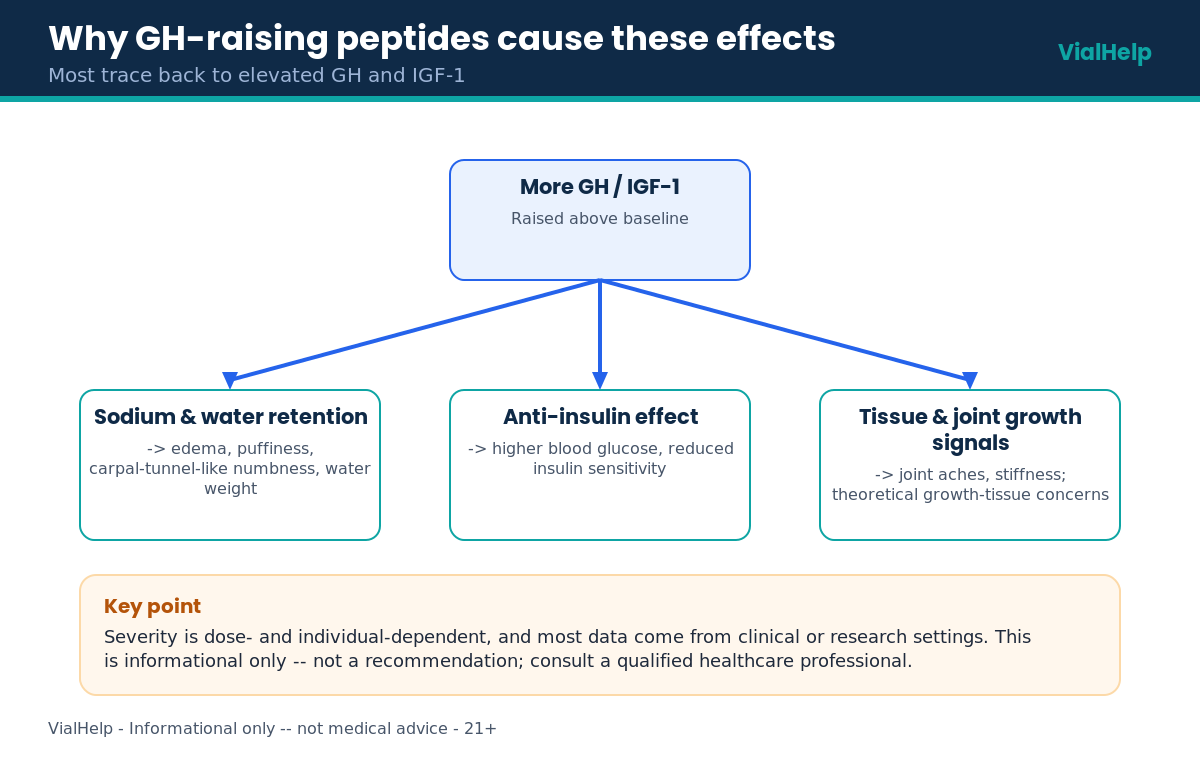
Most of these effects are not random — they are predictable consequences of pushing GH and IGF-1 above baseline. Growth hormone causes the kidneys to retain sodium and water, opposes the action of insulin, and signals tissue growth.
Compound-specific notes
- GHRPs (GHRP-2, GHRP-6): the appetite increase is the most distinctive added effect, because they mimic ghrelin. See GHRP-2.
- MK-677 (oral): in a two-year randomized trial, it raised lean mass but worsened insulin sensitivity and increased fasting glucose, with fluid retention also reported. See MK-677.
- GHRH analogs (sermorelin, CJC-1295, tesamorelin): generally fewer appetite effects, but the GH-related fluid and joint effects can still occur. See CJC-1295.
Where extra caution is warranted
Because these compounds affect blood sugar and fluid balance, several situations call for particular care — for example, anyone with blood-sugar concerns (the anti-insulin effect can raise glucose), or anyone prone to fluid retention. Severity is dose- and individual-dependent, and most rigorous data come from clinical or research settings rather than everyday use.
Frequently asked questions
Are growth hormone peptide side effects permanent?
Most reported effects (fluid retention, joint aches, appetite changes) are described as dose-related and tend to ease when levels return to baseline. Effects on blood sugar are a more important reason to be cautious.
Which GH peptide has the fewest side effects?
This article does not rank or recommend compounds. In general, more selective agents (for example, ipamorelin among the GHRPs) are reported to cause less appetite stimulation than GHRP-6 — but all GH-raising compounds share the core GH-related effects.
Do these peptides raise blood sugar?
They can. Growth hormone opposes insulin, so reduced insulin sensitivity and higher glucose are documented — most clearly for MK-677.
Related reading
Reconstitution calculator · Peptide library · Guides & how-tos
1. Nass R et al. Effects of an oral ghrelin mimetic on body composition and clinical outcomes in healthy older adults: a randomized trial. Ann Intern Med 2008. pubmed.ncbi.nlm.nih.gov/18981485
2. Sigalos JT, Pastuszak AW. The safety and efficacy of growth hormone secretagogues. Sex Med Rev 2018. pmc.ncbi.nlm.nih.gov/articles/PMC5632578
3. Growth hormone secretagogue — overview. en.wikipedia.org/wiki/Growth_hormone_secretagogue
4. Laferrère B et al. GHRP-2, like ghrelin, increases food intake in healthy men. J Clin Endocrinol Metab 2005. pubmed.ncbi.nlm.nih.gov/15699539
Informational only — not medical advice; consult a qualified healthcare professional. 21+.