
GHRH vs GHRP: GHRH Analogs vs GH Secretagogues
If you have spent any time in the peptide world, you have seen two families named together: GHRH analogs and GH secretagogues (the GHRPs). The GHRH vs GHRP question comes up constantly because both aim to raise growth hormone — but they do it through different doors, which is exactly why they are so often discussed side by side.
GHRH vs GHRP: two families, one goal
Growth hormone (GH) is released from the pituitary gland in pulses. Both families nudge that system to release more GH, but they bind different receptors. Understanding which door each one uses explains their different effects — and why researchers frequently combine them.
GHRH analogs: copying the body’s “make GH” signal
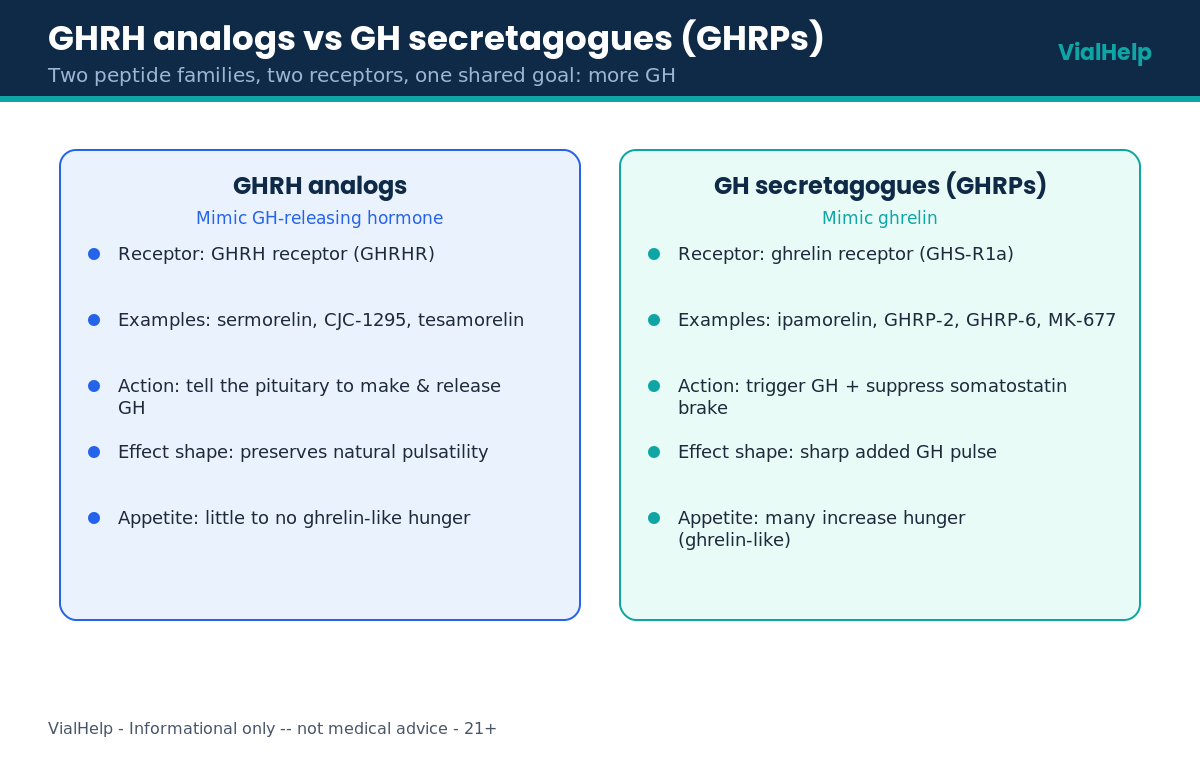
GHRH analogs mimic growth-hormone-releasing hormone and act on the GHRH receptor. Examples include sermorelin, CJC-1295 and tesamorelin. Because they work through the natural GHRH pathway, they tend to preserve the body’s normal pulsatile rhythm of GH release and generally produce little to no ghrelin-like hunger.
GH secretagogues (GHRPs): copying ghrelin
GHRPs mimic ghrelin and act on the ghrelin receptor (GHS-R1a). Examples include ipamorelin, GHRP-2, GHRP-6 and hexarelin, plus the oral, non-peptide MK-677, which is functionally grouped here even though it is a small molecule rather than a peptide. GHRPs trigger a sharp GH pulse and also suppress somatostatin (the body’s GH “brake”). Many of them — especially GHRP-2 and GHRP-6 — increase appetite.
Why the two families are combined
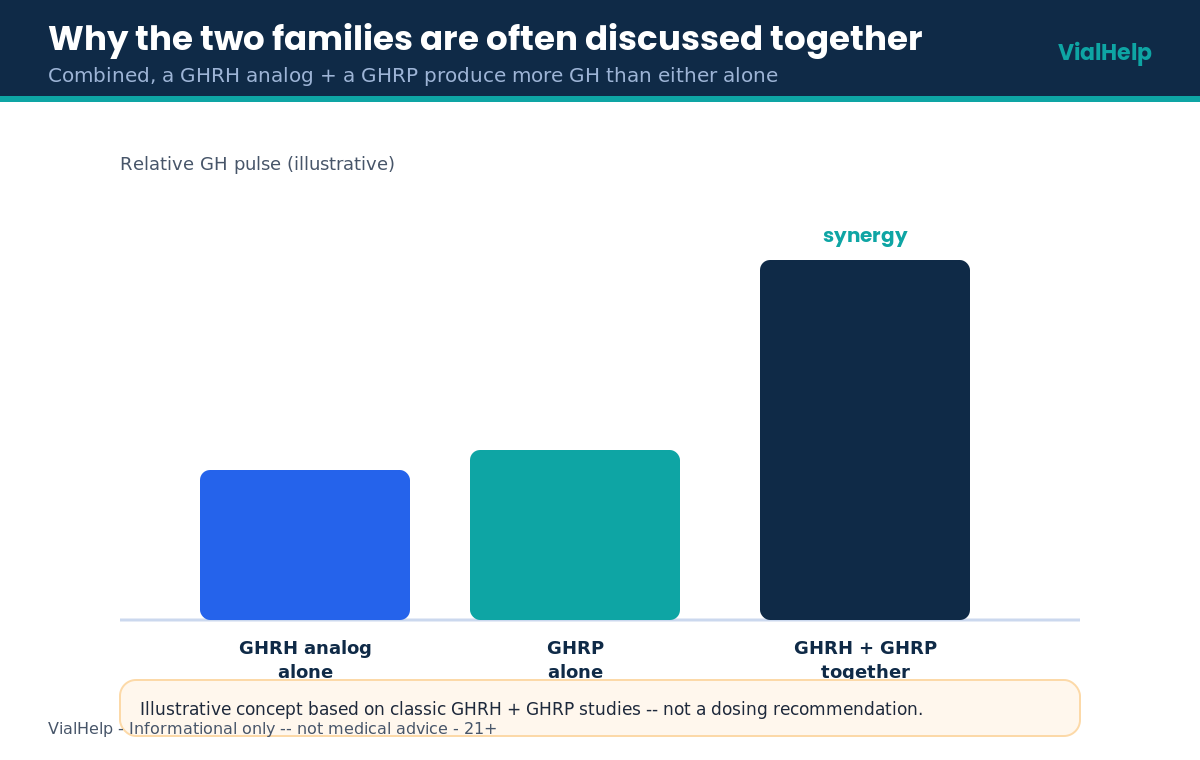
Because GHRH analogs and GHRPs push on different receptors, using one of each produces a larger GH pulse than either alone. This synergy — first described in classic endocrine studies — is the main reason a GHRH analog is so often paired with a GHRP in research settings.
Quick comparison
- Receptor: GHRH analogs → GHRH receptor; GHRPs → ghrelin receptor (GHS-R1a)
- Examples: GHRH — sermorelin, CJC-1295, tesamorelin; GHRP — ipamorelin, GHRP-2, GHRP-6, MK-677
- Pulsatility: GHRH analogs preserve natural pulses; GHRPs add a sharp extra pulse
- Appetite: GHRH analogs — little effect; many GHRPs — increased hunger
- Together: combining the two is synergistic, not just additive
How this connects to the lab math
Whichever family you are reading about, the practical skills are identical: you still reconstitute a vial, work out a concentration in mg/mL, and read a syringe correctly. Our reconstitution calculator and concentration converter handle that math for any compound.
Frequently asked questions
Is MK-677 a GHRP?
Not strictly. MK-677 is a non-peptide small molecule, so it is not a “peptide” at all. But because it acts on the same ghrelin receptor as the GHRPs, it is usually grouped with them functionally.
Which family is “better”?
Neither — they do different things. GHRH analogs preserve natural rhythm; GHRPs add a stronger pulse and often appetite. In research they are frequently combined rather than compared head to head. This is not a recommendation.
Do GHRH analogs cause hunger?
Generally little to none, which is one practical difference from the ghrelin-mimicking GHRPs.
1. Sigalos JT, Pastuszak AW. The safety and efficacy of growth hormone secretagogues. Sex Med Rev 2018. pmc.ncbi.nlm.nih.gov/articles/PMC5632578
2. Growth hormone secretagogue — overview. en.wikipedia.org/wiki/Growth_hormone_secretagogue
3. Growth hormone secretagogue receptor (GHS-R1a). en.wikipedia.org/wiki/Growth_hormone_secretagogue_receptor
4. Laferrère B et al. GHRP-2, like ghrelin, increases food intake in healthy men. J Clin Endocrinol Metab 2005. pubmed.ncbi.nlm.nih.gov/15699539
Informational only — not medical advice; consult a qualified healthcare professional. 21+.