
Sermorelin
Summary
Sermorelin (GRF 1-29) is the shortest fully active fragment of human GHRH; it stimulates the pituitary to release growth hormone and was once FDA-approved as Geref for diagnostic use and GH deficiency.
Quick facts
| Also known as | GRF(1-29), GHRH(1-29), Geref, sermorelin acetate |
| Category | Growth hormone secretagogue / GHRH analog |
| Status | Formerly FDA-approved (Geref, discontinued 2008); now compounded only |
| CAS | 86168-78-7 |
| Formula | C149H246N44O42S |
| Molecular weight | ≈3358 g/mol |
| Sequence | YADAIFTNSYRKVLGQLSARKLLQDIMSR-NH2 (GHRH 1-29, amidated) |
| Half-life | ≈10–20 minutes |
| Storage | Lyophilized: refrigerate, protect from light. Reconstituted: 2–8°C, do not freeze. |
In Plain English
Sermorelin is a shortened, lab-made copy of the natural signal that tells the body to make growth hormone. It was once used in a medical test to check whether a child’s growth-hormone system was working. Researchers study it for growth-hormone questions and healthy aging.
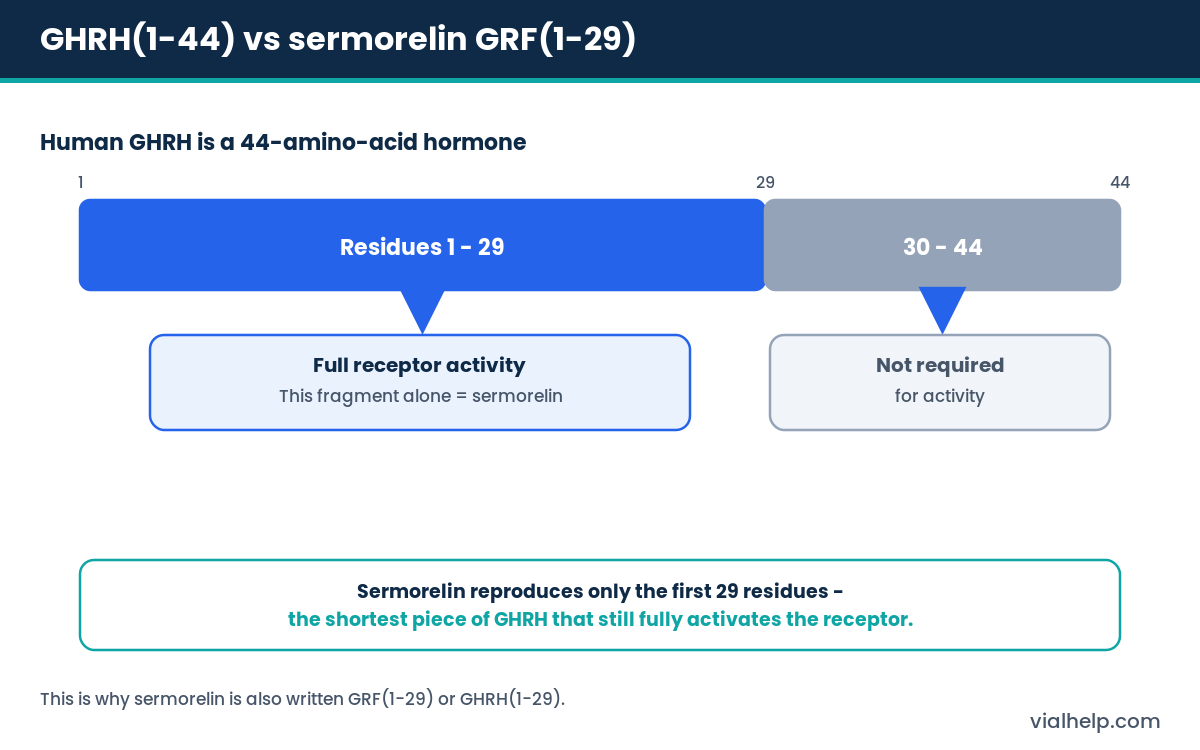
Sermorelin is the classic growth-hormone-releasing hormone (GHRH) analog — the shortest fragment of human GHRH that still fully activates its receptor. Also written as GRF(1-29) or GHRH(1-29), sermorelin reproduces the first 29 amino acids of natural GHRH. It was approved by the FDA in the 1990s under the brand name Geref for assessing pituitary function and treating growth hormone deficiency, and remains widely discussed today as the prototype GHRH peptide.
What is sermorelin?
Sermorelin is a 29-amino-acid peptide corresponding to residues 1–29 of human GHRH, capped with a C-terminal amide. Decades of research established that this 1-29 region is the minimum sequence needed for full GHRH biological activity — the remaining residues of the 44-amino-acid native hormone are not required to trigger growth hormone release. Its sequence is Tyr-Ala-Asp-Ala-Ile-Phe-Thr-Asn-Ser-Tyr-Arg-Lys-Val-Leu-Gly-Gln-Leu-Ser-Ala-Arg-Lys-Leu-Leu-Gln-Asp-Ile-Met-Ser-Arg-NH2, giving the molecular formula C149H246N44O42S and a molecular weight of about 3,358 g/mol (CAS 86168-78-7). Like natural GHRH, sermorelin has a very short half-life of roughly 10–20 minutes.
How sermorelin is studied to work
Sermorelin acts at the top of the growth-hormone axis, binding the same pituitary receptor as the body’s own GHRH. The reported pathway is straightforward:
- GHRH receptor binding: binds GHRH receptors on pituitary somatotroph cells.
- Pulsatile GH release: stimulates the pituitary to secrete growth hormone in its natural, rhythmic pulses.
- IGF-1 production: the resulting GH prompts the liver to produce insulin-like growth factor 1 (IGF-1).
- Preserved feedback: because it works through the pituitary rather than supplying GH directly, the body’s normal negative-feedback controls remain intact.
Reported effects and benefits in the research literature
Reported and studied effects of sermorelin include:
- Stimulated GH secretion — a reliable rise in growth hormone, which is the basis of its historical diagnostic use.
- Diagnostic value — used to test whether the pituitary can release GH in suspected growth hormone deficiency.
- Studied in pediatric GH deficiency — investigated as a treatment to promote growth in children with intact pituitary function.
- Physiologic pattern — favored in research discussions because it preserves pulsatile, feedback-regulated GH release rather than producing constant high levels.
What this does not mean: stimulating GH release is not the same as demonstrating benefit for body composition, recovery or aging. Much of the popular interest in sermorelin outpaces the controlled human evidence, and effects depend on a functioning pituitary.
What the human evidence shows
Sermorelin has a real regulatory history. It was FDA-approved as Geref (and Geref Diagnostic) — approved in the 1990s for evaluating pituitary somatotroph function and for treating growth hormone deficiency, including in children. The branded product was voluntarily discontinued in 2008; an FDA Federal Register determination noted it was not withdrawn for reasons of safety or effectiveness, and the discontinuation is generally attributed to manufacturing and commercial factors. As of 2026 there is no FDA-approved finished sermorelin product; any sermorelin in clinical use is compounded under 503A/503B pharmacy law. Reported side effects are generally mild — most commonly injection-site reactions, with occasional flushing or headache.
Handling, storage and reconstitution (research context)
- Lyophilized: keep refrigerated and protected from light; GHRH fragments are sensitive to heat and humidity.
- Reconstituted: refrigerate at 2–8°C, avoid freezing and shaking, and follow the supplier’s certificate of analysis for the in-use window.
- Use the reconstitution calculator to turn vial mg and diluent volume into a clear mg/mL concentration.
- Keep in mind that syringe “units” describe a volume, not a dose — see IU vs mL.
Cautions and considerations
- Sermorelin sold as a research peptide is not an FDA-approved finished product and is not quality-assured for human use.
- Its activity depends on a functioning pituitary; it will not substitute for growth hormone where the pituitary cannot respond.
- Verify purity, identity and endotoxin against a current COA — see our guide to reading a COA.
- This page is informational only and is not medical advice; consult a qualified healthcare professional.
Frequently asked questions
What does GRF(1-29) mean?
It refers to the first 29 amino acids of growth-hormone-releasing factor (another name for GHRH). That fragment is the shortest version that retains full activity, and it is exactly what sermorelin is.
Was sermorelin ever FDA-approved?
Yes. It was approved as Geref for diagnostic use and for growth hormone deficiency. The branded product was discontinued in 2008 — not for safety or effectiveness reasons — and no finished sermorelin product is FDA-approved today.
How is sermorelin different from CJC-1295 and tesamorelin?
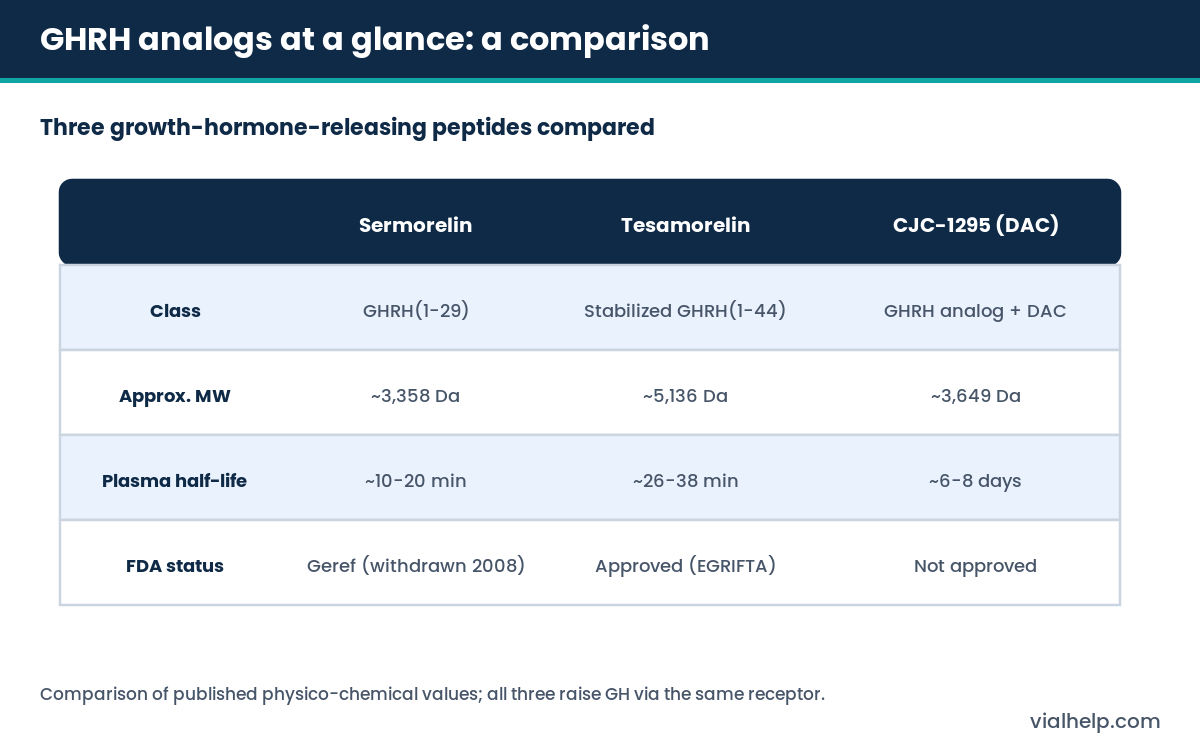
All three are GHRH-based. Sermorelin is the short, fast-clearing GRF(1-29) fragment; tesamorelin is a stabilized full-length GRF(1-44); and CJC-1295 with DAC binds albumin to last several days. The comparison below summarizes the differences.
Why is sermorelin’s half-life so short?
Like natural GHRH, sermorelin is rapidly broken down by plasma enzymes, giving a half-life of only about 10–20 minutes. Longer-acting analogs were engineered specifically to overcome this.
Related compounds and further reading
- Tesamorelin — a stabilized, FDA-approved full-length GHRH analog.
- CJC-1295 (with DAC) — a long-acting GHRH analog.
- Ipamorelin — a GH secretagogue frequently paired with GHRH analogs in research discussions.
- Browse the full peptide library and our research guides; see also IU vs mL.
- How to reconstitute peptides — step-by-step reconstitution method and concentration math.
- Sterile technique — aseptic handling and contamination prevention for research vials.
Share this article
References
For informational use only. Not medical advice; consult a qualified healthcare professional. 21+.
Sermorelin reconstitution calculator
Use the calculator below to find the concentration (mg/mL), draw volume and U-100 syringe units for Sermorelin once it is reconstituted with bacteriostatic water. Sermorelin has molecular formula C149H246N44O42S and a molecular weight of ≈3358 g/mol. Enter your vial amount and the water volume to see the lab math — informational use only, not dosing advice.