
Reconstituted Peptide Shelf Life: How Long Is It Good For?
Freeze-dried peptide powder can keep for months or even years when it is sealed and cold. But the moment you add water, the clock speeds up dramatically — which is why “how long is it good for?” is one of the most common storage questions. This guide covers the general principles of reconstituted peptide shelf life and beyond-use dating.
Reconstituted peptide shelf life: the short answer
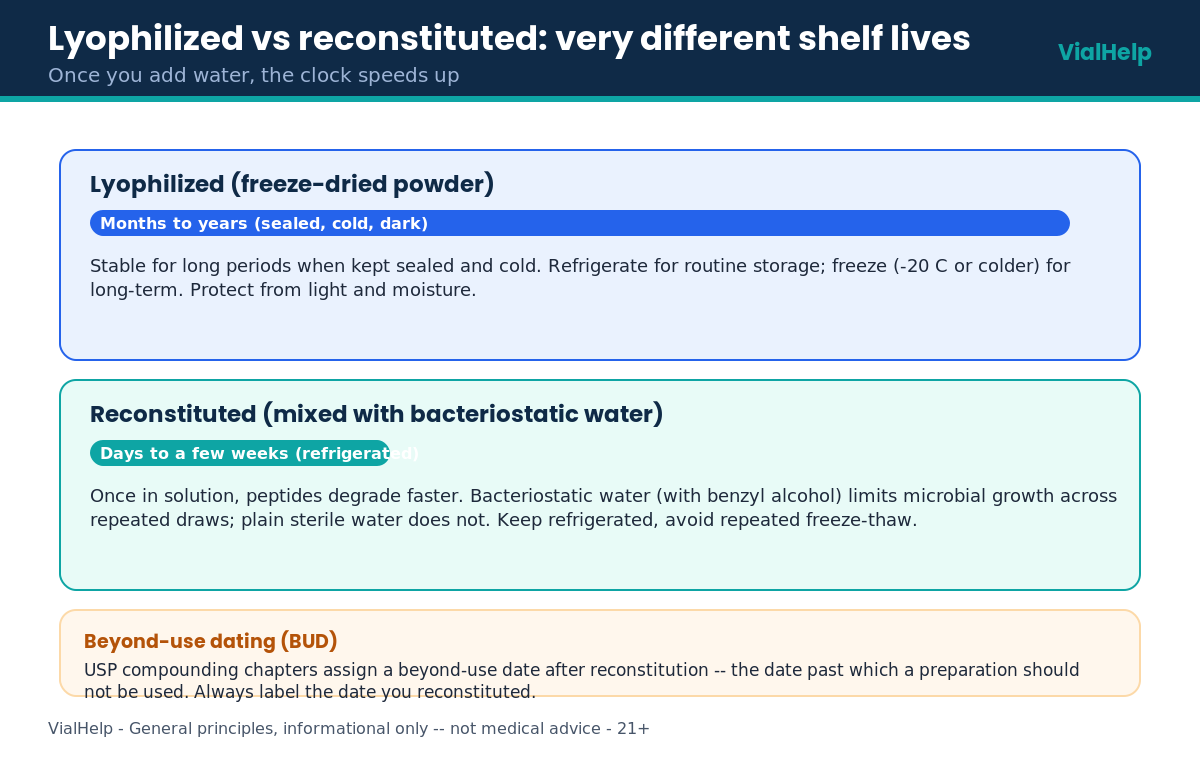
A lyophilized (freeze-dried) peptide is stable for a long time when stored properly. Once reconstituted with water, most peptides are typically good for a matter of days to a few weeks when refrigerated — the exact window depends on the specific compound, the diluent, and storage conditions. There is no single number that fits every peptide.
Why reconstituted peptides degrade faster
In dry form, the molecular machinery that breaks peptides down is largely paused. In solution, water enables chemical reactions (such as hydrolysis and oxidation) and allows any microbes to grow. Four levers matter most:
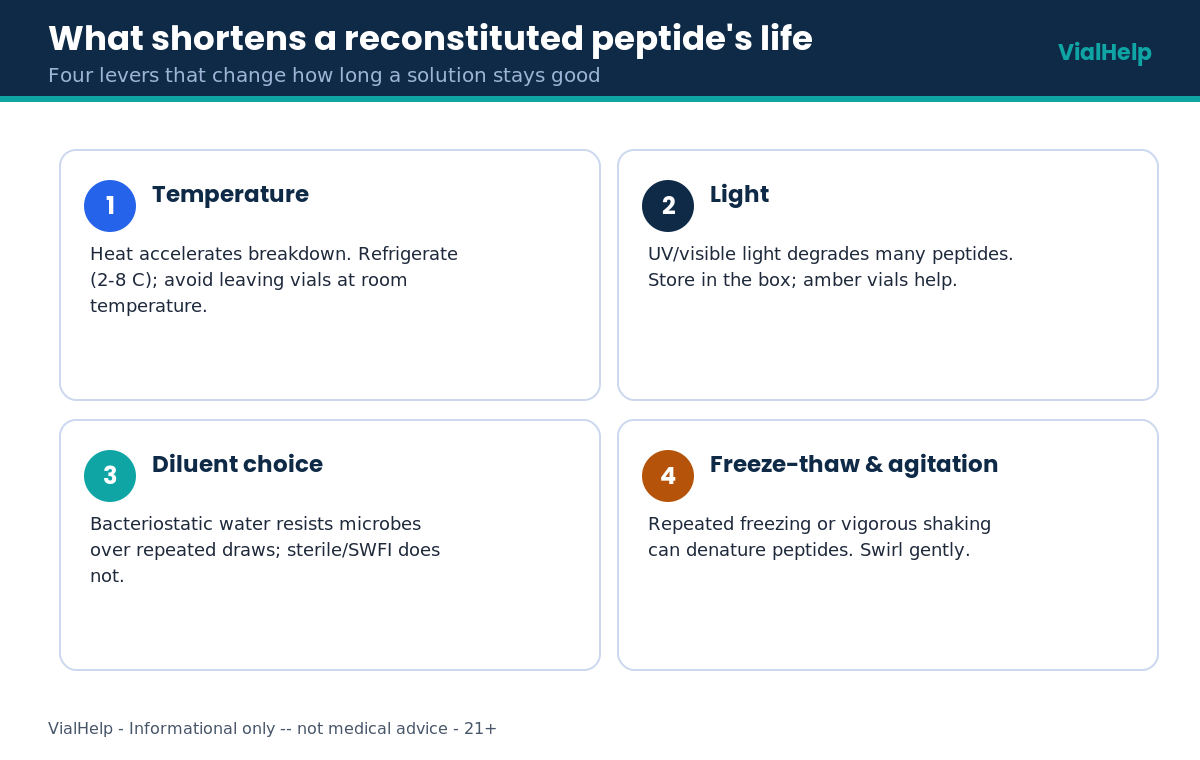
- Temperature — heat accelerates breakdown; refrigeration slows it
- Light — UV and visible light degrade many peptides
- Diluent — bacteriostatic water resists microbial growth over repeated draws; plain sterile water does not
- Freeze-thaw & agitation — repeated freezing or vigorous shaking can denature peptides
What is beyond-use dating (BUD)?
A beyond-use date is the date after which a prepared (reconstituted) product should no longer be used. It is different from a manufacturer’s expiration date, which applies to the unopened, original product. The United States Pharmacopeia (USP) describes beyond-use dating for compounded and reconstituted preparations in its compounding chapters (notably USP General Chapter <797> for sterile preparations). The practical takeaway: once you reconstitute, a new, shorter clock starts.
Practical storage principles
- Refrigerate reconstituted vials (2–8 °C); avoid leaving them at room temperature
- Use bacteriostatic water for vials you will draw from more than once
- Protect from light — keep the vial in its box or use an amber vial
- Avoid repeated freeze-thaw cycles; if you need long storage, aliquot into smaller portions and freeze once
- Always label the date you reconstituted — you cannot track a beyond-use date without it
- Inspect before use and discard if you see cloudiness, particles, or a color change
How to label and track it
The simplest habit that protects you is a clear label. Our reconstitution calculator includes a label maker that records the compound, concentration (mg/mL), and reconstitution date. If you are unsure how concentration relates to what you draw, see why units are not a dose.
Frequently asked questions
How long does a reconstituted peptide last in the fridge?
Commonly a few days to a few weeks, depending on the compound and conditions. This is a general range, not a guarantee — when in doubt, prepare smaller amounts more often.
Can I freeze a reconstituted peptide?
Some are aliquoted and frozen once for longer storage. The problem to avoid is repeated freeze-thaw cycling, which stresses the molecule each time.
Does bacteriostatic water extend shelf life?
It limits microbial growth across repeated punctures of the stopper, which is why it is preferred for multi-draw vials. It does not stop the chemical degradation that happens in solution over time.
1. USP General Chapter <797> Pharmaceutical Compounding — Sterile Preparations. usp.org/compounding/general-chapter-797
2. USP General Chapter <795> Pharmaceutical Compounding — Nonsterile Preparations. usp.org/compounding/general-chapter-795
3. U.S. FDA. Human Drug Compounding. fda.gov/drugs/…/human-drug-compounding
4. CDC. Injection Safety. cdc.gov/injection-safety
Informational only — not medical advice; consult a qualified healthcare professional. General principles; verify compound-specific stability. 21+.