
IGF-1 and Growth-Factor Peptide Side Effects: What Research Shows
Side-effects series
IGF-1 side effects are best understood from the one form with real human safety data — the approved drug mecasermin (Increlex) — because the research-market analogs IGF-1 LR3, IGF-1 DES, and MGF have essentially none. This article summarizes what the approved-drug label documents and what mechanism predicts for the analogs: balanced, informational reference, not medical advice.
What these compounds are
IGF-1 (insulin-like growth factor 1) is a small peptide hormone that carries out many of growth hormone’s growth-promoting effects. Its recombinant form, mecasermin (brand Increlex), is FDA-approved — but only for a narrow pediatric indication (severe primary IGF-1 deficiency), under physician supervision. It is not approved for muscle-building, anti-aging, or use in healthy adults.
The research-market analogs are not approved by any regulator and have essentially no human safety-trial data: IGF-1 LR3 (engineered to evade IGF-binding proteins, so it lasts much longer), IGF-1 DES (a short, potent truncated form), and MGF or mechano growth factor (a locally acting splice variant of the IGF-1 gene). Only the approved IGF-1 drug has a real human safety database; everything about the analogs below is inference from that drug and from IGF-1 biology.
Documented side effects of the approved IGF-1 drug
These come from the mecasermin (Increlex) label and its clinical dataset:
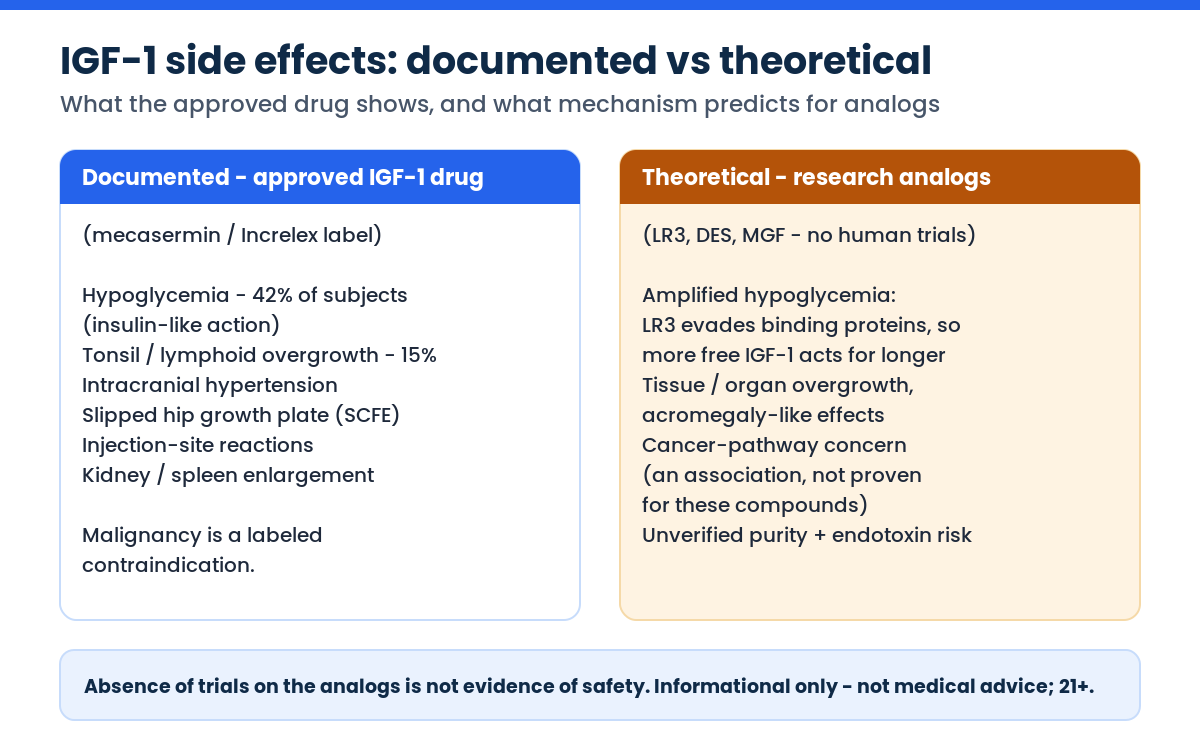
- Hypoglycemia — the dominant risk. IGF-1 has insulin-like activity; about 42% of trial subjects had at least one low-blood-sugar event, some severe. The drug is dosed within about 20 minutes of a meal to manage this.
- Tonsillar and lymphoid overgrowth — roughly 15% of subjects, sometimes causing snoring or sleep apnea.
- Intracranial hypertension (raised pressure around the brain), usually reversible when the dose is reduced.
- Slipped hip growth plate (slipped capital femoral epiphysis) and worsening of existing scoliosis, from rapid growth.
- Enlargement of the kidneys and spleen; facial soft-tissue thickening.
- Injection-site reactions (lipohypertrophy, bruising, pain) and, rarely, allergic reactions including anaphylaxis.
The label also makes active or suspected malignancy a contraindication, and long-term overdose is described as producing acromegaly-like features.
Theoretical risks for the research analogs
Because the analogs are used to push free IGF-1 above normal levels, the label’s dose-related signals become the central concern:
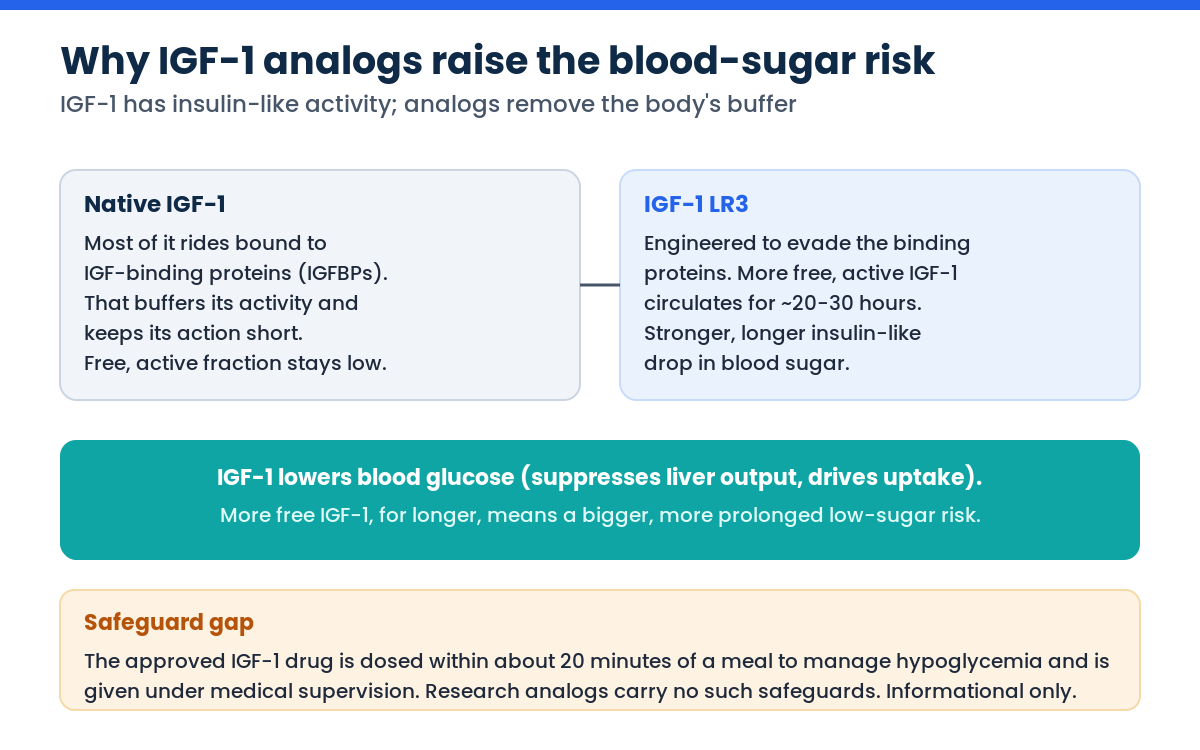
- Amplified hypoglycemia — analogs like LR3 evade the binding proteins that normally buffer IGF-1, so more free, active hormone circulates for longer. That points to a greater, more prolonged low-blood-sugar risk than the approved drug, without the meal-timing safeguards of medical supervision.
- Tissue and organ overgrowth, and acromegaly-like effects, matching what the label documents at therapeutic doses.
- A cancer-pathway concern. IGF-1 signaling promotes cell proliferation and survival and is a well-studied pathway in tumor biology. Epidemiology links higher circulating IGF-1 with certain cancers (for example, a large study associated higher IGF-1 with breast-cancer risk). This is an association from natural IGF-1 levels — not proof that injecting these compounds causes cancer — but it is a mechanism-plausible concern amplified by the label’s own dose-related neoplasia signal.
- Fluid retention and edema, consistent with IGF-1’s insulin-like, sodium-retaining activity.
The analogs specifically
- IGF-1 LR3 — reduced binding-protein affinity extends its half-life to roughly 20-30 hours, so it sustains high free IGF-1 the longest of the group. No human safety trials.
- IGF-1 DES — a truncated form that is more potent in cell assays but short-acting. No human safety data.
- MGF (mechano growth factor) — normally a local, very short-lived muscle-repair signal; that brief lifespan is itself a biological safety brake that modified versions (PEG-MGF) deliberately remove. Human evidence is essentially limited to preclinical work.
The honest summary: for all three analogs there are no controlled human safety trials, no established dosing, and no long-term outcome data.
Supply quality and endotoxin risk
A concrete, real-world hazard is contamination. Research-market peptides are made outside pharmaceutical GMP, and bacterial endotoxin (a fragment of gram-negative bacteria) readily contaminates synthesis water and equipment. Endotoxin is biologically active at trace levels and can cause reactions from fever and chills up to shock. Crucially, chemical purity does not equal endotoxin safety — a peptide can be 99% pure and still carry dangerous endotoxin, which is a separate test (the LAL assay). Unregulated material frequently lacks a verified endotoxin certificate.
Regulatory and anti-doping status
None of these are approved for performance, physique, or anti-aging use. Mecasermin’s approval is confined to the pediatric IGF-1-deficiency indication. Under the WADA Prohibited List, IGF-1 and its analogs and mechano growth factors fall under Category S2 (peptide hormones, growth factors and mimetics) and are banned at all times, in and out of competition.
What this does not mean
The documented mecasermin side effects come from a specific pediatric-deficiency population at therapeutic doses under medical supervision; those exact frequencies do not transfer directly to other users. The IGF-1–cancer link is an association from the epidemiology of natural IGF-1 levels, not proof that these compounds cause cancer, and should not be overstated. At the same time, the absence of human trials on the analogs is not evidence that they are safe — it is simply absence of evidence.
Frequently asked questions
What is the most common IGF-1 side effect?
Hypoglycemia (low blood sugar). IGF-1 has insulin-like activity; in trials of the approved drug about 42% of subjects had at least one hypoglycemic event.
Are IGF-1 LR3 and DES safer than the approved drug?
There is no evidence they are safer — there is simply no human safety data for them. By sustaining higher free IGF-1, LR3 in particular may carry a greater, longer hypoglycemia risk.
Does IGF-1 cause cancer?
IGF-1 signaling is involved in cell growth, and higher natural IGF-1 levels are associated with some cancers. That is an association, not proof that injecting IGF-1 analogs causes cancer; no human study has measured that.
Is IGF-1 banned in sport?
Yes. IGF-1, its analogs, and mechano growth factors are on the WADA Prohibited List (S2) and banned at all times.
Related reading
Reconstitution calculator · Peptide library · Guides & how-tos
References
- FDA Increlex (mecasermin) Prescribing Information, rev. 2025. accessdata.fda.gov
- DailyMed — INCRELEX (mecasermin) label. dailymed.nlm.nih.gov
- Murphy N, et al. IGF-1, IGFBP-3 and breast-cancer risk (~430,000 women), Annals of Oncology 2020. annalsofoncology.org
- IGF-1 signaling in cancer (review, PMC9395641). ncbi.nlm.nih.gov
- IGF-1Ec / Mechano Growth Factor (PMC3795771). ncbi.nlm.nih.gov
- WADA Prohibited List (Category S2). wada-ama.org
Informational only — not medical advice · 21+. This article is educational; it does not endorse or instruct use of any compound. Anyone with questions about IGF-1 or growth-factor peptides should consult a qualified healthcare professional.