
Endotoxin testing and LAL: why peptide purity isn’t the whole story
When people evaluate a research peptide’s quality, the first number they look at is usually the HPLC purity percentage. But purity is only one of the questions a good Certificate of Analysis answers — and on its own it can be misleading. Here is why endotoxin testing matters just as much.
Purity answers one question
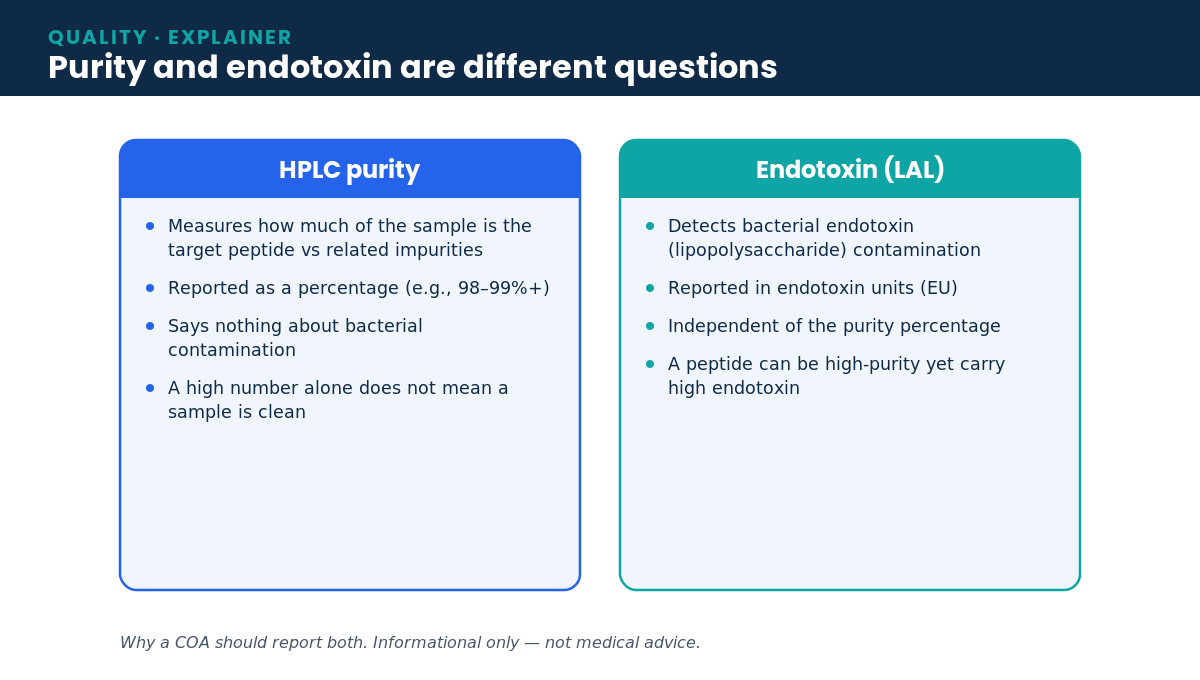
HPLC (high-performance liquid chromatography) purity tells you how much of a sample is the target peptide versus related impurities, usually expressed as a percentage such as 98% or 99%. It is a genuinely useful measure of how cleanly a peptide was synthesized and purified. What it does not tell you is whether the sample is contaminated with something that HPLC purity simply does not measure.
What endotoxin is and why it matters
Endotoxins are lipopolysaccharide molecules from the outer membrane of certain bacteria. They can be present even after the bacteria themselves are gone, and they are not removed or detected by a purity assay. This is the key point: a peptide can show a very high HPLC purity and still carry an unacceptable endotoxin load. Because endotoxin and purity are independent measurements, a single “99%” figure does not, by itself, indicate that a sample is free of contamination.
How LAL testing works
Endotoxin is typically measured with a Limulus amebocyte lysate (LAL) test, historically derived from horseshoe-crab blood, which reacts in the presence of endotoxin. Results are reported in endotoxin units (EU). The LAL test is a standard, well-established method described in pharmacopeial references such as the United States Pharmacopeia. The takeaway for readers is not the assay chemistry but the principle: identity, purity, and endotoxin are three separate checks, and a thorough Certificate of Analysis reports all three.
Reading it on a COA
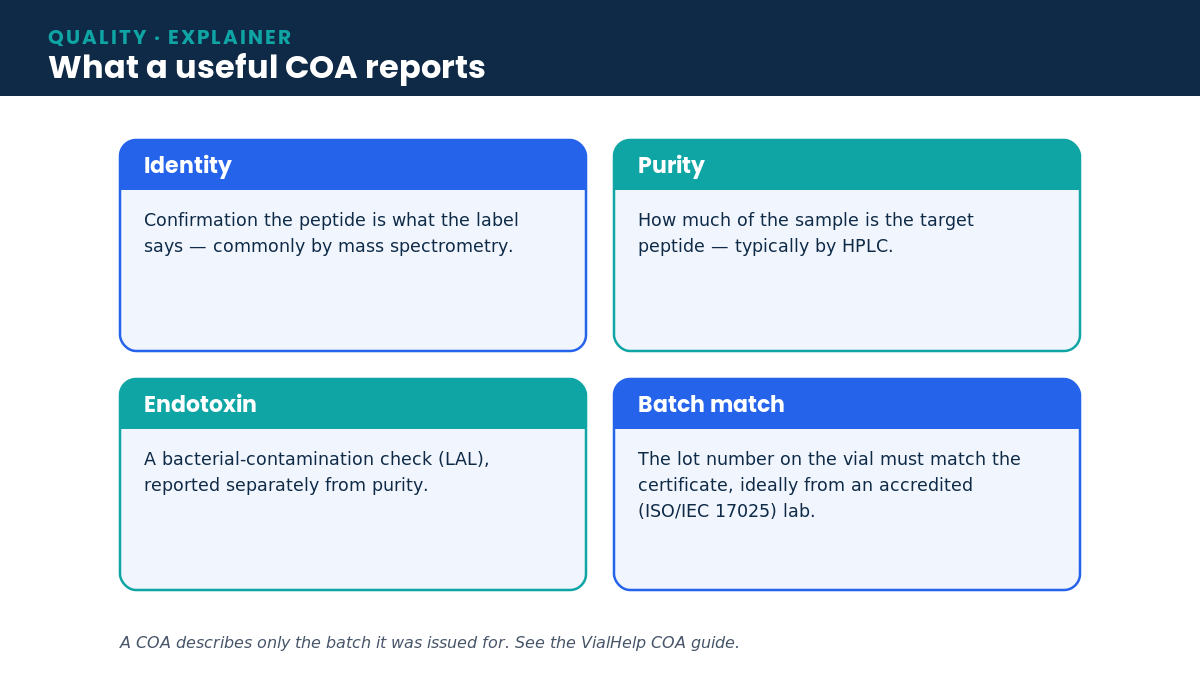
A useful COA ties together identity (commonly confirmed by mass spectrometry), purity (by HPLC), and an endotoxin result — ideally from an independent lab accredited to a recognized standard such as ISO/IEC 17025. And the single most practical check remains the simplest one: the batch or lot number on the vial must match the batch number on the certificate, because a COA only describes the specific lot it was issued for.
Frequently asked questions
If a peptide is 99% pure, is it safe?
Purity alone does not establish that. Purity does not measure endotoxin contamination, which is a separate test. This article is informational and not a safety determination for any product.
What is a good endotoxin level?
Acceptable endotoxin limits depend on the intended use and are defined in pharmacopeial standards. Rather than citing a single figure, the practical point is that a COA should report an endotoxin result at all, from a credible lab, for the matching batch.
Related on VialHelp
Read the full guide to reading a Certificate of Analysis, browse the peptide library, and see the latest peptide news.
Sources: FDA — Pyrogen and Endotoxins Testing guidance; United States Pharmacopeia (USP) bacterial endotoxins test <85>; ISO/IEC 17025 laboratory accreditation.
Related reading
Reconstitution calculator · Peptide library · Guides & how-tos
Share this article
For informational and educational use only — not medical advice. Intended for adults 21+.