
The Parathyroid Glands Explained: PTH, Calcitonin, and Calcium Balance
Endocrine system
The parathyroid glands are four small glands tucked behind the thyroid, and they run one of the body’s most tightly guarded numbers: the level of calcium in your blood. Tiny as they are, they release parathyroid hormone (PTH) — an 84-amino-acid peptide hormone that decides, minute by minute, whether calcium is pulled out of storage or locked away.
What the parathyroid glands are
Despite the name, the parathyroid glands are not part of the thyroid — they simply sit on the back of it, usually four of them. Their working cells are the chief cells, which synthesize and secrete PTH. A second population, the oxyphil cells, has no clearly established function and becomes more numerous with age.
They have an unusual developmental quirk: the glands arise from the third and fourth pharyngeal pouches in the embryo, and because the thymus (which shares the third pouch) migrates down into the chest, the inferior parathyroids actually come from the third pouch while the superior ones come from the fourth. It is a small anatomical puzzle that explains why a stray parathyroid gland is sometimes found low in the neck or chest.
How PTH keeps blood calcium in range
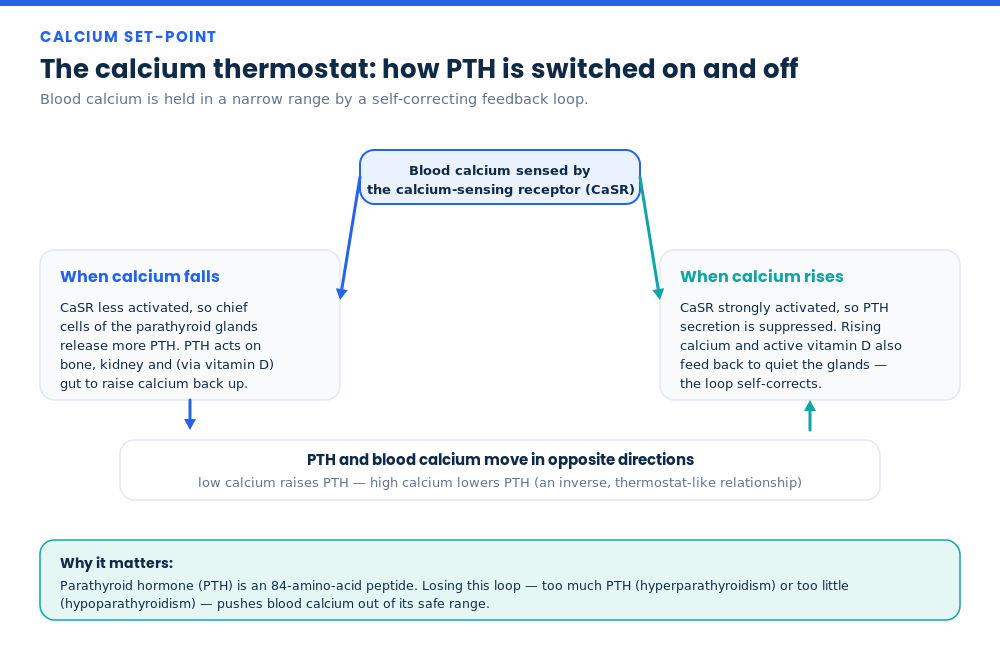
Blood calcium has to stay within a narrow band for nerves, muscle and clotting to work. The parathyroid glands manage this with a feedback loop that behaves like a thermostat. Chief cells carry a calcium-sensing receptor (CaSR) — a G-protein-coupled receptor — on their surface. When blood calcium falls, the CaSR is less activated and the glands release more PTH. When calcium rises, the receptor is strongly activated and PTH secretion is switched off.
Where PTH acts: bone, kidney and gut
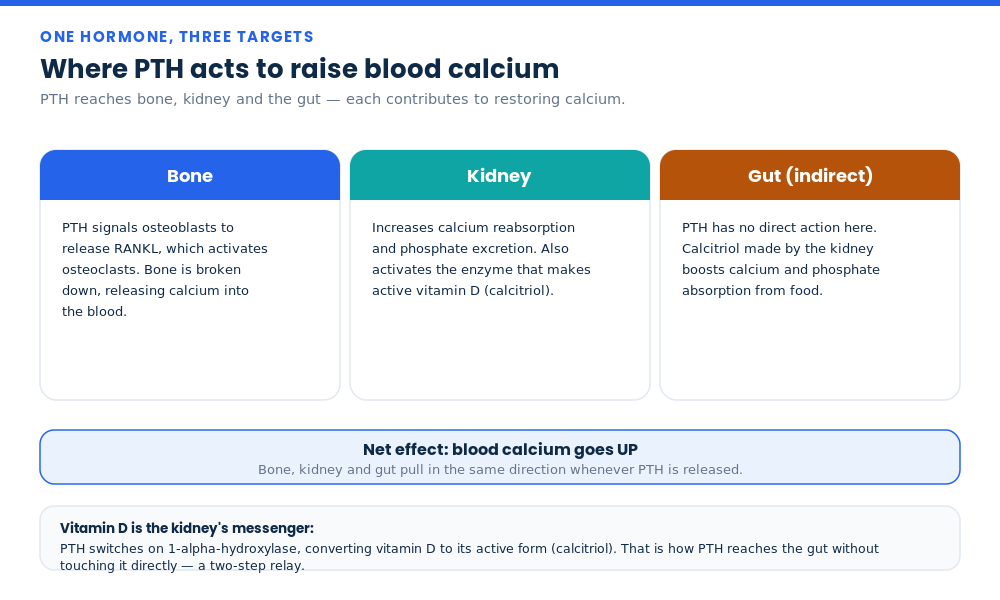
To raise calcium, PTH reaches three organs. In bone, it signals osteoblasts to release RANKL, which activates bone-dissolving osteoclasts, freeing calcium into the blood. In the kidney, it increases calcium reabsorption and phosphate excretion, and switches on the enzyme (1-alpha-hydroxylase) that converts vitamin D into its active form, calcitriol. PTH has no direct action on the gut; instead, calcitriol made by the kidney boosts calcium absorption from food. Because calcitriol works through a nuclear hormone receptor, this arm of the system is slower than the fast bone and kidney effects — a two-step relay rather than a direct push.
Calcitonin: the opposite signal
If PTH raises calcium, what lowers it? The classic counterpart is calcitonin, a 32-amino-acid peptide secreted not by the parathyroids but by the parafollicular “C cells” of the thyroid. It restrains osteoclasts and reduces renal reabsorption, nudging calcium down. In humans its everyday role is modest — it is sometimes called “the forgotten hormone,” because losing it (or having too much) causes little change in calcium. Salmon calcitonin, which is more potent than the human form, is used as a drug for conditions such as Paget disease of bone and hypercalcemia.
The PTH paradox: a bone-loss hormone that became a bone-building drug
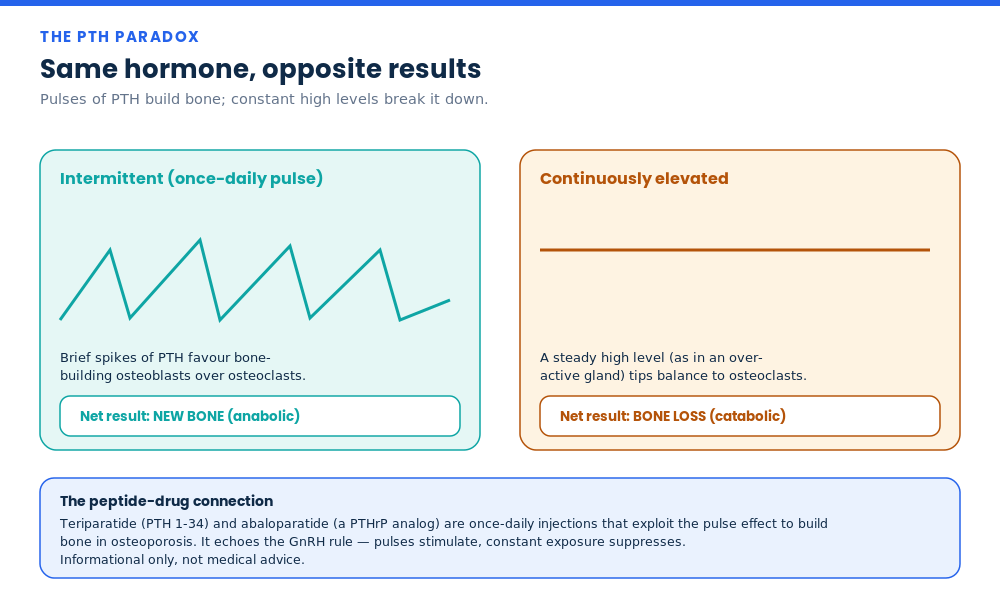
Here is the twist that makes PTH famous in pharmacology. When PTH is continuously elevated — as in an overactive gland — the net effect on the skeleton is bone loss. But when PTH is delivered in brief, intermittent pulses, the balance tips the other way and the body lays down new bone. Once-daily injectable PTH fragments exploit exactly this pulse effect: teriparatide is recombinant PTH(1-34), the biologically active amino-terminal fragment, and abaloparatide is a synthetic analog of the related molecule PTHrP. Both are anabolic (bone-building) treatments for osteoporosis. The pattern echoes a rule seen elsewhere in endocrinology — with GnRH, pulses stimulate while constant exposure suppresses. This section is informational only and is not medical or dosing advice.
When the system breaks
Too much PTH — primary hyperparathyroidism, usually from a benign adenoma — raises blood calcium and lowers phosphate, and is classically remembered by the phrase “stones, bones, moans, and psychic overtones.” Too little PTH — hypoparathyroidism — lets calcium fall, causing numbness, cramping and tetany; the most common cause is accidental damage to the glands during thyroid or neck surgery. A related molecule, PTHrP (parathyroid hormone-related protein), normally acts locally in tissues, but some tumours secrete it in excess and drive hypercalcemia of malignancy by hijacking the same receptor PTH uses.
Frequently asked questions
Are the parathyroid glands part of the thyroid?
No. They are separate endocrine glands that happen to sit on the back of the thyroid. The thyroid controls metabolism; the parathyroids control blood calcium — different jobs entirely.
Is PTH a steroid or a peptide?
PTH is a peptide hormone — an 84-amino-acid chain — and its active core is the first 34 residues. That is why it acts through a cell-surface receptor and cannot be taken as a pill; like other peptide hormones it must be injected.
What does the calcium-sensing receptor actually do?
It is the gland’s thermostat. The CaSR continuously reads the calcium level in the blood and tells the chief cells how much PTH to release, keeping calcium within its narrow safe range.
If PTH breaks down bone, why is it used to treat osteoporosis?
Because timing changes the outcome. Constant high PTH removes bone, but once-daily pulses build it. Teriparatide and abaloparatide are engineered to deliver that bone-building pulse.
References
- Lofrese JJ, Basit H, Lappin SL. Physiology, Parathyroid. StatPearls (NBK482510). ncbi.nlm.nih.gov/books/NBK482510
- McLaughlin M, Awosika AO, Jialal I. Calcitonin. StatPearls (NBK537269). ncbi.nlm.nih.gov/books/NBK537269
- Embryology, Parathyroid. StatPearls (NBK554580). ncbi.nlm.nih.gov/books/NBK554580
- PubChem: Parathyroid Hormone (Human, 1-34), CID 16129682. pubchem.ncbi.nlm.nih.gov/compound/16129682
- FDA Label: FORTEO (teriparatide) injection. accessdata.fda.gov
- FDA Label: TYMLOS (abaloparatide) injection. accessdata.fda.gov
Informational only — not medical advice · 21+